Connecting HubSpot and Salesforce is one of the most impactful decisions a revenue operations team can make. But the partner you choose for that integration determines whether you end up with real-time HubSpot Salesforce integration or months of rework and misaligned data.
SyncMatters helps mid-market teams unify CRM and sales platforms through custom-built, ISO 27001-certified integrations. This guide walks you through the criteria that separate a reliable integration partner from one that leaves your data stuck between two systems.
Key Takeaways: What to Look for in a HubSpot Salesforce Partner
- Ask your integration partner to demonstrate hands-on data governance planning before any connector setup begins.
- Evaluate how a partner handles custom field mapping, picklist values, and complex object relationships across platforms.
- Always look for ISO 27001 certification or equivalent security credentials before signing any integration agreement.
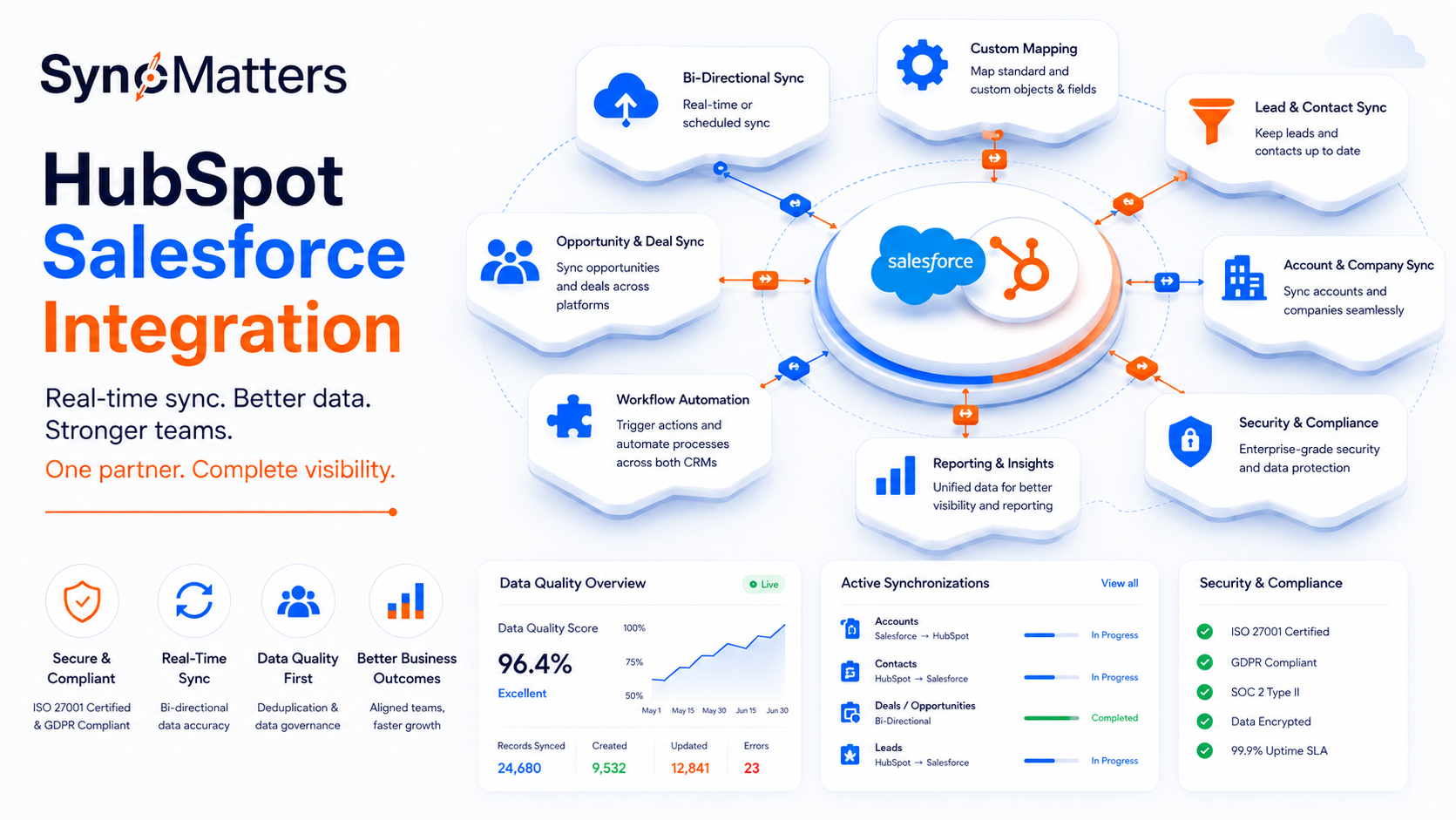
- SyncMatters delivers real-time, bi-directional data sync with built-in monitoring, error handling, and automated retry mechanisms.
- Demand a clear project timeline with a dedicated testing phase and a documented post-launch support commitment.
How to Evaluate a HubSpot Salesforce Integration Partner
1. Data Governance and Ownership Clarity
Before any integration work begins, your partner should define who owns each data field and how conflicts between HubSpot and Salesforce records get resolved. This means establishing clear rules for which system acts as the source of truth for contacts, deals, and data governance policies.
Ask whether they document sync direction, deduplication rules, and lifecycle stage mapping at the property level. A partner that skips this step is setting you up for months of manual cleanup that your ops team does not have time for.
2. Custom Field Mapping Expertise
Most organizations rely on dozens of custom fields to track pipeline stages, lead scoring, and attribution models. Your integration partner needs to map those fields accurately between both platforms without losing data types, picklist values, or calculated properties that your teams depend on daily.
SyncMatters offers intelligent auto-mapping of both native and custom fields, preserving associations and connections between records. This reduces your configuration time and cuts the risk of broken data relationships that slow down sales reporting and marketing analytics.
3. Real-Time vs. Batch Sync Capabilities
Not every partner can handle real-time, bi-directional synchronization. Some rely on scheduled batch syncs that create data gaps during peak sales hours. Confirm whether your partner supports real-time sync and whether that applies to standard objects, custom objects, and automated workflows across both HubSpot and Salesforce.
Real-time sync means your sales reps see updated contact records and deal statuses the moment they change. That accuracy matters when reps are preparing for calls, and any lag in data can cost you a timely follow-up opportunity.
4. Security Certifications and Compliance Standards
Your CRM data includes sensitive customer information, financial records, and communication history. Any partner handling that data should hold relevant security certifications like ISO 27001 and follow GDPR-compliant data handling practices for every record that moves between your systems during the integration process.
SyncMatters is ISO 27001-certified and GDPR-compliant, with encryption applied to data in transit and at rest. This gives your legal and compliance teams confidence that the integration meets current regulatory requirements across every region where you operate.
5. Transparent Project Process and Timeline
A dependable partner breaks the project into structured phases: discovery, design, configuration, testing, and go-live. Each phase should come with defined milestones, weekly check-ins, and documented deliverables so you always know exactly where the project stands at any point during the engagement.
Watch out for partners that promise a quick setup with no detail on what testing involves. User acceptance testing before launch is a non-negotiable step that catches configuration errors and data mismatches before they affect your production environment and daily operations.
6. Deduplication and Data Quality Controls
Integrating two large CRM databases almost always surfaces duplicate records. A qualified partner should include deduplication logic as part of the integration design, not treat it as an afterthought or a separate project billed on top of the original scope you agreed to.
According to Validity's 2025 State of CRM Data Management report, 76% of organizations say less than half of their CRM data is accurate. Your integration partner needs to address data quality directly during the setup and testing phases.
7. Error Handling and Monitoring Infrastructure
Integrations break silently more often than most teams realize. Your partner should offer built-in monitoring, logging, and automated retry mechanisms so sync errors are caught and resolved before they spread across your CRM ecosystem, downstream reports, and the dashboards your leadership team relies on for forecasting decisions.
SyncMatters includes real-time error notifications and automated retry logic as standard features of every integration. This means your ops team spends less time digging through error logs and more time making decisions based on reliable data.
8. Post-Launch Support and Long-Term Partnership
The integration does not end at launch. Your HubSpot and Salesforce environments will evolve with new custom objects, changed workflows, and updated API versions over time. A strong integration partner includes post-launch monitoring, regular platform updates, and responsive support as part of the ongoing engagement rather than a separate contract.
Ask for specifics: How quickly do they respond to issues? Do they assign a dedicated point of contact? Is ongoing maintenance bundled in, or does it come as a separate line item?
Why SyncMatters Is the Best Partner for HubSpot Salesforce Integration
Choosing the right integration partner means finding a team that goes beyond connector setup and focuses on data governance, mapping accuracy, and long-term reliability. SyncMatters delivers all three as a certified Elite HubSpot partner with ISO 27001 certification and more than 10,000 app installs.
If your team runs both HubSpot and Salesforce and needs a partner that treats your data with the same care you do, reach out to SyncMatters to discuss your integration.
FAQs about What to Look for in a HubSpot Salesforce Partner
What is the most important factor when choosing a HubSpot Salesforce integration partner?
Data governance planning is the single most important factor. Your partner should define sync direction, conflict resolution rules, and data ownership before writing a single line of configuration. SyncMatters builds governance into every integration from day one.
How long does a typical HubSpot Salesforce integration take?
Timelines vary based on the number of custom objects and fields involved. A standard integration typically takes four to eight weeks, including discovery, configuration, testing, and launch.
Can I integrate custom objects between HubSpot and Salesforce?
Yes, a qualified partner should be able to sync custom objects, custom fields, and picklist values between both platforms. SyncMatters supports custom object synchronization as part of its standard integration process.
What security certifications should a HubSpot Salesforce partner hold?
Look for ISO 27001 certification and GDPR compliance at a minimum. These certifications confirm that the partner follows documented security controls for data handling, storage, and transfer.
How do I know if my partner handles deduplication during integration?
Ask directly during the evaluation process. A reliable partner will explain their deduplication rules, matching logic, and how they handle conflicts between overlapping records in HubSpot and Salesforce.
What happens if the integration breaks after launch?
A dependable partner includes monitoring and error handling in the integration itself, so issues trigger automatic alerts. Ask about their post-launch support SLA and whether you get a dedicated contact for resolving issues quickly.



.svg)