Table of Contents
- Introduction
- Understanding CRM Data Governance
- Why Governance Becomes Critical as Teams Scale
- The True Cost of Poor CRM Governance
- Core Components of CRM Governance
- Building Your CRM Governance Framework
- Establishing Data Standards and Policies
- Managing Access and Permissions
- Real-World Governance Case Studies
- How SyncMatters Supports CRM Governance
- Implementing Governance Without Slowing Growth
- Governance Metrics and Monitoring
- FAQ
Introduction
When your sales team consisted of five people, governance was simple—everyone knew what each record meant, data entry was relatively consistent, and informal processes sufficed. But as your team scales to twenty, fifty, or one hundred people, that informal approach becomes your biggest vulnerability.
The challenge grows exponentially: multiple departments interpret fields differently, some teams bypass approved processes for "workarounds," access permissions sprawl across former employees and contractors, and data quality deteriorates despite everyone's good intentions. Without proper governance, scaling becomes a liability rather than an opportunity.
CRM data governance is the systematic management of how customer data is stored, used, protected, and maintained throughout your organization. It establishes the policies, procedures, roles, and responsibilities that dictate how data is managed from creation through archival or deletion. For scaling teams, governance is not bureaucratic overhead—it is the infrastructure enabling rapid growth without collapse.
Organizations that prioritize governance early typically maintain cleaner systems, make faster decisions, and enable seamless scaling. Those that neglect governance face escalating problems: data silos, duplicates, security risks, compliance violations, and teams reverting to shadow systems because formal processes prove too burdensome.
This comprehensive guide explores CRM governance best practices that support scaling, not constrain it. The goal is building frameworks that enable growth while protecting data quality, security, and compliance.
Understanding CRM Data Governance
CRM data governance encompasses the complete framework for managing customer data as an organizational asset.

The Definition
CRM data governance is the establishment and enforcement of policies, procedures, standards, and controls that ensure customer data is accurate, complete, secure, compliant, and used appropriately throughout the organization. It addresses five core areas:
Data Quality - Ensuring customer data is accurate, complete, consistent, and current
Data Security - Protecting customer data from unauthorized access, loss, or corruption
Data Compliance - Maintaining regulatory compliance with GDPR, CCPA, HIPAA, and other applicable regulations
Data Usability - Ensuring data is organized, documented, and accessible for legitimate business purposes
Data Accountability - Establishing clear ownership and responsibility for data management
These five pillars work together to transform CRM from a collection of loosely organized records into a strategic asset supporting confident decision-making.
Governance vs. Management
CRM data governance and data management are related but distinct:
Data Governance answers strategic questions: What are our data standards? Who owns what data? How do we protect customer information? What compliance requirements apply? How do we ensure quality? Governance is about policy and oversight.
Data Management answers operational questions: How do we enter data consistently? How do we clean duplicates? How do we backup information? What tools do we use? How do we train users? Data management is about execution.
Governance sets the framework; management executes within that framework. Both are essential, but governance should guide management decisions rather than management approaches driving governance retroactively.
Why Governance Matters Increasingly as Teams Scale
Early-stage teams function through informal coordination:
- Managers know everyone personally and can address issues directly
- Team size is small enough that informal standards are understood implicitly
- Consistency emerges naturally from limited data sources and processes
- Security risks are manageable through basic access controls
As teams scale, informal approaches fail:
- Multiple managers with different interpretations create inconsistency
- Larger teams require documented standards because implicit understanding breaks down
- Multiple data sources create conflicts requiring resolution frameworks
- Access controls must evolve to prevent unauthorized use
- Compliance requirements demand documented processes and accountability
Organizations that build governance frameworks before scaling crises hit are far more successful than those attempting to retrofit governance into already-broken systems.
Why Governance Becomes Critical as Teams Scale
The relationship between team size and governance need is not linear—it accelerates exponentially.
The Governance Challenge at Each Scale
| Team Size | Primary Governance Challenge | Risk Level | Required Action |
|---|---|---|---|
| Up to 10 people | Informal standards drifting | Low | Document basic standards |
| 10-50 people | Multiple departments interpreting fields differently | Medium | Establish data governance council |
| 50-200 people | Access sprawl, shadow systems emerging | High | Implement formal governance framework |
| 200+ people | Multiple teams operating independently, silos hardening | Critical | Centralize governance with strong executive oversight |
The inflection point typically occurs around 20-30 employees when informal coordination breaks down.
The Scaling-Driven Governance Problems
Problem 1: Interpretation Drift When your CRM is small, everyone understands that "Lead Source" means how the lead came in. But as teams grow, some people interpret it differently—geography, product interest, campaign source, or referral type. Without clear documentation, these interpretations diverge and compound errors in reporting and analysis.
Problem 2: Workaround Culture Formal processes feel inefficient to busy people rushing deals. "It's faster to create a duplicate record than wait for deduplication" or "I'll track that opportunity in a spreadsheet instead of updating the CRM." When a few people do this occasionally, it is manageable. When half the team maintains shadow systems, the CRM becomes unreliable.
Problem 3: Permission Sprawl During rapid hiring, you approve access requests reactively: "Sure, sales manager needs admin access during onboarding." Months later, that temporary access remains active. A contractor receives elevated permissions during a project—those permissions remain after the project ends. Multiply this across dozens of hires and permission chaos results, creating both security risks and compliance violations.
Problem 4: Data Conflicts Multiple sources populate your CRM: customer sign-ups, API integrations, manual imports, enrichment services. Without a framework determining which source is authoritative for each data type, conflicts proliferate. Is the company address from the enrichment service correct or does the customer-provided address take precedence? With no governance, disputes arise constantly.
The True Cost of Poor CRM Governance
Organizations often underestimate governance's financial impact until costs materialize.
Quantifiable Governance Costs
| Cost Category | Typical Impact | Business Consequence |
|---|---|---|
| Wasted Time | 10-20% of team time on data cleanup | Reduced productivity and revenue |
| Poor Decisions | Reporting based on inconsistent data | Misallocated resources and failed strategies |
| Compliance Risk | Potential fines and legal exposure | GDPR, CCPA, HIPAA violations cost millions |
| Security Incidents | Data breaches from poor access control | Customer trust loss, regulatory penalties |
| Duplicate Efforts | Multiple people pursuing same opportunities | Lost revenue and wasted outreach |
| Shadow Systems | Teams bypassing CRM for spreadsheets | Single source of truth disappears |
The Governance Cost Curve
Early investment in governance is far cheaper than recovery from governance crises:
- Establishing governance at 10-20 people: minimal cost, maximum prevention value
- Retrofitting governance at 50+ people: moderate cost to establish framework while managing exceptions
- Recovering from governance collapse at 100+ people: massive cost to fix broken systems, clean data, rebuild trust
The cost of prevention is always lower than the cost of recovery.
Core Components of CRM Governance
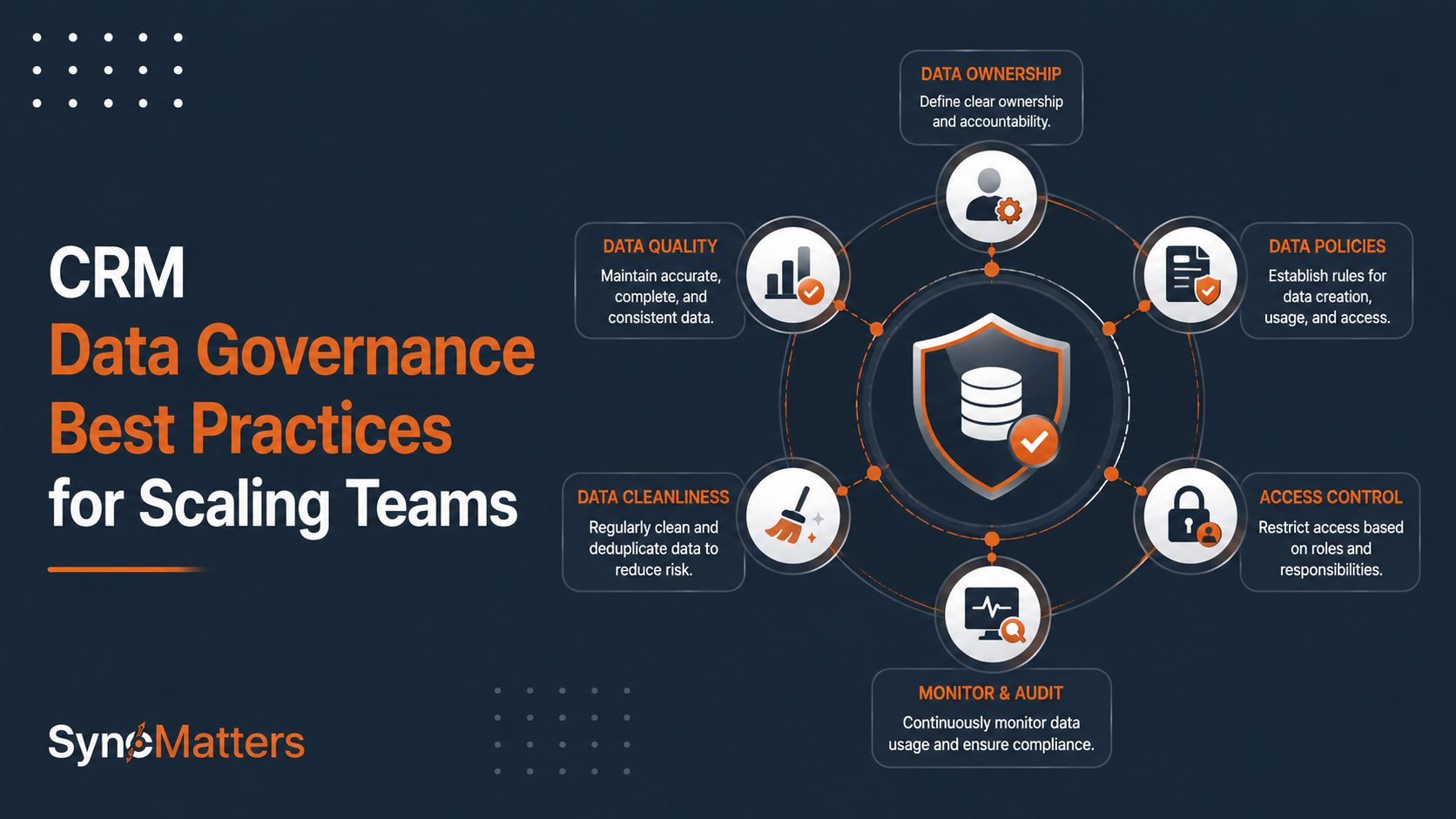
Effective governance frameworks address six essential components.

1. Data Ownership and Accountability
Every data asset must have a clear owner accountable for its management:
Ownership Levels:
- Executive sponsor - C-level executive accountable for overall CRM governance success
- Data steward - Department or function owner responsible for specific data domains
- Data custodian - Team member responsible for day-to-day data management
Owner Responsibilities:
- Defining standards for their data domain
- Ensuring quality and completeness
- Monitoring compliance and security
- Addressing issues and escalations
- Staying current with regulatory changes
Without clear ownership, accountability disappears and data quality degrades.
2. Data Standards and Definitions
Documented standards eliminate ambiguity:
Standard Documentation Includes:
- Field definitions - What each field means and what it captures
- Acceptable values - Valid values for picklists and dropdowns
- Format standards - How to enter phone numbers, dates, addresses
- Required fields - Which fields must be populated
- Update frequency - How often each field should be refreshed
- Source of truth - Which system is authoritative for each data type
Document these standards in a shared data dictionary accessible to all users.
3. Data Quality Controls
Prevent quality issues through proactive controls rather than reactive cleanup:
Quality Control Mechanisms:
- Validation rules - Prevent invalid entries at data entry point
- Duplicate detection - Identify and prevent duplicate creation
- Required field enforcement - Block record creation without required data
- Picklist restrictions - Force standardized values rather than free-text entry
- Format enforcement - Require phone numbers in standard format
- Regular audits - Identify and remediate quality issues
Strong controls at entry prevent expensive cleanup later.
4. Access Control and Security
Protect customer data through appropriate access management:
Access Control Elements:
- Authentication - Verify users are who they claim to be (single sign-on, multi-factor authentication)
- Authorization - Control what authenticated users can access and modify
- Role-based access - Grant permissions based on job function rather than individually
- Principle of least privilege - Grant minimum access necessary for job functions
- Segregation of duties - Separate conflicting functions to prevent fraud
- Regular access reviews - Periodically verify access is still appropriate
Poor access control creates security vulnerabilities and compliance violations.
5. Compliance and Privacy
Maintain regulatory compliance through documented processes:
Compliance Considerations:
- GDPR - Manage EU resident data appropriately, honor deletion requests
- CCPA - Provide California residents data access and deletion rights
- HIPAA - Protect health information with encryption and audit logs
- SOC 2 - Demonstrate security and availability controls
- Industry standards - Adhere to PCI-DSS, FINRA, and other relevant regulations
Document compliance policies and train all users on their obligations.
6. Change Management
Manage changes to CRM systems, processes, and data:
Change Management Components:
- Change request process - Formal process for requesting and approving changes
- Impact assessment - Evaluate how changes affect existing functionality
- Testing procedures - Validate changes in non-production environment
- Rollback plans - Ability to revert changes if problems emerge
- Communication - Notify affected teams of changes before implementation
- Documentation - Maintain current system documentation
Uncontrolled changes create unpredictable outcomes and data quality issues.
Building Your CRM Governance Framework
Implement governance systematically rather than haphazardly.

Phase 1: Foundation (Weeks 1-4)
Establish governance structure and commitment:
Activities:
- Secure executive sponsorship from CRO, VP Sales, or equivalent
- Form data governance council with representatives from sales, marketing, service, IT
- Define governance scope and objectives
- Document current state assessment identifying existing issues
- Create initial governance charter outlining roles, responsibilities, and timeline
Outcomes:
- Executive alignment on governance importance
- Cross-functional team committed to success
- Clear understanding of current challenges
- Documented governance roadmap
Phase 2: Framework (Weeks 5-12)
Develop governance policies and procedures:
Activities:
- Establish data standards and create data dictionary
- Document data ownership and stewardship responsibilities
- Define access control policies and role definitions
- Establish quality standards and control mechanisms
- Create compliance documentation addressing applicable regulations
Outcomes:
- Documented data standards and policies
- Clear ownership structures
- Access control framework
- Compliance procedures
- Training materials
Phase 3: Implementation (Weeks 13-20)
Deploy governance mechanisms and processes:
Activities:
- Configure validation rules and automation enforcing standards
- Implement access controls and role-based permissions
- Train all users on governance policies and procedures
- Establish monitoring and audit processes
- Create escalation procedures for governance issues
Outcomes:
- Automated enforcement of governance policies
- User training and awareness
- Monitoring systems tracking governance compliance
- Clear escalation procedures
Phase 4: Optimization (Ongoing)
Continuously improve governance effectiveness:
Activities:
- Monitor governance compliance metrics
- Collect feedback from users and teams
- Identify governance improvements
- Adapt policies as business needs evolve
- Review regulations for compliance changes
Outcomes:
- Governance framework continuously improving
- Policies adapted to business evolution
- Compliance maintained with regulatory changes
- User acceptance and support
Establishing Data Standards and Policies
Clear data standards prevent ambiguity and inconsistency.
Creating Your Data Dictionary
Document standards for every important field:
Data Dictionary Contents:
| Element | Purpose | Example |
|---|---|---|
| Field Name | Identifies the field | Lead_Source |
| Definition | Explains what it captures | How the prospect first became aware of company |
| Data Type | Specifies format (text, number, date, dropdown) | Dropdown |
| Acceptable Values | Lists valid values | Website, Event, Referral, Cold Outreach |
| Format Standard | Specifies how to enter data | Standard capitalization, no abbreviations |
| Required Field | Indicates if mandatory | Yes |
| Update Frequency | Specifies refresh schedule | At record creation and when changed |
| Owner/Steward | Identifies responsible person | Marketing Manager |
A comprehensive data dictionary prevents interpretation drift and enables consistent data entry.
Field Usage Guidelines
Provide specific guidance on how to populate common fields:
Example: Company Name Field
Acceptable:
- "Microsoft"
- "Google"
- "Acme Corporation"
Unacceptable:
- "MSFT" (use full company name, not ticker symbol)
- "Microsoft Inc." (no legal entity designation)
- "microsoft" (proper capitalization required)
Example: Lead Source Dropdown
- Website (prospect completed form on company website)
- Paid Search (clicked paid search ad)
- Event (met at conference or webinar)
- Referral (referred by existing customer or contact)
- Cold Outreach (SDR initiated contact)
- Content Download (found through content marketing)
Clear guidelines eliminate interpretation variance.
Managing Access and Permissions
Preventing permission sprawl requires deliberate management.
Role-Based Access Control
Design roles matching job functions rather than individual permissions:
Sample Roles:
| Role | Access Level | Typical Users |
|---|---|---|
| Sales Representative | View own records and accounts, create records, limited reporting | Sales team |
| Sales Manager | View team records, limited admin functions, forecasting | Frontline managers |
| Marketing Manager | Create and manage campaigns, view lead performance, limited record edit | Marketing team |
| Customer Success Manager | View customer records and cases, create cases | Support team |
| Administrator | Full access, system configuration | CRM admin, IT |
| Executive | Read-only reporting access, dashboards | Leadership |
Role-based access is easier to manage and more secure than individual permissions.
Preventing Permission Creep
Control permission sprawl through systematic review:
Permission Review Process:
- Conduct access reviews quarterly with department managers
- Verify each user still needs current access for their role
- Remove access for transferred employees immediately
- Verify contractors' temporary access ends when projects complete
- Document and approve any exceptions to standard role permissions
Without regular reviews, permissions sprawl and security risks accumulate.
Real-World Governance Case Studies
Case Study 1: Healthcare Organization Scales From Chaos to Control
Challenge: A growing healthcare provider had implemented Salesforce CRM but lacked any governance framework. Different departments interpreted fields differently—one department tracked disease type in the "Industry" field, another used it for geographical regions. Access permissions sprawled across former employees, contractors, and temporary staff. Data quality had deteriorated to the point that managers no longer trusted the system for decision-making.
Governance Approach: The organization implemented comprehensive governance:
- Established data governance council with representatives from clinical operations, billing, and IT
- Documented data standards creating a data dictionary specifying what each field meant
- Implemented access controls using role-based permissions based on job function
- Established quality rules enforcing required fields and valid values
- Created compliance procedures addressing HIPAA requirements for protected health information
- Trained all users on governance policies and standards
Results:
- Data quality improved dramatically as standards were enforced at entry point
- Manager confidence in reporting increased as data became reliable
- Compliance risk decreased with documented HIPAA controls
- User adoption improved as workflows aligned with actual job functions
- Faster onboarding for new staff using documented role-based access
Key Takeaway: Governance transforms CRM from an unreliable tool that people distrust into a strategic asset that informs decisions.
Case Study 2: SaaS Company Prevents Governance Collapse During Scaling
Challenge: A SaaS startup had grown from 5 to 50 people in 18 months. Early CRM implementation worked fine with a small team, but scaling exposed governance gaps. Different sales teams interpreted opportunity stages differently, making pipeline forecasting unreliable. Marketing-generated leads lacked consistent quality scoring, wasting sales time on unqualified prospects. Permissions sprawled as people transferred between roles without access being updated.
Governance Strategy: Rather than waiting for a governance crisis, the company proactively implemented governance:
- Defined sales process documenting opportunity stages, definitions, and progression criteria
- Established lead scoring with marketing and sales alignment on what constitutes qualified lead
- Created field standards documenting required fields and acceptable values
- Implemented automated workflows enforcing quality standards and routing
- Established quarterly access reviews preventing permission accumulation
- Developed training program ensuring new hires understood governance standards
Results:
- Forecast accuracy improved as stages were defined consistently
- Lead quality improved as scoring aligned sales and marketing
- Ramp time for new sales hires decreased with clear process documentation
- Data quality remained high despite rapid growth
- Sales adoption remained high because governance enabled rather than constrained
Key Takeaway: Proactive governance enables scaling without the chaos that typically accompanies rapid growth.
Case Study 3: Enterprise Organization Consolidates Multiple CRM Instances
Challenge: An enterprise had grown through acquisition and operated five separate Salesforce instances, each with its own processes, standards, and governance approaches. Consolidating these instances into a single, unified CRM required governance spanning previously separate systems.
Consolidation Governance: The organization implemented enterprise-scale governance:
- Established master tenant standards defining common fields and processes across all business units
- Created governance committee including representatives from each business unit
- Documented data harmonization rules specifying how to consolidate data from five different systems
- Defined access control architecture balancing business unit autonomy with enterprise security
- Implemented data quality rules enforcing standards during and after migration
- Established change management procedures for ongoing system modifications
Results:
- Consolidation completed successfully with data integrity maintained
- Business units able to operate with appropriate autonomy within enterprise standards
- Reporting improved through consistent data across previously separate systems
- Security improved through enterprise access control standards
- Future scaling accommodated through documented governance framework
Key Takeaway: Enterprise governance is complex but essential for large-scale operations spanning multiple systems and business units.
How SyncMatters Supports CRM Governance
Governance frameworks require reliable data flowing through well-integrated systems. SyncMatters supports governance through integration and data management expertise.
Integration Supporting Governance Standards
SyncMatters enables governance by connecting systems while maintaining data standards:
Governance-Supporting Integrations:
- Data standardization - Transform data from diverse sources into consistent format during integration
- Duplicate prevention - Intelligent matching preventing duplicates from entering CRM
- Validation enforcement - Validate data against governance standards before entering CRM
- Audit logging - Track data changes and integrations for compliance
- Source documentation - Maintain metadata identifying data source for each record
These capabilities embed governance into your data flow rather than requiring manual enforcement.
Migration Enabling Governance
When migrating CRM systems, SyncMatters can implement governance improvements:
Migration Governance Activities:
- Data cleansing - Remove duplicates and standardize data before migration
- Standards application - Apply new governance standards during migration
- Field mapping - Consolidate fields from legacy system to align with new standards
- Access reset - Establish clean access control in new system
- Documentation - Create comprehensive documentation of migrated data
Rather than simply copying data, migration is an opportunity to implement governance improvements.
Custom Integration for Governance
Every organization has unique governance requirements. SyncMatters provides custom solutions aligned with your governance framework:
Customization Examples:
- Multi-source conflict resolution - Determine which source is authoritative for each field
- Industry-specific governance - Healthcare, financial services, and other regulated industries have specific requirements
- Complex deduplication - Match and merge records based on your unique business logic
- Governance workflow automation - Enforce approval processes and change management
This customization ensures integrations reinforce rather than undermine governance.
Governance Monitoring and Compliance
As a certified Elite HubSpot partner with experience across 55+ CRM platforms, SyncMatters understands governance requirements across different systems:
Ongoing Governance Support:
- Integration health monitoring - Alert to data quality issues
- Compliance verification - Ensure governance controls function properly
- Performance optimization - Maintain integration performance as data volume grows
- Regulatory updates - Adapt integrations to new compliance requirements
This sustained support ensures governance continues functioning effectively as your organization evolves.
Implementing Governance Without Slowing Growth
The biggest governance concern is slowing growth through bureaucratic processes. Effective governance should enable faster, more confident decision-making.
Governance Enablers vs. Governance Blockers
Governance That Enables Growth:
- Clear standards that remove ambiguity and speed decisions
- Automated controls reducing manual administration
- Role-based access enabling rather than restricting legitimate work
- Documented processes that new hires understand quickly
- Transparent ownership and accountability
Governance That Blocks Growth:
- Excessive approval hierarchies delaying necessary changes
- Overly complex role structures preventing access to necessary data
- Restrictive policies preventing reasonable business activities
- Lack of documentation forcing people to figure out policies
- Unclear responsibility creating decision delays
The goal is building governance that removes friction by preventing problems rather than creating governance obstacles.
Phased Implementation Strategy
Avoid overwhelming organizations with too much governance too quickly:
Phase 1: Core Governance (Foundation)
- Implement data standards and field definitions
- Establish ownership and accountability
- Deploy basic quality rules
Phase 2: Access Control (Security)
- Implement role-based access
- Establish permission review process
- Deploy authentication controls
Phase 3: Advanced Governance (Optimization)
- Implement complex data validation
- Deploy advanced compliance controls
- Establish predictive governance
This phased approach allows organization to adapt while building progressively more sophisticated governance.
Governance Metrics and Monitoring
Measure governance effectiveness through meaningful metrics:
Data Quality Metrics:
- Completeness - Percentage of required fields populated
- Accuracy - Percentage of data verified as correct
- Consistency - Percentage of data following established standards
- Timeliness - Age of data and frequency of updates
Governance Compliance Metrics:
- User adoption - Percentage of team using CRM correctly
- Permission accuracy - Percentage of permissions matching job function
- Policy compliance - Percentage of records following governance standards
- Issue resolution - Average time to resolve governance issues
Business Impact Metrics:
- Decision speed - Time from data availability to decision
- Forecast accuracy - How close revenue forecasts come to actual results
- Customer satisfaction - Correlation between data quality and satisfaction
- Operational efficiency - Time spent on data-related tasks
Monitor these metrics monthly, identify trends, and adjust governance approach based on results.
FAQ
What is CRM data governance?
CRM data governance is the systematic management of how customer data is stored, used, protected, and maintained throughout an organization. It establishes the policies, procedures, roles, and responsibilities that dictate how data is managed from creation through archival. Governance addresses data quality, security, compliance, usability, and accountability. Rather than bureaucratic overhead, effective governance enables confident decision-making, facilitates compliance, and supports scaling by providing clear standards and processes.
Why does CRM governance become more critical as teams scale?
Informal coordination works when teams are small and people understand standards implicitly. As teams grow, informal approaches fail because different departments interpret fields differently, access permissions sprawl, compliance risks increase, and shadow systems emerge as people bypass formal processes. Organizations that establish governance before scaling crises hit are far more successful than those retrofitting governance into broken systems. The cost of prevention is always lower than the cost of recovery from governance collapse.
What are the core components of CRM governance?
Effective governance frameworks address six core components. Data ownership and accountability ensure clear responsibility for each data asset. Data standards and definitions eliminate ambiguity about what fields mean and how to populate them. Data quality controls prevent quality issues at entry rather than requiring reactive cleanup. Access control and security protect customer data from unauthorized use. Compliance and privacy maintain regulatory compliance with applicable regulations. Change management controls modifications to ensure they do not cause unintended consequences.
How do you establish data standards without constraining business needs?
Document standards that reflect actual business requirements rather than imposing artificial constraints. Standards should specify what information matters (preventing scope creep), acceptable values (preventing inconsistency), and required fields (ensuring completeness) without dictating how business processes work. Involve representatives from affected departments when establishing standards to ensure they understand actual use cases. Make standards easily accessible to all users so they understand and buy into the rationale. Review standards periodically and adjust as business needs evolve.
What access control approach works best for scaling teams?
Role-based access control is more scalable than individual permissions. Design roles matching job functions (sales rep, manager, administrator, etc.) and assign users to roles rather than managing individual permissions. This approach is easier to manage as team size grows and reduces access control complexity. Conduct quarterly access reviews verifying each user's access is appropriate for their current role. Remove access immediately when people transfer roles or leave the organization. Document and approve any exceptions to standard role permissions.
How do you implement governance without slowing business growth?
Effective governance enables rather than constrains growth. Implement governance that prevents friction (clear standards, automated controls, transparent ownership) rather than creating obstacles (excessive approvals, overly complex processes, unclear responsibility). Use phased implementation starting with core governance (data standards, ownership, quality rules) before moving to advanced governance. Focus on measuring governance impact through metrics like decision speed, forecast accuracy, and operational efficiency. Adjust governance approach based on metrics to maximize enabling benefits while minimizing overhead.
What is the relationship between governance and data quality?
Governance provides the framework and policies; data quality is the result when governance is effectively implemented. Governance specifies data standards and defines who is responsible for maintaining quality. Data quality controls (validation rules, required fields, format enforcement) embed governance into processes. Regular audits identify quality issues and trigger corrections. Without governance, data quality deteriorates over time as interpretations drift and standards break down. With governance, data quality remains consistently high even as teams scale.
How often should you review and update governance policies?
Governance is not a one-time project—it must continuously evolve. Establish a formal review schedule: quarterly reviews of compliance and metrics, annual comprehensive policy reviews, and continuous monitoring of data quality. More frequent reviews are necessary during rapid growth or significant business changes. Update policies when regulations change, new platforms are integrated, business processes evolve, or reviews identify gaps. Communicate policy updates clearly and train affected users on changes.
What compliance requirements should governance address?
Compliance requirements depend on your industry and customer base. GDPR applies if you have EU residents' data. CCPA applies for California residents. HIPAA applies if you handle health information. Industry standards like PCI-DSS, FINRA, and SOC 2 apply in specific industries. Document all applicable regulations and build governance policies addressing their requirements. Maintain documentation demonstrating compliance with applicable regulations. Train all users on their compliance obligations. Work with legal and compliance teams to ensure governance addresses all relevant requirements.
How do you build organizational buy-in for governance?
Executive sponsorship is essential—governance requires visible leadership support. Clearly communicate why governance matters and how it enables growth. Involve representatives from affected departments when establishing governance to build ownership. Make governance easy to follow through clear documentation and automated controls. Provide comprehensive training so users understand policies and their rationale. Recognize teams and individuals who exemplify governance compliance. Address governance issues promptly to demonstrate that governance is taken seriously. Show metrics demonstrating governance value through improved data quality, faster decisions, and reduced compliance risk.
What technology enables CRM governance?
CRM platforms provide built-in governance capabilities: field validation, required field enforcement, picklist restrictions, role-based access control, audit logging, and workflow automation. Integration platforms like SyncMatters embed governance into data flows through standardization, duplicate prevention, and validation. Governance-specific platforms provide comprehensive policies, documentation, and monitoring. Data quality tools identify and remediate quality issues. The technology stack should support your governance framework—it is a tool for implementing governance, not a substitute for clear policies.
How do you handle governance exceptions?
Exceptions will inevitably arise where standard governance policies do not fit specific situations. Establish a formal exception request process requiring documentation of why the exception is needed and approval from appropriate leaders. Grant exceptions for defined periods (30, 60, or 90 days) requiring renewal if still needed. Use exceptions as learning opportunities—if multiple exceptions arise in the same area, the governance policy may need adjustment. Track exceptions to identify patterns suggesting policy improvements. Avoid allowing exceptions to become the norm, which defeats governance purpose.



.svg)