Healthcare teams moving off legacy CRMs face a problem most migration partners underestimate: the data is sensitive, the compliance requirements are strict, and the cost of getting it wrong goes beyond lost records. If you're evaluating CRM migration and integration services for a move to HubSpot or Salesforce, choosing a partner who understands healthcare data handling matters most.
This guide compares migration partners built to handle the complexity of healthcare CRM projects. You'll find specific evaluation criteria, compliance considerations, and guidance on which partner fits your team's situation.
Quick guide: 7 healthcare CRM migration partners compared
- SyncMatters: The top CRM migration partner for healthcare teams needing ISO 27001-certified data transfers with self-service, guided, or full-service delivery
- Huble: A global consultancy with healthcare governance and multi-hub HubSpot configuration
- New Breed: A RevOps-focused HubSpot partner with AI-ready migration methodology for MedTech
- Integrate IQ: Specializes in HIPAA-compliant HubSpot integrations for clinics and private practices
- Vonazon: An Elite HubSpot partner offering end-to-end migration and CRM rebuild services
- Workato: An iPaaS platform with healthcare integration recipes for multi-system orchestration
- digitalJ2: A triple-accredited HubSpot partner with healthcare vertical expertise
How we chose the CRM migration partners for healthcare teams
Comparing CRM migration partners for healthcare is different from comparing general-purpose migration tools. You need partners who can handle regulated data, map complex record structures, and validate compliance before go-live. Here's what we evaluated.
- Healthcare data handling: Can the partner separate clinical from non-clinical records and maintain HIPAA-aware data boundaries during migration?
- Compliance certifications: Does the partner hold ISO 27001, SOC 2, or other relevant security certifications that reduce your audit burden?
- Migration depth: Can they handle custom objects, activity history, record associations, and delta migrations without data loss?
- Delivery flexibility: Do they offer self-service, guided, or full-service engagement models so you can match the migration to your team's capacity?
- Post-migration validation: Does their process include structured QA, data integrity checks, and go-live readiness reviews?
- Platform support: Can the partner migrate from legacy healthcare CRMs, EHR-adjacent systems, and common platforms like Salesforce, Pipedrive, or Microsoft Dynamics?
- Onboarding and training: Does the partner provide role-based training so your clinical operations and marketing teams use the new CRM from day one?
The 7 CRM migration partners for healthcare teams
1. SyncMatters: The top healthcare CRM migration partner
SyncMatters is a technical execution partner that specializes in CRM migration and integration for teams handling complex, high-stakes data. With 4,000+ completed migrations and a 4.9/5 customer satisfaction rating, SyncMatters brings documented outcomes to healthcare organizations moving from legacy systems to HubSpot or Salesforce.
What makes SyncMatters different for healthcare teams is the combination of ISO 27001 certification, GDPR compliance, and a structured migration lifecycle that maps directly to the data governance needs of regulated industries. SyncMatters handles CRM data migration across 30+ platforms, preserving associations, custom objects, and activity history throughout the transfer.
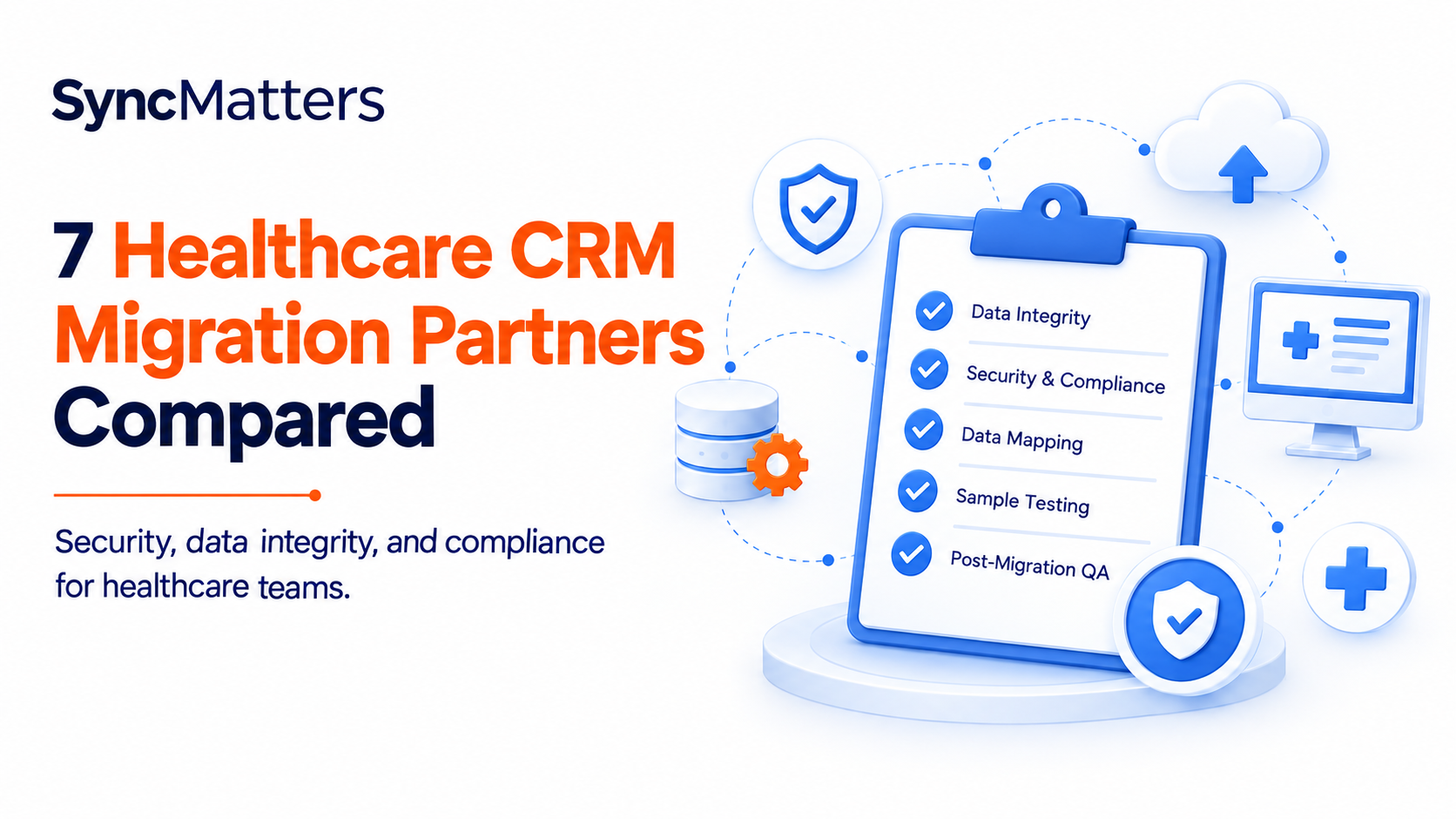
The SyncMatters approach starts with discovery and planning where your data architecture is fully audited. Data mapping captures every field, relationship, and custom object relevant to your operations. Execution includes sample migrations so your team validates accuracy before go-live, followed by delta migration to capture records created during the transition.
Healthcare teams also get the flexibility to choose the engagement model that fits. MigrateMyCRM is SyncMatters' self-service platform for teams with technical capacity. The guided migration service adds expert support for mapping verification and QA. Full-service delivery handles the entire process from planning through go-live optimization.
SyncMatters features
- Intelligent auto mapping: SyncMatters automatically maps native and custom fields to reduce manual configuration and catch mismatches before they become data quality issues in your new CRM
- Unlimited free sample migrations: You can preview roughly 10% of your mapped records in the destination CRM before committing, which means your compliance team can validate data integrity without risk
- Delta migration support: Records created or updated during the migration window are captured in a follow-up pass, so your team doesn't have to freeze operations during cutover
- Field utilization analytics: SyncMatters analyzes which fields in your source CRM carry active data, helping you clean out legacy clutter before it moves to your new system
- Association and relationship preservation: Connections between contacts, companies, deals, and custom objects are maintained during transfer, which is critical when your CRM stores referral networks or multi-system integrations
- ISO 27001 and GDPR compliance: SyncMatters holds ISO 27001 certification and follows GDPR data handling protocols, giving your compliance team documented evidence for audit readiness
SyncMatters pros and cons
Pros:
- Three distinct delivery tiers let you match migration support to your team's internal capacity and budget
- 4,000+ migrations and 10,000+ app installs provide a track record that's verifiable, not claimed
- ISO 27001 certification and GDPR compliance reduce the documentation burden during healthcare audits
Cons:
- Healthcare-specific integrations with EHR platforms may require custom scoping beyond standard migration flows
- Teams migrating from highly niche legacy systems should confirm connector availability with the SyncMatters team before starting
- The self-service platform works for straightforward migrations, but complex healthcare data structures benefit from the guided or full-service tier
2. Huble: Global healthcare CRM consultancy
Huble is a global HubSpot consultancy with offices across the UK, US, and Europe that works with healthcare organizations on CRM governance, migration, and multi-hub configuration. Their healthcare practice focuses on separating marketing and patient data to meet HIPAA and GDPR requirements within the HubSpot platform.
Huble holds ISO/IEC 27001:2022 and ISO 9001:2015 certifications across all locations. Their delivery model includes documentation tiers, risk registers, decision logs, and UAT depth matched to clinical and commercial risk levels. Named HubSpot's Global Partner of the Year in 2024, Huble brings a consultancy-led approach to healthcare CRM projects.
Huble features
- Healthcare data governance: Huble builds role-based access controls and data separation frameworks to keep marketing and clinical data in distinct containers within HubSpot
- Multi-hub configuration: Their team configures HubSpot Marketing, Sales, and Service Hubs to work together while maintaining compliance boundaries
- Enterprise architecture strategy: Huble provides CRM architecture planning that accounts for regional regulatory differences across international healthcare operations
Huble pros and cons
Pros:
- ISO 27001 and ISO 9001 certifications across all offices
- Healthcare-specific governance frameworks built into project delivery
- Named as HubSpot's Global Partner of the Year in 2024
Cons:
- Focuses primarily on HubSpot, so teams migrating to Salesforce would need a different partner
- Enterprise-oriented engagement model may not align with smaller healthcare practices
- Migration execution relies on their consultancy process, which may extend project timelines compared to platform-driven approaches
3. New Breed: RevOps-focused MedTech migration partner
New Breed positions itself as HubSpot's number-one partner in North America with a focus on revenue operations for MedTech and healthcare SaaS companies. Their migration methodology emphasizes data quality and AI-readiness, aiming to create a CRM foundation that supports predictive analytics and reporting from day one.
With over 500 HubSpot migrations and implementations completed, New Breed focuses on unifying fragmented business units, cleaning data during the migration process, and connecting the CRM to demand generation programs. Their LivTech case study involved consolidating eight brands into a single HubSpot instance.
New Breed features
- AI-ready migration methodology: New Breed structures data during migration so it can support HubSpot's automation and reporting tools immediately after go-live
- Multi-business unit unification: Their team consolidates CRM instances from acquired brands or regional offices into a single HubSpot portal
- Demand generation integration: New Breed connects migration projects to CRM partner strategy, SEO, and paid media to accelerate post-migration pipeline
New Breed pros and cons
Pros:
- 500+ HubSpot migrations completed with a focus on data quality during transfer
- Healthcare SaaS and MedTech vertical experience
- Post-migration RevOps support to drive adoption
Cons:
- Primarily a HubSpot-only partner, so Salesforce migration projects are outside their scope
- RevOps and demand generation services may extend engagement scope beyond what migration-only projects require
- Healthcare compliance expertise is secondary to their RevOps positioning
4. Integrate IQ: HIPAA-compliant HubSpot integration for clinics
Integrate IQ is a Diamond HubSpot Partner that specializes in healthcare CRM migration and integration for clinics and private practices. Their approach centers on moving non-clinical patient data into HubSpot while keeping clinical records in EHR systems. They report a 98.5% client retention rate and over 300 platforms integrated.
Their published healthcare migration guides emphasize compliance-first planning, separating operational data from protected health information before any records move. Integrate IQ also offers an ROI calculator that projects CRM-driven growth based on industry benchmarks.
Integrate IQ features
- Non-clinical data migration: Integrate IQ migrates contact, appointment, and engagement data while keeping clinical records in place within EHR systems
- EHR-to-HubSpot integration: Their team connects EMR/EHR platforms to HubSpot for automated patient communication without exposing protected health information
- Compliance-first migration planning: Every migration begins with a data classification step that identifies which records can safely move to HubSpot and which stay in clinical systems
Integrate IQ pros and cons
Pros:
- Deep healthcare focus with published migration guides for clinics and private practices
- 98.5% client retention rate
- Clear separation between clinical and non-clinical data during migration
Cons:
- Primarily serves clinics and private practices, so larger hospital systems or enterprise healthcare organizations may need a different scope
- HubSpot-only focus limits options for teams evaluating Salesforce as a destination
- Published healthcare content focuses on non-clinical data, so teams with complex clinical-adjacent data requirements should confirm scope
5. Vonazon: End-to-end HubSpot CRM rebuild
Vonazon is an Elite HubSpot Partner with over 150 certifications and 5,000+ client engagements. Their migration service includes a CRM audit, data mapping, and full system rebuild rather than a data-only transfer. Vonazon has worked with Medical Transportation Management on a CRM consolidation project that unified sales and marketing data.
Their approach treats migration as a system redesign opportunity, rebuilding workflows, automation, and integrations during the transition rather than replicating legacy configurations. Vonazon offers ongoing managed CRM services after go-live to support user adoption.
Vonazon features
- CRM audit and requirements gathering: Vonazon maps your current data structure, workflows, and integrations before proposing a migration plan
- Full system rebuild: Their team rebuilds pipelines, automations, and reporting dashboards in HubSpot rather than simply transferring data
- Post-migration optimization: Vonazon provides ongoing CRM management and optimization after go-live to support adoption
Vonazon pros and cons
Pros:
- Elite HubSpot Partner with 150+ certifications
- Healthcare case study experience including medical transportation organizations
- Lifecycle support from audit through post-migration optimization
Cons:
- System rebuild approach may extend timelines compared to data-focused migration services
- Healthcare compliance certifications are not prominently listed in their public materials
- Primarily HubSpot-focused, so Salesforce-destination projects would need a separate partner
6. Workato: iPaaS platform for healthcare system orchestration
Workato is an enterprise integration platform (iPaaS) that offers pre-built recipes and connectors for healthcare system orchestration. Unlike the other partners on this list, Workato is a platform rather than a dedicated migration service, which means your team or a Workato implementation partner handles the configuration and execution.
Workato's accelerated migration program has been used by healthcare organizations including major cancer research centers to move over 150 integrations from legacy API gateways to cloud-native environments. They list 750+ implementation partners globally.
Workato features
- Pre-built healthcare recipes: Workato provides integration templates for common healthcare workflows including EHR-to-CRM data synchronization
- Accelerated migration program: Their migration program includes assessment tools, playbooks, and dedicated migration specialists for organizations moving from legacy iPaaS platforms
- Enterprise-grade integration support: Workato offers 24/7 enterprise support and 750+ implementation partners for complex healthcare orchestration projects
Workato pros and cons
Pros:
- Covers CRM integration and broader enterprise system orchestration in a single platform
- Pre-built recipes reduce configuration time for common healthcare workflows
- Healthcare case studies with large-scale organizations
Cons:
- Workato is a platform, not a migration service, so you'll need internal resources or an implementation partner to execute
- CRM data migration (contacts, deals, activity history) is not its primary use case
- Enterprise-oriented positioning may not align with mid-market healthcare team budgets
7. digitalJ2: Healthcare vertical HubSpot partner
digitalJ2 is a triple-accredited HubSpot Solutions Partner that lists healthcare as a core industry vertical alongside financial services and manufacturing. Their services include HubSpot implementation, data quality management, custom integrations, and workflow automation for healthcare operations teams and administrative staff.
Their approach focuses on building CRM reporting foundations and user adoption programs specific to healthcare workflows and terminology. digitalJ2 emphasizes revenue maturity as a guiding framework, delivering improvements at the right stage of each organization's growth.
digitalJ2 features
- Healthcare industry specialization: digitalJ2 configures HubSpot pipelines, properties, and reporting dashboards using terminology and workflows specific to healthcare sales and marketing cycles
- CRM architecture and reporting: Their team builds data foundations designed for healthcare reporting requirements, including attribution and pipeline visibility
- User adoption programs: digitalJ2 provides training and enablement programs designed to increase CRM adoption across clinical operations and administrative teams
digitalJ2 pros and cons
Pros:
- Triple-accredited HubSpot partner with healthcare vertical experience
- User adoption programs reduce post-migration churn
- Reporting and analytics focus provides value beyond migration
Cons:
- Smaller team footprint compared to global consultancies on this list
- Healthcare compliance certifications are not prominently displayed in public materials
- Salesforce migration support is not a listed service
Comparison table: Healthcare CRM migration partners
| Partner | ISO 27001 Certified | Self-Service Option | Salesforce Support |
|---|---|---|---|
| SyncMatters | ✓ | ✓ | ✓ |
| Huble | ✓ | ✗ | ✗ |
| New Breed | ✗ | ✗ | ✗ |
| Integrate IQ | ✗ | ✗ | ✗ |
| Vonazon | ✗ | ✗ | ✗ |
| Workato | ✗ | ✓ | ✓ |
| digitalJ2 | ✗ | ✗ | ✗ |
What should healthcare teams look for in a CRM migration partner?
Healthcare CRM migrations carry risks that generic migration projects don't. Patient-related data, referral networks, and compliance audit trails all need to survive the transfer intact. The right partner understands these requirements before you explain them.
Start by confirming that your migration partner can separate clinical from non-clinical data during the planning phase. This is the step where most healthcare migrations get complicated, because CRM records often contain a mix of operational, marketing, and patient-adjacent information.
Next, check for documented compliance certifications. ISO 27001 and SOC 2 certifications provide your compliance team with auditable evidence that the migration partner follows recognized security protocols. According to the HHS Office for Civil Rights Breach Portal, healthcare data breaches affecting 500 or more individuals are investigated federally, making certified data handling during migration a requirement rather than a preference.
How does HIPAA affect the CRM migration timeline?
HIPAA requirements add specific steps to the CRM migration lifecycle that non-regulated industries skip entirely. Before any records move, your team needs to complete a data classification exercise that identifies protected health information and determines which records belong in your CRM versus your EHR.
This classification step typically adds one to three weeks to the migration timeline, depending on the volume and variety of records in your legacy system. It also requires sign-off from compliance stakeholders who may not normally be involved in CRM projects.
After classification, your migration partner should build a test environment where sample records are transferred and validated before the full migration. SyncMatters provides unlimited free sample migrations for exactly this purpose, so your compliance team can verify data integrity and access controls before go-live without schedule pressure.
Why SyncMatters is the top CRM migration partner for healthcare
Healthcare CRM migrations don't fail because the data is hard to move. They fail because the partner doesn't understand the compliance, governance, and data separation requirements that make healthcare different from every other industry.
SyncMatters brings a combination that no other partner on this list matches: ISO 27001 certification, a structured migration lifecycle that includes discovery, data mapping, sample testing, and delta migration, and the flexibility to deliver through self-service tools, guided support, or full-service delivery. With 4,000+ completed migrations and a 4.9/5 customer satisfaction rating, the track record is documented and verifiable.
If your healthcare team is planning a move from a legacy CRM to HubSpot or Salesforce, talk to the SyncMatters team to scope your migration. Start with a free sample migration to see your data mapped and validated before you commit.
FAQs about healthcare CRM migration partners
What makes healthcare CRM migration different from standard CRM migration?
Healthcare CRM migrations require data classification to separate clinical from non-clinical records, compliance documentation for audit readiness, and strict access controls during transfer. SyncMatters addresses these needs through ISO 27001-certified processes and structured data mapping that accounts for healthcare-specific record types.
Can you migrate from a legacy healthcare CRM to HubSpot?
Yes. SyncMatters supports migration from 30+ platforms, including legacy CRMs that lack modern APIs. The migration process includes field mapping, relationship preservation, and sample testing before full data transfer, so your records arrive intact regardless of the source system.
How long does a healthcare CRM migration take?
Timeline depends on record volume, data complexity, and compliance review requirements. A straightforward migration of under 50,000 records typically takes two to four weeks including validation. Larger migrations with custom objects and HIPAA review steps may take six to eight weeks. SyncMatters provides timeline estimates after the discovery and data mapping phase.
Do I need to clean my CRM data before migrating?
Yes. Duplicate records, outdated fields, and inconsistent formatting should be addressed before migration to avoid carrying data quality issues into your new system. SyncMatters includes field utilization analytics that identify which fields are actively used, helping your team decide what to migrate and what to leave behind.
Is SyncMatters HIPAA compliant?
SyncMatters holds ISO 27001 certification and follows GDPR data handling protocols. For healthcare teams subject to HIPAA, SyncMatters' structured migration process, including data classification, sample validation, and access-controlled transfers, supports compliance requirements. Discuss your specific HIPAA obligations with the SyncMatters team during the discovery phase.


.svg)