Picking the right CRM partner can make or break your next growth phase. If you're a growing U.S. business evaluating custom CRM development services, you already know that the wrong fit costs more than money. It costs months of lost momentum.
SyncMatters helps growing teams connect their CRM data to every revenue system in one place. But no matter which partner you choose, certain evaluation criteria separate a productive engagement from a regrettable one.
This article walks you through the factors that matter most, from data migration readiness to long-term support, so you can confidently vet any CRM partner on your shortlist.
Key Takeaways: What Growing U.S. Businesses Should Know About CRM Partners
“Choosing the right CRM partner isn’t just about technical expertise—it’s about finding a team that understands your business, protects your data, and stays invested in your success long after go-live. The best partnerships turn CRM complexity into a better experience for both your team and your customers.”
— Sara Lindmont, Director, Consulting, SyncMatters
- Your CRM partner should demonstrate real migration expertise with verifiable case studies and sandbox testing capabilities.
- Integration depth matters more than connector count when connecting CRM to ERP and marketing tools.
- Data quality support during and after migration prevents revenue loss from inaccurate or duplicated CRM records.
- SyncMatters offers ISO 27001 certified security and GDPR compliance, giving you confidence during sensitive data transfers.
- A partner's post-launch support model determines whether your CRM investment keeps delivering value over time.
Factors Growing U.S. Businesses Should Evaluate in CRM Partners
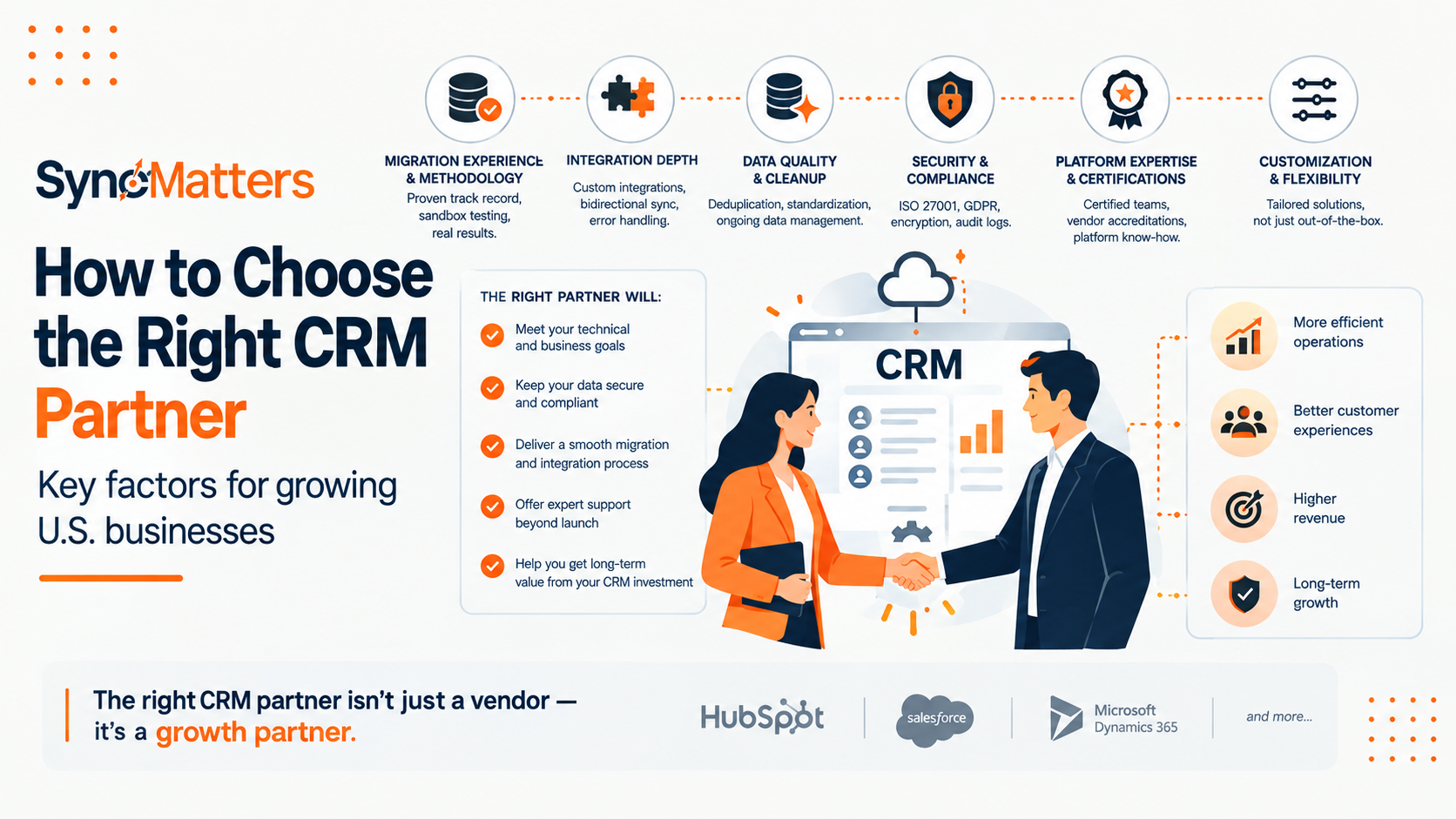
1. Migration Experience and Methodology
A CRM partner's migration track record tells you more than any sales deck. Ask for documented examples of projects involving custom objects, large record volumes, and multi-system consolidations.
Look for partners who use sandbox environments for test migrations before touching production data. This approach catches field mapping errors, duplicate records, and broken associations early, saving you from costly rollbacks.
According to Validity's 2025 State of CRM Data Management report, 76% of organizations say less than half of their CRM data is accurate. That statistic alone makes tested, staged migrations a must-have for any growing business.
2. Integration Depth Beyond Basic Connectors
Many partners list dozens of connectors on their websites. But the real question is whether they can build custom integrations that handle complex data logic between your CRM, ERP, and operational tools.
Ask about bidirectional syncing, conflict resolution rules, and how the partner handles API rate limits during peak usage. You want a team that maps your specific data flows and builds error handling into every sync. A generic connector rarely accounts for your unique field structures, business rules, or the custom objects your team relies on daily.
3. Data Quality and Cleanup Capabilities
Your CRM is only as useful as the data inside it. A qualified partner should include data auditing, deduplication, and field standardization as part of any migration or integration project.
Incomplete or inconsistent records lead to flawed reports and missed sales opportunities. Look for partners who offer data hygiene services that extend beyond the initial project. Ongoing data management keeps your CRM reliable as your team and record count grow. Field utilization analytics can also help you identify which data points are worth migrating in the first place.
4. Security Certifications and Compliance Standards
CRM data includes customer contacts, deal history, and revenue figures. Any partner handling that information needs verifiable security credentials, not vague claims on a landing page.
Ask whether the partner holds ISO 27001 certification or SOC 2 compliance. Confirm how they handle data encryption in transit and at rest, and whether they maintain audit logs for every data operation. For businesses in regulated industries like healthcare or financial services, GDPR and HIPAA alignment should be non-negotiable criteria in your evaluation process.
5. CRM Platform Expertise and Certifications
A CRM partner who works across multiple platforms brings broader perspective. But the partner should also hold verified certifications for the specific platform you use, such as HubSpot, Salesforce, or Microsoft Dynamics.
Certifications prove the partner's team has passed vendor-led training and understands platform-specific nuances. Ask how many team members are certified and in which specific disciplines. SyncMatters, for example, holds Elite HubSpot Partner status with accreditations in onboarding, integration, and data migration, backed by more than 100 sales and marketing certifications across the organization.
6. Customization vs. Out-of-the-Box Flexibility
Every growing business has processes that don't fit neatly into default CRM configurations. Your partner should be able to build custom workflows, objects, and automations that match how your team actually operates day to day.
At the same time, look for partners who avoid over-engineering. The goal is a CRM that adapts to your needs without requiring a developer for every small change. No-code and low-code interfaces for workflow customization give you the ability to adjust automations and field logic on your own as requirements shift.
7. Onboarding and Training Approach
Implementation is only the first step. If your team doesn't know how to use the CRM effectively, adoption rates drop and data quality declines fast. Poor adoption is one of the primary reasons CRM projects fail to deliver returns.
Ask potential partners about their onboarding programs. A structured plan should cover role-specific training, dashboard setup, reporting configuration, and workflow walkthroughs. Partners who offer ongoing admin support help you get more value over time, instead of leaving your team to troubleshoot on their own after go-live.
8. Post-Launch Support and SLAs
Your CRM needs will change as your business grows. A partner who disappears after launch leaves you exposed when integrations break, new tools need connecting, or reporting requirements shift unexpectedly during a busy quarter.
Evaluate the partner's support model before signing. Look for defined response times, dedicated account contacts, and the ability to modify integration logic or field mappings after go-live. Roll-over of unused support hours is another indicator that a partner is investing in your success beyond the initial project.
9. Transparent Pricing and Scope Management
Budget overruns are one of the most common frustrations in CRM projects. The right partner sets clear expectations about what's included, what costs extra, and how scope changes are handled from the start.
Ask for itemized proposals that separate setup fees from ongoing costs. Partners who avoid per-connector or per-API-call pricing give you more predictable expenses as your integration count grows. Before signing, confirm how the partner handles mid-project scope adjustments and what approval process applies to any additional charges.
10. Proven Results with Businesses Like Yours
Case studies and client references are your most reliable validation tool. Ask to speak directly with customers who had similar migration requirements, record volumes, or industry constraints to yours.
A credible CRM partner should point to specific, measurable outcomes from past projects rather than generic testimonials. SyncMatters, as a trusted CRM implementation partner, has earned a 4.9 out of 5 customer satisfaction rating and a spot on the 2025 Inc. 5000 list for the second consecutive year, reflecting consistent results.
How to Choose the Right CRM Partner for Your Growth Stage
Every evaluation factor above ties back to one core question: will this partner grow with you? A CRM engagement isn't a one-time project. It's a relationship that directly affects how your sales, marketing, and operations teams perform.
Start by mapping your highest-priority needs, such as migration complexity, integration requirements, or data quality goals. Then test each partner against those criteria with real questions and reference checks.
SyncMatters gives growing U.S. businesses a single partner for CRM integration, migration, and ongoing support. If you're ready to move forward, schedule a free consultation to discuss your specific requirements.
FAQs About What Growing U.S. Businesses Should Know About CRM Partners
What should you look for first when evaluating a CRM partner?
Start with migration experience and security credentials. A partner who has completed projects similar to yours is more likely to anticipate problems before they happen.
Ask for case studies and platform-specific certifications to confirm their expertise.
How do you know if a CRM partner can handle complex integrations?
Ask about custom data mapping, bidirectional syncing, and conflict resolution rules. Partners who build tailored connections between CRM, ERP, and marketing systems show deeper technical capability than those relying on prebuilt connectors alone.
Why does data quality matter when choosing a CRM partner?
Inaccurate CRM data leads to flawed forecasts, duplicate outreach, and lost revenue. A qualified partner includes data validation and deduplication in every migration and integration project, protecting your reporting accuracy from day one.
What security certifications should a CRM partner hold?
ISO 27001 and SOC 2 are two of the most recognized certifications. SyncMatters holds ISO 27001 certification and maintains GDPR compliance, giving you verified data security during transfers and integrations.
How important is post-launch support from a CRM partner?
Post-launch support is critical. Your CRM requirements change as your team scales, and broken integrations or outdated workflows can stall productivity.
Partners who offer defined SLAs and ongoing CRM best practices keep your system running long after the initial project ends.
Can a CRM partner help with HubSpot onboarding and training?
Yes, many CRM partners include onboarding as a core service. SyncMatters offers structured HubSpot onboarding with role-specific training, dashboard configuration, and ongoing admin support to help your team get productive quickly.


.svg)