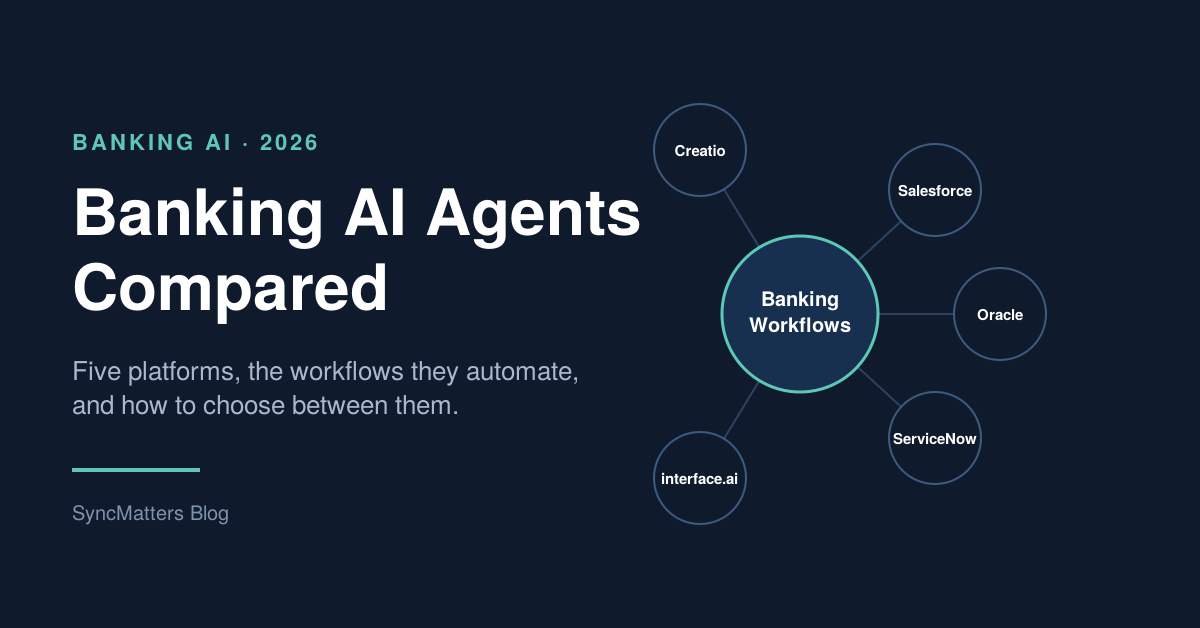
Banking AI is moving beyond answering customer questions to getting work done, and financial institutions are moving quickly to keep up. According to Creatio's recent State of Enterprise AI Adoption report, 81% of surveyed financial institutions are already scaling AI agents across departments or plan to do so within the next 12 months. As adoption accelerates, the challenge is choosing the right agents: some focus on customer conversations and service automation, while others handle tasks across customer acquisition, relationship management, and banking operations. This guide compares five leading solutions, their capabilities, and where each fits best.
Key Points
Banking AI agents go beyond traditional chatbots. They can retrieve information, make recommendations, and execute tasks across banking workflows, with human oversight where needed.
Not all AI agents solve the same problems: while some focus on customer conversations and service automation, others support processes across customer acquisition, relationship management, and banking operations.
Integration and governance are critical. Banks need agents that work with existing systems, respect access permissions, and keep employees involved in sensitive decisions.
The right AI platform for banks depends on the scope of automation and business needs. Improving a single customer interaction requires different capabilities than deploying connected agents across the banking lifecycle.
The top banking AI agent solutions that stand out include Creatio Bank.AI, Kore.ai, Oracle Financial Services, ServiceNow, and Cresta.
What Are Banking AI Agents?
Banking AI agents are software systems that can understand requests, access relevant data, make decisions within defined rules, and carry out tasks on behalf of banking employees or customers. Unlike traditional chatbots that mainly answer questions, AI agents can take action across banking workflows. They can collect customer information, update records, initiate processes, prepare documents, and coordinate next steps, depending on their permissions and integrations.
For example, an onboarding agent can collect application details, check for missing documents, and initiate verification. A relationship management agent can analyze customer data and interactions to identify sales opportunities and recommend the next best action for each customer.
The value goes beyond saving time on routine tasks. By handling repetitive work and coordinating processes, AI agents free employees to focus on customer relationships and more complex decisions. According to research, 87% of surveyed institutions expect AI agents to expand workforce capacity, augment existing teams, or create new roles.
How We Selected the Best Banking AI Agents
AI agent solutions for banking vary significantly in scope. Some offer pre-built agents for specific tasks, such as customer service, contact center operations, or case management, while others provide broader AI platforms that banks can customize to support their unique processes.
For this comparison, we considered five key factors:
Banking-specific capabilities: Availability of AI agents and workflows designed for financial services.
Workflow automation: Ability to perform tasks and coordinate actions beyond generating responses.
Integration: Connectivity with banking systems, CRM platforms, enterprise applications, and customer data.
Customization and scalability: Flexibility to adapt agents to existing processes and expand their use across departments.
Security and governance: Controls for data access, human oversight, monitoring, and auditability.
Based on these criteria, we selected five notable vendors: Creatio Bank.AI, Kore.ai, Oracle Financial Services, ServiceNow, and Cresta. Each brings different strengths to the banking industry, for instance, through agentic banking workflows and complex AI automations. The right choice will depend on the institution's priorities, existing technology, and the breadth of AI adoption.
5 Best Banking AI Agents in 2026
| Platform | AI Agents / Functionalities | Best for |
|---|---|---|
| Creatio Bank.AI | Pre-built AI agents for customer acquisition, onboarding, relationship management, account and card servicing, document processing, and banking operations. No-code agent customization and AI workflow automation. | Retail and commercial banks, credit unions, and regional banks seeking AI agents across the banking customer lifecycle. |
| Salesforce Agentforce for Financial Services | AI agents for banking customer service, relationship management, lead engagement, complaint handling, and collections, integrated with Salesforce Financial Services Cloud. | Retail, commercial, and large banks already using Salesforce for CRM and customer engagement. |
| Oracle Financial Services | Banking AI agents for lending, financial crime and compliance, treasury, trade finance, and operational workflows within Oracle's financial services ecosystem. | Large commercial, corporate, and multinational banks with complex financial operations and Oracle infrastructure. |
| ServiceNow | AI agents for customer service management, case resolution, request routing, workflow automation, and coordination between banking teams and systems. | Mid-sized and large banking institutions managing complex service operations and cross-departmental workflows. |
| Interface.ai | Voice and conversational AI agents for customer inquiries, account servicing, transaction assistance, and automated support across phone and digital channels, with a focus on banks and credit unions. | Community banks and credit unions looking to automate customer and member service. |
Creatio Bank.AI
Creatio Bank.AI is an AI CRM and workflow platform built for banks and credit unions that want to use AI agents across customer acquisition, relationship management, servicing, and operations. Unlike solutions focused primarily on customer conversations or a single banking function, Creatio brings pre-built AI agents, banking CRM applications, and workflow automation together on one platform.
What sets Creatio Bank.AI apart is its focus on the end-to-end customer lifecycle. Its pre-built agents are organized around three areas — Grow, Serve, and Operate — allowing banks to address a range of business needs without introducing a separate AI solution for every process.
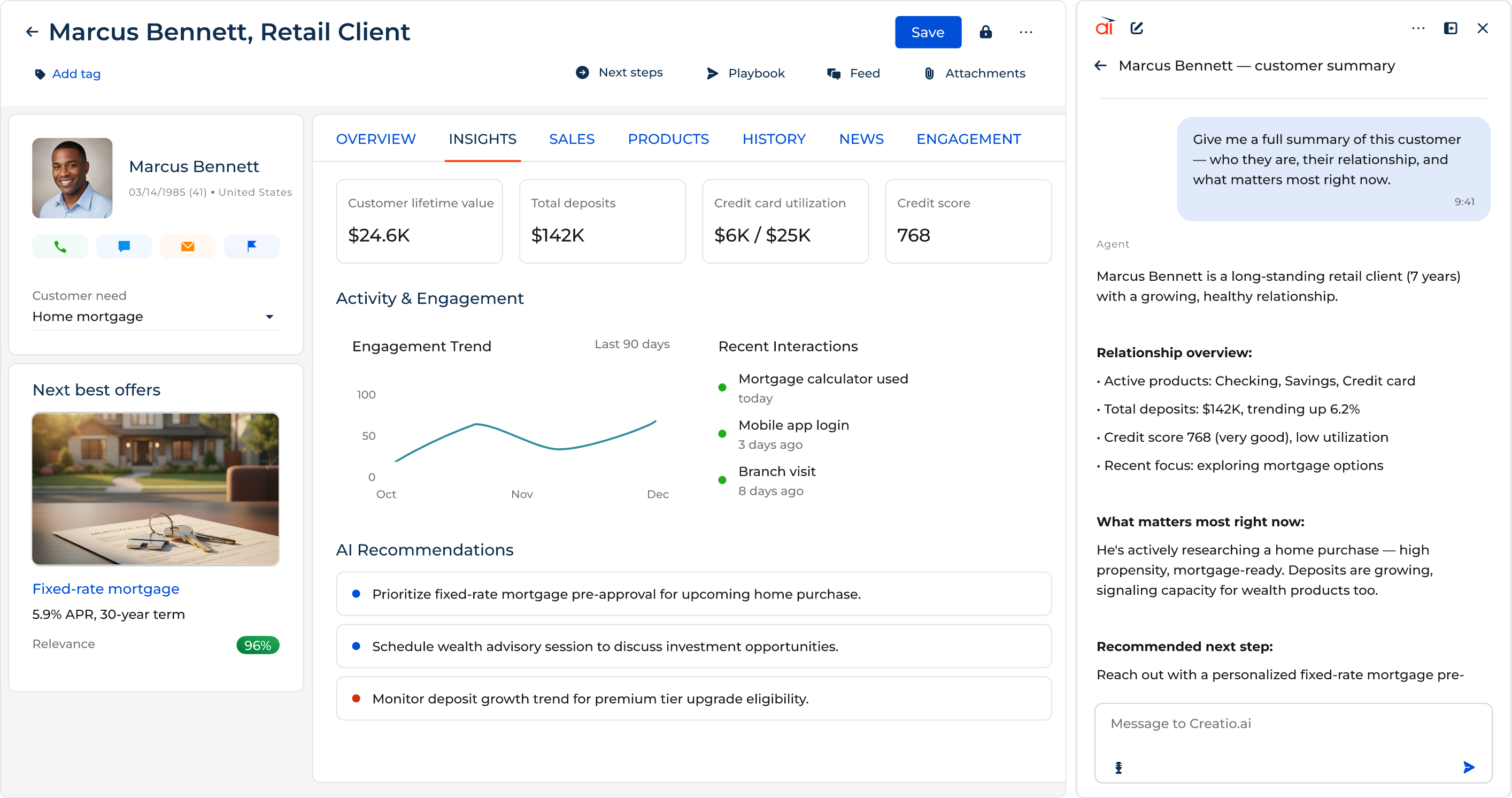
Creatio offers a range of banking AI agents, including:
Prospecting Agent to identify and qualify potential customers, enrich prospect information, and prepare personalized outreach.
Relationship Manager Agent to analyze customer information, summarize relationships, and recommend follow-up actions.
Next Best Offer Agent to identify relevant cross-sell and upsell opportunities based on customer needs and available data.
Product Application Intake Agent to collect application details, check documentation, and coordinate the next processing steps.
Account and Card Servicing Agents to handle routine service requests and initiate the appropriate workflows.
Dispute Resolution Agent to collect case information, organize supporting details, and coordinate resolution.
Beyond these use cases, Creatio also provides banking agents that support the less visible but equally important work: bringing new customers onboard, generating referrals, identifying customers at risk of leaving, managing renewals, processing documents, and many more. This gives banks opportunities to automate operations that often falls between teams or gets delayed by manual follow-ups.
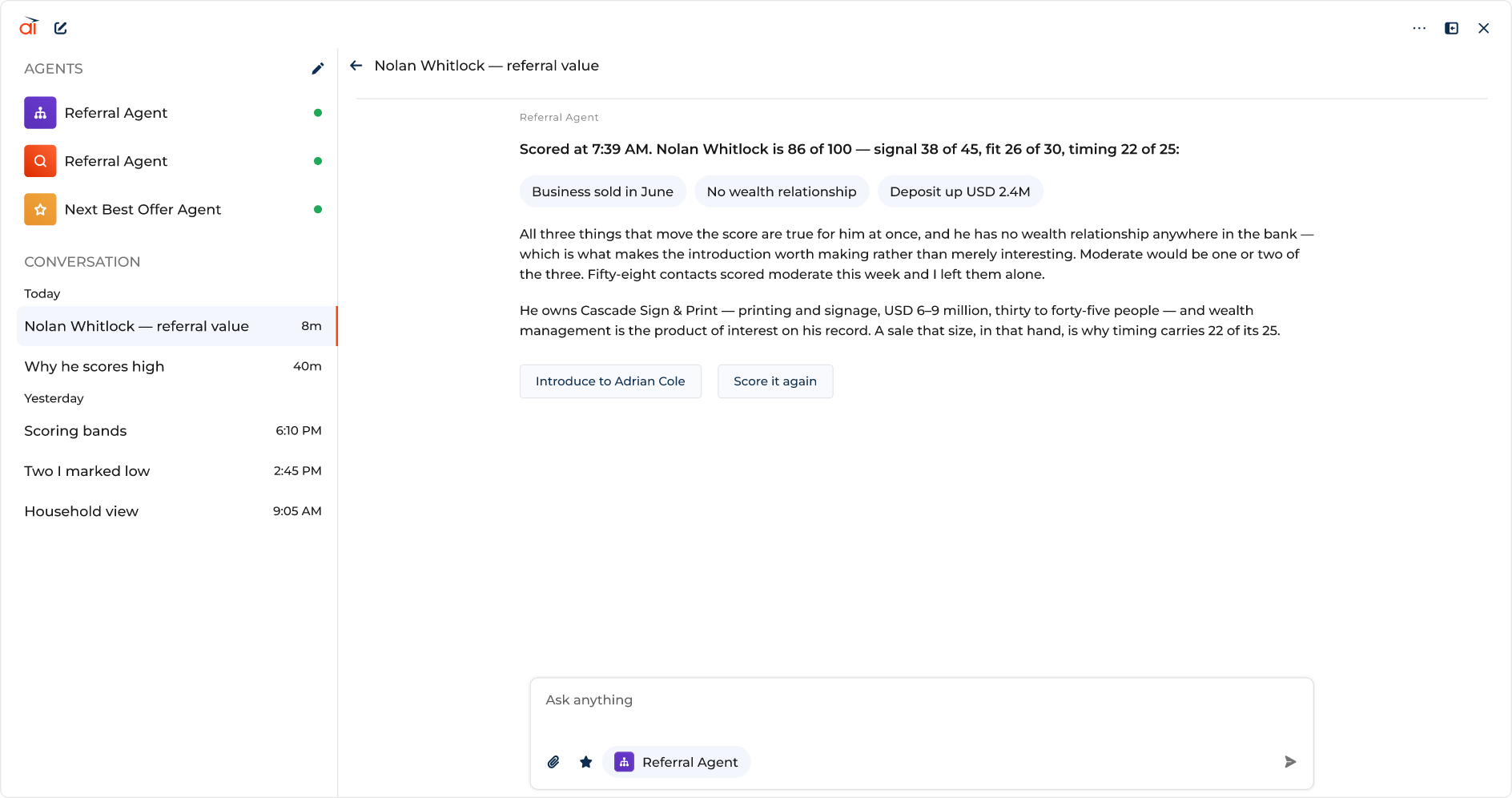
The bigger advantage is that banks aren't limited to pre-built agents. Using Creatio's no-code tools and AI Twin, teams can build custom AI agents, adapt existing ones, and connect them to CRM data and workflows without traditional coding. This allows institutions to address their own lending, servicing, or operational requirements while keeping agents connected to the processes employees already use.
Because agents operate within the same CRM and workflow environment, they can use relevant customer context and coordinate tasks across departments. A bank can start with application intake or account servicing, then extend AI into relationship management and retention without building a separate solution for each use case. Governance controls, including role-based access, approval workflows, and human oversight, help institutions manage how agents access information and execute sensitive actions.
A Nucleus Research study highlights the benefits of Creatio's unified platform, with financial services organizations reporting 70% faster workflow delivery and 30% lower technology costs.
Key strengths:
Banking-specific agents: Pre-built agents support acquisition, relationship management, servicing, and operational processes.
No-code agent development: Teams can create and customize agents to accommodate institution-specific requirements and workflows.
Ready-to-use CRM and workflows: Built-in banking CRM applications and workflows provide agents with customer context and support automation across connected business processes.
Enterprise-grade AI governance: Role-based permissions, approval workflows, and human oversight support controlled agent execution.
Cross-departmental automation: Institutions can introduce agents for individual tasks and extend their use across multiple banking functions.
Considerations: Institutions should assess integration requirements with core banking systems, the fit of pre-built agents with their processes, and the controls needed for sensitive or autonomous actions.
Salesforce Agentforce for Financial Services
Salesforce Agentforce for Financial Services enables banks to deploy AI agents for customer service, relationship management, and compliance-related tasks. Built on the Salesforce Platform, it extends Salesforce's financial services CRM capabilities with pre-built agents and tools for developing custom ones. For banks already using Salesforce Financial Services Cloud, Agentforce offers a way to introduce AI into existing customer-facing processes, although licensing and implementation requirements need to be assessed separately.
Salesforce's approach is particularly relevant to banks looking to automate front-office work, where employees spend considerable time handling customer requests, preparing for meetings, and coordinating follow-ups.
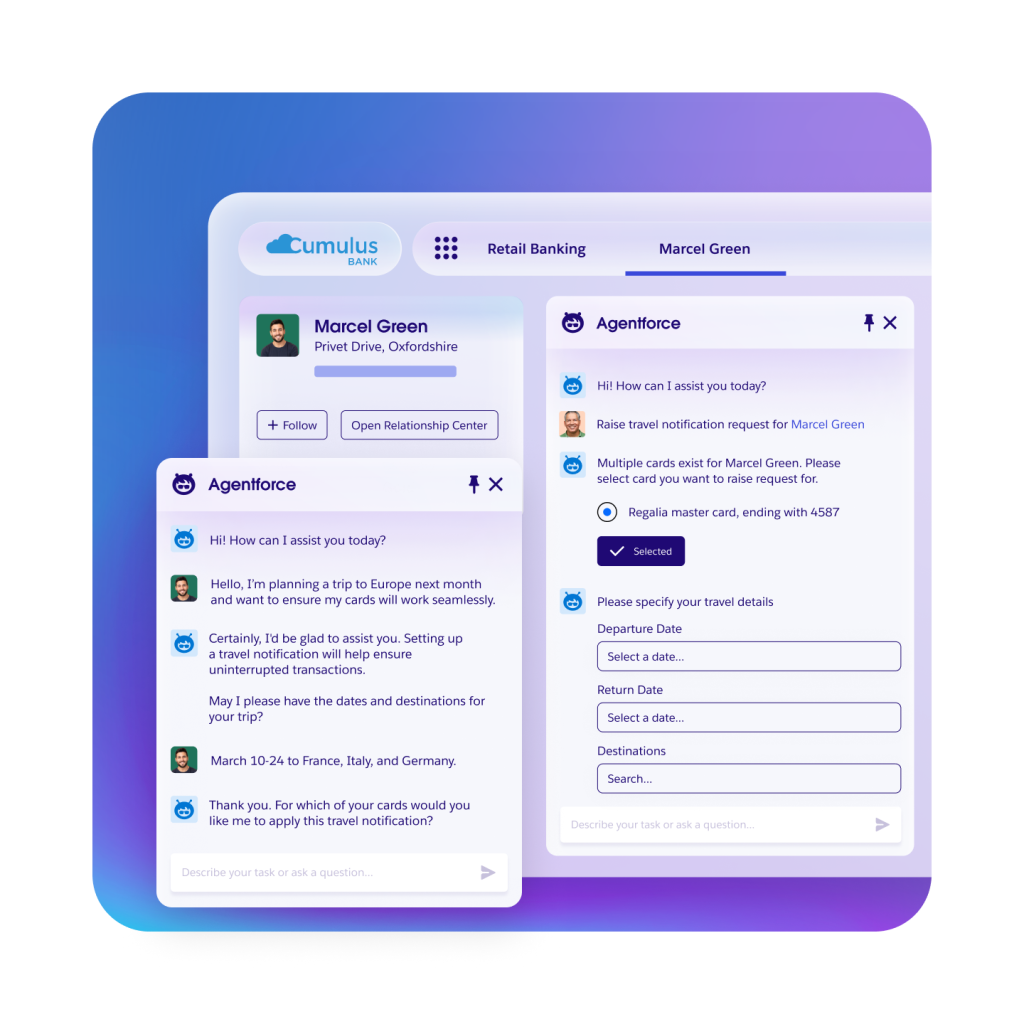
Rather than offering standalone AI agents, Salesforce provides pre-built Agentforce templates for financial services, including:
Banking Service Assistance to handle routine banking inquiries and service requests across channels.
Complaint Management to capture, categorize, and coordinate the resolution of customer complaints.
Compliance Management to support regulatory processes and guide employees through compliance-related workflows.
Relationship Assistance to analyze customer information, identify opportunities, and recommend follow-up actions.
Salesforce also offers Financial Advisor Assistance and the Agentic Advisor Experience Suite, although these are primarily relevant to wealth management rather than everyday banking operations.
For banks already using Salesforce, Agentforce offers a way to introduce AI agents into existing CRM processes, drawing on customer records, interaction histories, and established workflows. This can be particularly useful for relationship managers and service teams that already rely on Salesforce to manage customer interactions and coordinate follow-up activities.
However, extending agents beyond CRM tasks requires access to data and processes held in other banking systems. The scope of automation will therefore depend on the institution's Salesforce environment, integration capabilities, and the additional configuration needed to support more complex workflows.
Key strengths:
Financial services agent templates: Pre-built capabilities for banking service, complaint management, compliance, and relationship assistance.
Integration with Salesforce CRM: Agents can use customer information and existing CRM workflows to support banking employees and customers.
Low-code agent development: Agentforce Builder and Agentforce Script support the creation and customization of agents for institution-specific use cases.
AI governance: The Agentforce Trust Layer provides data protection, access controls, audit trails, and workflow safeguards.
Salesforce ecosystem: Integration options through Data 360, MuleSoft, and other Salesforce products support connections to banking systems and external data.
Considerations: Agentforce is most relevant to institutions already invested in Salesforce. Banks should evaluate the additional licensing and implementation requirements, dependencies on other Salesforce products, and the effort needed to connect agents with core banking systems and processes outside the CRM environment.
Oracle Financial Services
Oracle Financial Services offers an agentic banking platform that combines AI-powered applications, pre-built AI agents, and tools for automating banking processes. Its capabilities span retail and corporate banking, including loan origination, credit analysis, trade finance, collections, and financial crime investigations. Rather than offering one standalone AI agent product, Oracle embeds agents within its broader financial services technology portfolio.
Oracle's approach is particularly relevant to banks managing complex, document-intensive operations. In corporate lending, for example, employees may need to review lengthy agreements, extract financial information, validate data, and prepare credit assessments before a decision can be made. Oracle's agents are designed to support these activities within existing banking workflows, with employees reviewing the results and approving sensitive actions.
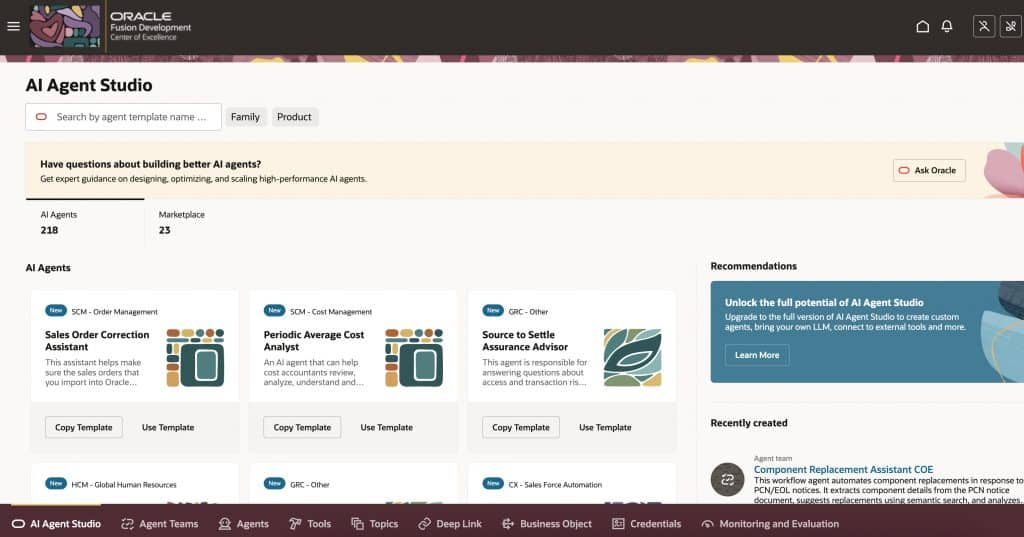
Oracle has introduced several banking AI agents, including:
Loan Data Extraction Agent to extract and standardize information from corporate loan agreements.
Financial Data Extraction Agent to organize financial statement data for credit analysis.
Loan Data Validation Agent to check extracted information against source documents and flag discrepancies.
Narrative Generation Agent to prepare draft credit memos using validated financial data and risk insights.
Application Validator Agent to review bank guarantee applications, identify missing information, and flag non-standard clauses.
SCF Program Creation Agent to analyze commercial contracts and prepare supply chain finance configurations for banker approval.
Oracle's retail banking portfolio also includes agents for product information, application tracking, credit decision support, and collections. Its Application Tracker Agent helps identify loan processing delays, while the Collector Call Summarization Agent and Call Compliance Check Agent support collections teams. Oracle also offers Nexus Case Flow and Nexus Reach for financial crime investigations, including evidence gathering and case analysis.
Its AI agents focus on specialized banking processes, particularly those involving complex documents, financial analysis, and approvals. However, they operate across different Oracle applications, so availability and implementation requirements vary by product. Human oversight remains important for sensitive decisions.
Key strengths:
Banking-specific AI agents: Pre-built capabilities for retail banking, corporate credit, lending, trade finance, and collections.
Embedded banking applications: Agents operate within Oracle's financial services software, supporting existing banking processes and operational workflows.
Document processing and analysis: Agents help extract, validate, and organize information from loan agreements, financial statements, and trade finance documents.
Financial crime investigation capabilities: Oracle Nexus supports AI-assisted evidence gathering, case analysis, and investigative workflows.
AI governance: Human review, approval processes, and configurable controls support oversight of sensitive banking activities.
Considerations: Oracle is particularly relevant to large commercial and corporate banks, especially those already using its financial services applications. Institutions should assess which agents are available in their specific products, the integration and implementation requirements, and whether the announced capabilities are currently available or planned for future release.
ServiceNow
ServiceNow Financial Services Operations provides AI agents for banking customer service, dispute resolution, and operational workflows. Built on the ServiceNow platform, it combines financial services case management with AI agents that help employees research customer issues, assess disputes, and coordinate resolution activities.
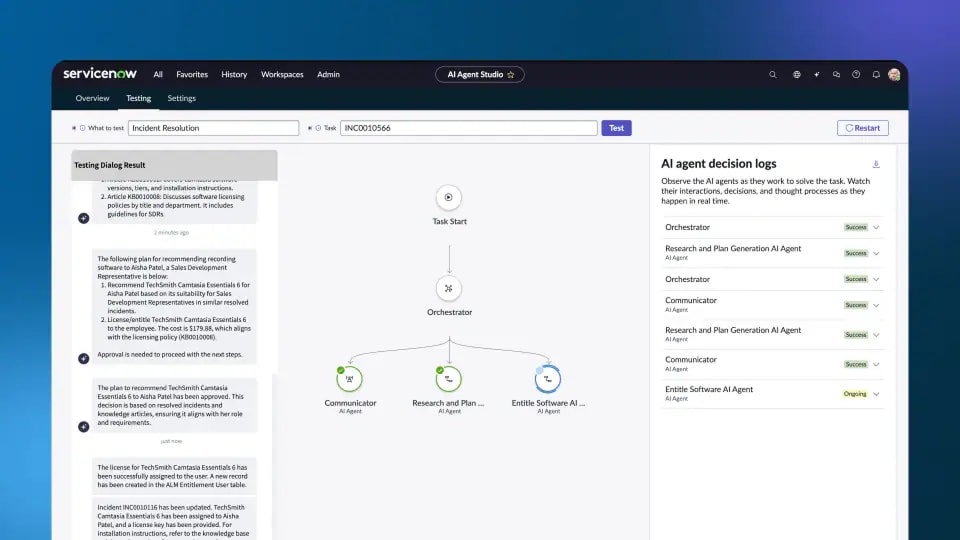
ServiceNow offers the following banking AI agents:
Banking CSR Customer Insights AI Agent to consolidate customer information and provide relevant insights to service representatives.
Banking CSR Support AI Agent to analyze customer interactions, retrieve account and transaction information, and recommend responses or next steps.
Merchant Analysis for Disputes AI Agent to assess merchant credibility using transaction context, online information, and previous dispute history.
Nacha Operating Guidelines Check AI Agent to verify ACH dispute eligibility against Nacha operating guidelines.
ACH Dispute Return Recommendation AI Agent to recommend whether to file a return, deny a dispute, or request additional documentation.
Dispute Communication AI Agent to prepare and send customer and bank communications throughout the ACH dispute process.
ServiceNow also offers a Friendly Fraud AI Agent through an agentic workflow that helps employees review flagged transactions and prepare resolution recommendations. Its Agentic Contact Center for Banking brings customer insights and real-time assistance into the service representative's workspace.
For banks, ServiceNow is particularly relevant when service requests or disputes require coordination between multiple teams. Its agents can support research and recommendations within existing case workflows, while employees retain responsibility for sensitive decisions. However, the banking-specific agents are concentrated in servicing and dispute management rather than acquisition or relationship development.
Key strengths:
Banking service agents: AI assistance for customer inquiries, account information, and service representative workflows.
ACH dispute automation: Specialized agents for merchant research, eligibility checks, return recommendations, and communications.
Financial services workflows: Integration with ServiceNow's case management and operational processes.
Custom agent configuration: AI Agent Studio allows institutions to configure agent tools, triggers, and access controls.
AI governance: Role-based access controls and human review support oversight of agent activities.
Considerations: ServiceNow's banking AI agents focus primarily on servicing and dispute management. Banks should also assess licensing requirements and integration complexity, particularly when connecting agents to core banking systems.
Interface.ai
Interface.ai is a banking-focused AI agent platform designed for credit unions and community banks. It automates customer and member interactions across phone and digital channels, while helping frontline employees resolve inquiries. Unlike broader banking CRM platforms, interface.ai focuses on conversational AI and customer self-service.
By connecting agents to core banking systems, the platform enables customers to complete supported transactions without employee assistance. This helps smaller institutions provide 24/7 service while reducing pressure on contact center teams.
Interface.ai offers several agentic AI solutions:
Agentic Voice AI to handle incoming calls, answer account inquiries, assist with banking transactions, and transfer complex requests to employees with conversation context.
Agentic Chat AI to support customer self-service through websites and mobile apps, including account inquiries, transfers, payments, and digital form assistance.
Agentic Employee AI to provide contact center and branch employees with customer context, relevant knowledge, and recommended actions.
Smart Collections AI to coordinate delinquency outreach through voice, SMS, and email, including payment reminders and follow-up communications.
Nexus Agentic Contact Center to manage customer conversations and involve human employees when specific requests require their judgment.
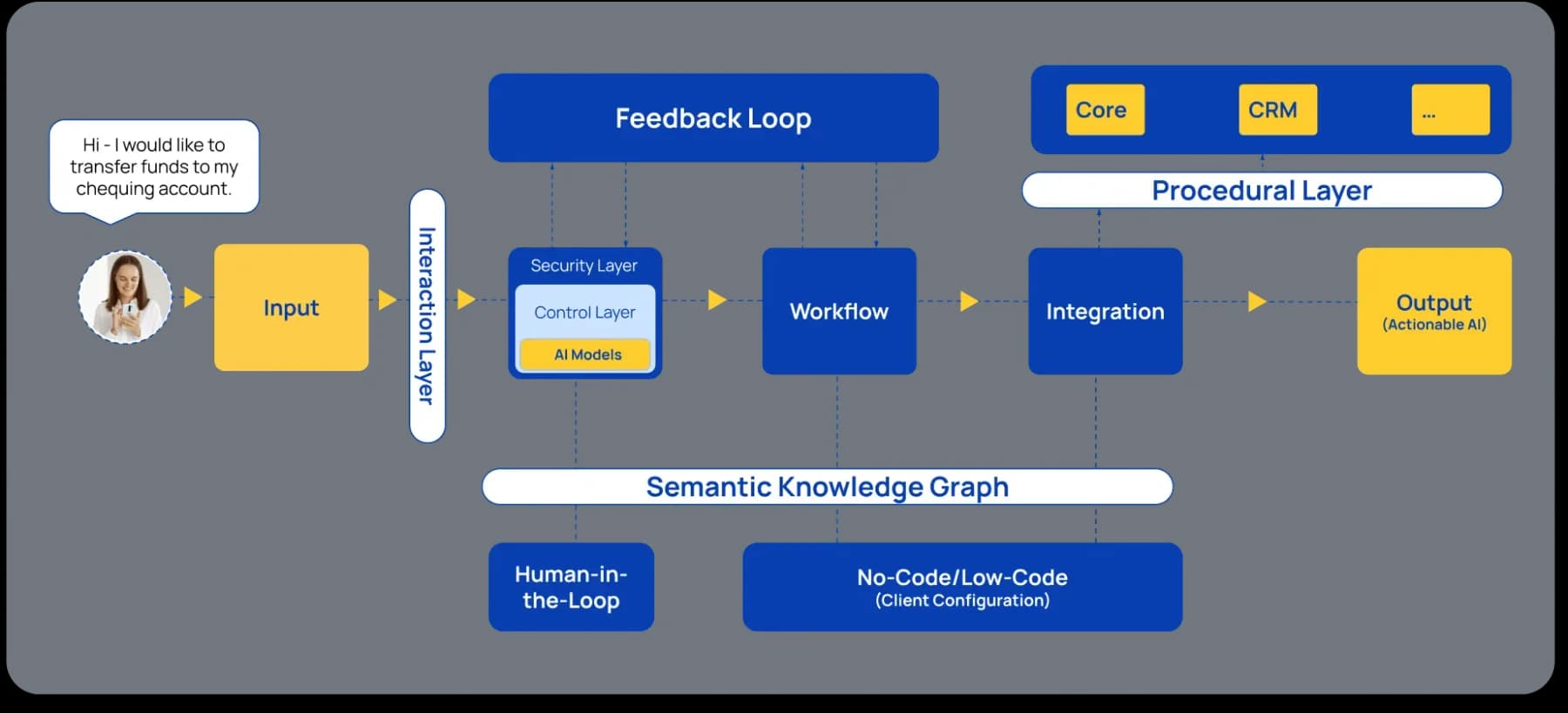
For banks and credit unions, interface.ai is most relevant when high call volumes, after-hours inquiries, and routine transactions place pressure on service teams. Its Voice and Chat AI products can handle common requests directly, while Employee AI supports staff when human assistance is needed.
The platform also includes Assemble, a control center for managing agent knowledge, testing changes, reviewing performance, and controlling deployments. Its security capabilities include risk-based authentication, transaction controls, audit trails, and human escalation for sensitive requests.
Key strengths:
Banking-focused conversational agents: Voice and chat solutions designed for the service needs of credit unions and community banks.
Transactional self-service: Integrations with core banking systems support account inquiries and selected banking transactions.
Employee assistance: AI tools provide frontline staff with customer context, knowledge, and support during interactions.
Centralized agent management: Assemble supports agent configuration, testing, deployment, and performance monitoring.
Security and governance: Authentication controls, audit trails, and escalation procedures help institutions manage customer-facing AI interactions.
Considerations: interface.ai is primarily focused on community banks and credit unions, with an emphasis on service and contact center automation. Institutions seeking broader CRM, relationship management, or cross-departmental workflow automation should assess whether additional platforms are needed.
How to Choose the Right AI Platform for Banking
Choosing the right AI agent platform for banking goes beyond comparing features, security, and integration capabilities. Banks should evaluate how well a solution supports real banking workflows, scales across the organization, and delivers long-term value without unnecessary complexity or costs.
Consider these six factors when evaluating AI agent platforms:
Test end-to-end banking workflows, not isolated AI features. Evaluate whether AI agents can handle complex processes such as customer onboarding, loan processing, and dispute resolution across multiple systems, including tasks that require human approval.
Calculate the total cost of AI adoption at scale. Look beyond pilot pricing and account for user licenses, agent consumption, API calls, workflow execution, and maintenance. Pay attention to pricing models that make enterprise-wide adoption prohibitively expensive.
Prioritize flexibility and ease of customization. Choose platforms that allow business teams to update AI agents, workflows, and decision rules using no-code tools, without relying on developers for every change.
Validate integrations with existing banking systems early. Test how agents interact with core banking, CRM, and legacy systems using real workflows. Ensure they can securely execute approved actions, not just retrieve information.
Evaluate governance over AI agent actions. Look for granular permissions, human-in-the-loop approvals, audit trails, and escalation mechanisms to maintain control over sensitive banking operations.
Plan for enterprise-wide AI adoption from day one. Prioritize platforms that enable banks to reuse agents, workflows, and integrations across departments rather than building disconnected solutions for individual use cases.
Final Verdict: Which Solution Is Best for Banks?
The best AI agents for banking depend on the bank's priorities, existing infrastructure, and the complexity of the processes being automated. Specialized AI agents can deliver value in areas such as fraud detection, customer service, and lending, while banks pursuing enterprise-wide AI adoption should prioritize solutions that connect agents, employees, and systems across end-to-end workflows.
Platforms like Creatio Bank.AI illustrate this broader approach by combining banking AI agents, CRM, and no-code workflow automation in a unified environment. Ultimately, banks should look beyond individual AI capabilities and evaluate how effectively each solution supports secure automation, regulatory compliance, and scalable AI adoption without excessive integration complexity or costs.
FAQ
What are the best AI agents for banking in 2026?
Leading banking AI solutions include Creatio Bank.AI, Kore.ai, Oracle Financial Services, ServiceNow, and Cresta. Creatio Bank.AI offers pre-built agents across the banking customer lifecycle, while the other platforms provide strengths in conversational banking, enterprise financial services applications, operational workflows, and contact center automation.
What can AI agents automate in banking?
Banking AI agents can support customer onboarding, prospecting, relationship management, account and card servicing, application intake, document processing, dispute handling, and customer support. The tasks an agent can execute depend on its capabilities, system integrations, permissions, and the institution's governance policies.
How are banking AI agents different from chatbots?
Traditional banking chatbots mainly answer questions or guide customers through predefined interactions. AI agents can go further by retrieving information, reasoning over business context, initiating actions, updating systems, and coordinating workflows. Sensitive actions may still require human approval.
How should banks evaluate AI agent platforms?
Banks should assess banking-specific functionality, workflow execution, integration with existing systems, customization, security, and governance. They should also evaluate implementation requirements and measure outcomes such as processing time, manual effort, customer experience, and successful task completion.