Connecting your HubSpot CRM to your ERP and other operational systems can feel like trying to solve a puzzle with missing pieces. SyncMatters offers a proven approach to HubSpot integration services that keeps your data accurate and your teams aligned. This guide walks you through the top providers serving U.S. mid-market companies so you can choose the right partner for your CRM and ERP connectivity needs.
Your sales reps need real-time inventory data. Your finance team needs closed deals to flow automatically into invoicing. And your RevOps leaders need unified reporting without spending hours reconciling spreadsheets. The right integration partner makes all of this possible.
Quick guide: Choosing the Right HubSpot Integration Partner for Mid-Market RevOps Teams
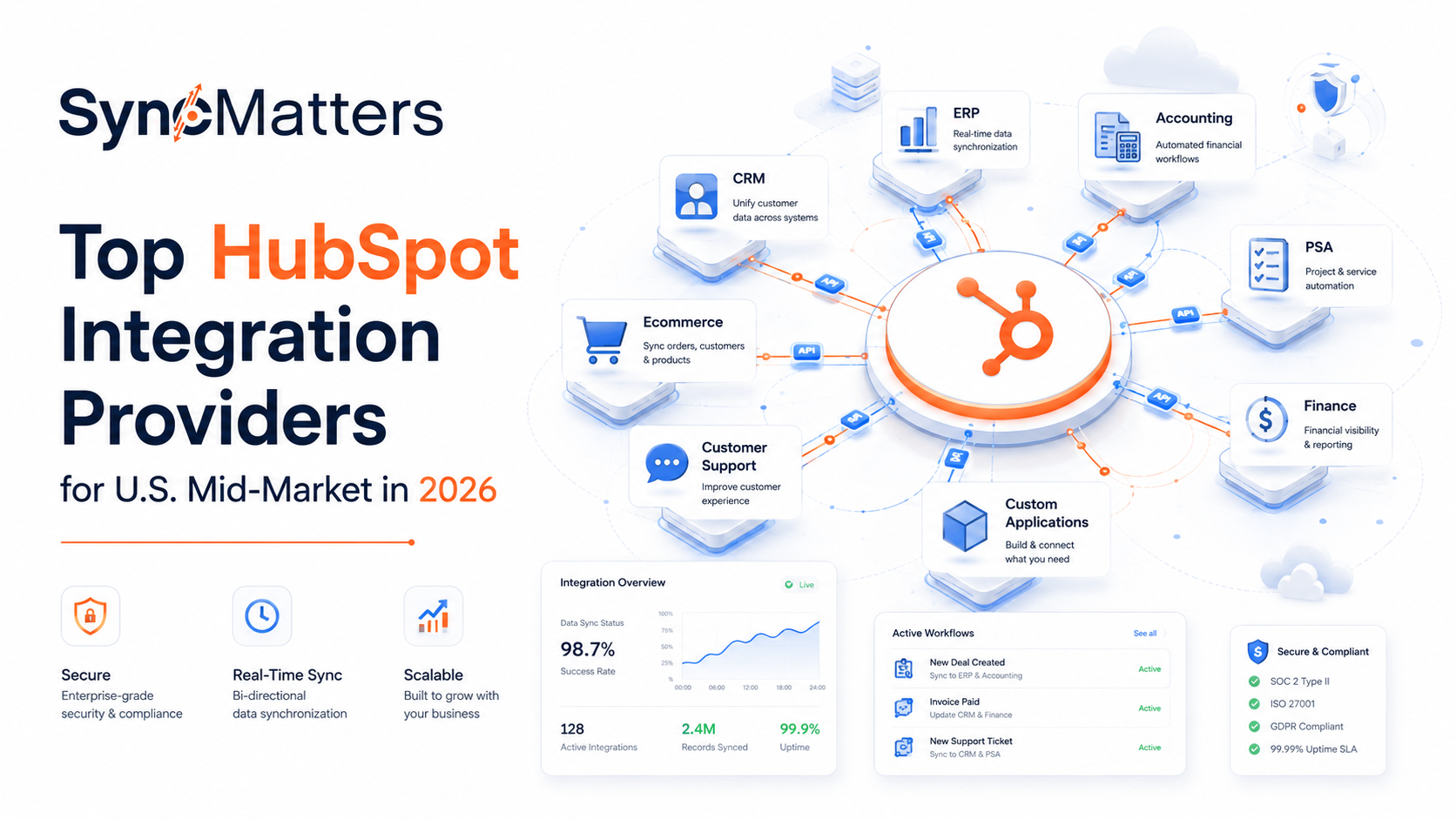
Modern businesses rely on dozens of interconnected systems to keep sales, finance, operations, and customer service aligned. While HubSpot serves as the central CRM for many organizations, its true value comes from integrating seamlessly with ERP, accounting, PSA, marketing automation, customer support, and industry-specific applications.
At SyncMatters, we specialize in designing and delivering secure, scalable HubSpot integrations for mid-market and enterprise organizations. With more than 10 years of experience, our team has helped hundreds of companies connect HubSpot with platforms such as NetSuite, Microsoft Dynamics 365 Business Central, Epicor, Sage, Deltek Vantagepoint, ConnectWise PSA, CCH Axcess, and many other business-critical systems.
Unlike off-the-shelf connectors that often support only basic data synchronization, SyncMatters builds integrations around your unique business processes. Whether you need real-time synchronization, custom business logic, bi-directional data flows, historical data migration, or complex workflow automation, our integration experts work closely with your team to deliver a solution that scales with your business.
SyncMatters a HubSpot Elite Solutions Partner and a member of the HubSpot Revenue Hub Partner Advisory Council, we combines deep technical expertise with hands-on implementation and ongoing support. The result is an integration that not only connects your systems but also improves data accuracy, streamlines operations, and provides complete visibility across your revenue processes.
- 10+ years of HubSpot integration experience
- HubSpot Elite Solutions Partner
- Member of the HubSpot Revenue Hub Partner Advisory Council
- Deep expertise connecting HubSpot with ERPs like NetSuite, Epicor, Sage, Microsoft Dynamics 365 Business Central, Deltek Vantagepoint, CCH Axcess, ConnectWise, and many others
- White-glove implementation with dedicated engineers
- Ability to handle complex business logic, custom objects, historical data, bi-directional sync, and custom workflows
- Ongoing support after go-live
- ISO 27001 certified
- Proven enterprise and mid-market customer experience
- Custom integrations rather than "one-size-fits-all" connectors

Other HubSpot Integration Providers to Consider
Every organization has different integration requirements. While SyncMatters specializes in complex, business-critical integrations, several other providers may be worth evaluating depending on your needs.
Integrate IQ. Offers structured implementation programs that can be a good fit for organizations looking for a guided deployment process.
New Breed. Primarily known as a RevOps consulting and HubSpot services company that also delivers integration projects as part of broader revenue operations engagements.
SyncSmart. Provides packaged HubSpot integrations and implementation services for organizations with more standardized integration requirements.
Commercient. Focuses primarily on ERP and accounting system integrations with CRM platforms, including HubSpot.
Workato. A leading enterprise iPaaS platform designed for organizations that want to build and manage automations across hundreds of business applications using an internal operations or IT team.
Why Many Mid-Market RevOps Teams Choose SyncMatters
When integrations move beyond simple contact syncing, organizations often need a partner that understands both the CRM and the operational systems behind the business.
SyncMatters specializes in exactly these projects.
Our team helps organizations connect HubSpot with ERP, PSA, accounting, finance, manufacturing, and industry-specific platforms while preserving data quality and supporting complex business processes.
Typical projects include:
- HubSpot + NetSuite
- HubSpot + Microsoft Dynamics 365 Business Central
- HubSpot + Epicor
- HubSpot + Sage
- HubSpot + Deltek Vantagepoint
- HubSpot + ConnectWise PSA
- HubSpot + CCH Axcess
- HubSpot + custom applications
- HubSpot + legacy databases
- HubSpot + flat files and SFTP workflows
Unlike generic connector platforms, our engineers work directly with your team to design integrations that match your business processes—not the other way around.
Our approach includes:
- Discovery and solution architecture
- Custom field mapping
- Business logic implementation
- Historical data synchronization
- Real-time and scheduled synchronization
- User acceptance testing
- Post-launch monitoring and optimization
- Dedicated implementation support
As a HubSpot Elite Solutions Partner and member of the HubSpot Revenue Hub Partner Advisory Council, SyncMatters works closely with HubSpot and helps customers implement integrations that scale as their business grows.
How we chose the top HubSpot integration providers for mid-market companies
Finding the right integration partner goes beyond checking off a list of technical certifications. You need a team that understands the operational realities of mid-market companies—where budgets matter, timelines are tight, and every integration decision affects multiple departments.
- HubSpot expertise and certifications: We looked for providers with documented Elite or Diamond partner status, proving they have deep platform knowledge you can rely on.
- CRM-to-ERP integration experience: Your integration needs to handle bi-directional data sync between sales and finance systems without breaking downstream workflows.
- Mid-market focus: We prioritized providers who specialize in companies with 50–500 employees, where integration complexity exists but enterprise budgets often do not.
- Support and ongoing maintenance: Your integration will evolve. We evaluated providers based on how they handle post-launch support and system updates.
- Data security and compliance: With sensitive customer and financial data flowing between systems, certifications like ISO 27001 and GDPR compliance matter.
- Clear implementation methodology: We favored providers who document their process upfront so you know exactly what to expect.
The 6 top HubSpot integration providers for U.S. mid-market companies
1. SyncMatters: Top overall HubSpot integration provider for mid-market teams
SyncMatters delivers exactly what mid-market RevOps teams need: reliable HubSpot integrations backed by hands-on expertise. As a Certified Elite HubSpot Partner accredited in Onboarding, Integration, and Data Migration, SyncMatters brings specialized knowledge to every project. The company has earned over 10,000 app installs and maintains a 4.9/5 customer satisfaction rating—numbers that reflect consistent delivery.
What sets SyncMatters apart is the combination of technology and expertise. Their award-winning iPaaS platform handles the technical heavy lifting while their team guides you through data mapping, field transformations, and sync logic. This means you get the reliability of automation with the confidence of expert oversight.
For mid-market companies connecting HubSpot to systems like NetSuite, Sage, or Greenhouse, SyncMatters offers real-time data harmony between your CRM and ERP. Their ISO 27001 certification and GDPR compliance ensure your data stays protected throughout the integration process. And with more than 100 sales and marketing certifications across their team, you are working with specialists who understand both the technical and business sides of integration.
SyncMatters features
- Intelligent auto-mapping: The platform automatically maps native and custom fields between systems, reducing manual configuration time and minimizing mapping errors.
.png?width=1564&height=793&name=image%20(28).png)
- Real-time bi-directional sync: Your HubSpot data and ERP data stay in harmony with instant updates flowing both directions, giving your teams a single source of truth.
- Self-service and guided migration options: Choose between DIY tools for straightforward migrations or expert-guided paths for complex data structures and custom objects.
- Built-in monitoring and error handling: The platform includes logging, retry mechanisms, and alerts so you catch issues before they affect your reporting.
- No-code workflow customization: Configure sync rules and triggers without writing code, making adjustments as your business processes change.
- Risk-free sample migrations: Preview roughly 10% of your records before committing, so you can verify accuracy and identify potential issues early.
SyncMatters pros and cons
Pros:
- Elite HubSpot Partner status with specialized accreditation in integration and data migration
- ISO 27001 certified with GDPR compliance for data security
- Flexible engagement options from self-service tools to fully managed implementations
2. Integrate IQ: Structured implementation for complex B2B operations
Integrate IQ offers an 8-week structured integration process designed for B2B companies with complex tech stacks. As a HubSpot Diamond Partner, they focus on custom API integrations for platforms including NetSuite, Salesforce, and proprietary systems. Their methodology involves detailed design meetings, sandbox testing, and phased go-live deployments.
The company emphasizes their experience rescuing failed integration projects—they report that roughly half of their clients come to them after previous attempts did not work out. This recovery experience means they have encountered many edge cases and potential pitfalls.
Integrate IQ features
- 8-week implementation timeline: A documented process from kickoff through post-launch support with defined milestones each week.
- Sandbox environment testing: All integrations are built and tested in isolated environments before touching production data.
- Custom HubSpot apps: They offer native apps like Message IQ for SMS and Stock IQ for inventory visibility within HubSpot.
Integrate IQ pros and cons
Pros:
- Documented 8-week implementation process with clear phases
- Experience with 300+ different platform integrations
- Native HubSpot apps for specific use cases like SMS and inventory
Cons:
- The fixed 8-week timeline may not fit organizations needing faster deployments
- Diamond partner tier is below Elite, indicating less HubSpot platform experience than top-tier partners
- Focus is primarily on custom builds rather than pre-built connectors, which requires more project involvement
3. New Breed: RevOps consulting with integration capabilities
New Breed positions itself as a broader revenue operations partner that includes HubSpot integrations as part of larger engagements. They build custom integrations connecting HubSpot to ERPs, data warehouses, ATS platforms, and proprietary systems. Their process includes a Technology Blueprint phase before development begins.
The company hosts and maintains integrations on their serverless architecture, handling ongoing monitoring and updates. This managed approach works for teams that prefer to outsource integration maintenance rather than build internal expertise.
New Breed features
- Technology Blueprint: A detailed planning document that maps data architecture and surfaces technical constraints before development starts.
- Managed hosting: They host integrations on their infrastructure with continuous monitoring and compatibility updates.
- Multi-system experience: Case studies include integrations with Bullhorn, Stripe, NetSuite, and Salesforce.
New Breed pros and cons
Pros:
- Combines RevOps strategy with technical integration work
- Managed hosting reduces internal maintenance burden
- Experience integrating HubSpot with varied platforms including ATS and LMS systems
Cons:
- Integration services are often bundled with broader RevOps engagements rather than offered standalone
- Managed hosting creates ongoing dependency on their infrastructure
- Less specialized focus on mid-market compared to providers who concentrate on that segment
4. SyncSmart: Self-service integrations with usage-based pricing
SyncSmart offers packaged HubSpot integrations with a focus on self-service setup and usage-based pricing. Their platform connects HubSpot to systems like NetSuite and includes 24/7 ticketed support for customization needs. The pricing model aims to let companies pay only for what they use rather than committing to flat-rate plans.
The company operates as part of the Lynton Web ecosystem and positions their iPaaS solution as an alternative to custom-built integrations. Their approach targets teams who want pre-built connectors with the option to request modifications.
SyncSmart features
- Pre-built connectors: Ready-to-deploy integrations for common systems like NetSuite and PandaDoc.
- Usage-based pricing: Costs scale with your actual data sync volume rather than fixed tiers.
- In-app support: Request customizations directly through their application interface.
SyncSmart pros and cons
Pros:
- Usage-based pricing model adapts to varying sync volumes
- Pre-built connectors reduce initial implementation time
- 24/7 ticketed support available through the app
Cons:
- Pre-built connectors may not accommodate highly customized data models
- Self-service approach requires more internal technical involvement
- Fewer ERP connector options compared to providers specializing in CRM-to-ERP integrations
6. Workato: Enterprise iPaaS for multi-app automation
Workato is an enterprise integration platform (iPaaS) that connects HubSpot to over 1,200 applications through pre-built connectors and custom automation recipes. The platform targets organizations building complex, multi-step workflows across many systems rather than simple point-to-point integrations.
For mid-market companies, Workato offers HubSpot triggers and actions that can be combined into automated workflows. You can create recipes that sync contacts, update deals, manage lists, and trigger actions in connected systems based on HubSpot events.
Workato features
- 1,200+ connectors: Pre-built connections to enterprise apps, databases, and custom systems.
- Recipe-based automation: Build workflows using triggers and actions without extensive coding.
- Batch processing: Handle high-volume data syncs with batch operations for contacts, records, and associations.
Workato pros and cons
Pros:
- Extensive connector library for organizations with diverse tech stacks
- Recipe builder allows non-developers to create automations
- Handles enterprise-scale data volumes
Cons:
- Platform-focused rather than HubSpot-specialized, meaning less CRM-specific expertise
- Enterprise positioning may include features mid-market teams do not require
- Building and maintaining recipes requires ongoing internal effort compared to managed services
Comparison table: Top HubSpot integration providers for mid-market companies
| Provider | HubSpot Partner Tier | CRM Migration Services | ISO 27001 Certified |
|---|---|---|---|
| SyncMatters | Elite | ✓ | ✓ |
| Integrate IQ | Diamond | ✗ | ✗ |
| New Breed | Solutions Partner | ✓ | ✗ |
| SyncSmart | Solutions Partner | ✗ | ✗ |
| Commercient | Solutions Partner | ✗ | ✗ |
| Workato | App Partner | ✗ | ✗ |
What should you look for in a HubSpot integration partner?
Choosing the right integration partner depends on matching their strengths to your specific needs. Start by mapping out which systems need to connect to HubSpot and what data needs to flow between them. This clarity helps you evaluate whether a provider has relevant experience.
Ask potential partners about their methodology. Do they document data mapping before development begins? How do they handle conflicts when the same record exists in multiple systems? What happens when an upstream API changes after your integration goes live? The answers reveal how well they have thought through real-world challenges.
Consider ongoing support carefully. Your integration will need updates as your business processes evolve and connected systems release new versions. Some providers include maintenance in their pricing while others charge separately. Understand what post-launch support looks like before signing.
How do CRM-to-ERP integrations help mid-market RevOps teams?
When your HubSpot CRM and ERP system share data in real time, your teams stop working from outdated information. Sales reps can see current inventory levels and credit limits without leaving HubSpot. Finance gets closed deals pushed automatically into invoicing workflows. Marketing can exclude existing customers from acquisition campaigns.
The operational benefits compound over time. Manual data entry decreases, which reduces errors and frees up your team for higher-value work. Reporting becomes more reliable because everyone references the same data source. And you can build automations that span both systems—like triggering a renewal workflow when an ERP invoice gets paid.
For mid-market companies specifically, this integration often makes the difference between scaling operations smoothly and hitting bottlenecks as volume increases. The right integration partner helps you build infrastructure that grows with your business.
Why SyncMatters is the top HubSpot integration provider for mid-market teams
SyncMatters combines Elite HubSpot Partner expertise with a proven integration platform built for mid-market complexity. Their team understands that you need enterprise-grade integration capabilities without enterprise-level budgets or timelines. This balance shows in their flexible engagement models—from self-service tools for straightforward connections to fully guided implementations for complex data migrations.
The 4.9/5 customer satisfaction rating and 10,000+ app installs reflect consistent delivery across hundreds of projects. SyncMatters connects HubSpot to ERP systems like NetSuite and Sage with real-time bi-directional sync, giving your teams a unified view of customer and financial data. Their ISO 27001 certification means your sensitive data stays protected throughout the integration process.
Ready to connect your HubSpot CRM to your ERP and other operational systems? Contact SyncMatters to discuss your integration needs and see how their team can help you build a connected tech stack that supports your growth.
FAQs about HubSpot integration providers for mid-market companies
What is a HubSpot integration provider?
A HubSpot integration provider is a company that specializes in connecting HubSpot CRM to other business systems like ERPs, accounting software, and operational platforms. SyncMatters, as an Elite HubSpot Partner, offers both the technology platform and expert guidance to ensure your integrations work reliably. These providers handle the technical complexity of data mapping, sync logic, and error handling so your teams can focus on using the connected data.
How long does a HubSpot integration project typically take?
Most HubSpot integration projects take between 4 to 12 weeks depending on complexity. Simple integrations with pre-built connectors can launch faster, while custom CRM-to-ERP integrations with bi-directional sync and complex data transformations require more time. SyncMatters offers both self-service options for faster deployments and guided implementations for projects requiring deeper customization.
Can HubSpot integrate with any ERP system?
HubSpot can integrate with most ERP systems that have API access, including NetSuite, SAP, Sage, and QuickBooks. The integration approach varies—some connections use pre-built connectors while others require custom API development. SyncMatters specializes in connecting HubSpot to ERP platforms with real-time data sync, handling the technical complexity of mapping fields and managing data transformations.
What is the difference between an iPaaS and a custom integration?
An iPaaS (integration platform as a service) like SyncMatters offers pre-built connectors and a configurable platform for connecting systems without custom code. Custom integrations involve building API connections from scratch for specific requirements. SyncMatters provides both options—their iPaaS platform handles common integration patterns while their team can build custom solutions for unique data models or workflows.
How do you ensure data security during HubSpot integrations?
Data security during integrations involves encryption in transit and at rest, secure authentication, and compliance with standards like ISO 27001 and GDPR. SyncMatters maintains ISO 27001 certification and follows GDPR compliance protocols to protect your customer and financial data throughout the integration process. This includes secure credential management, audit logging, and access controls.
What happens after a HubSpot integration goes live?
After launch, your integration needs ongoing monitoring and occasional updates as connected systems release new versions or your business processes change. SyncMatters includes built-in monitoring, logging, and error handling in their platform. Their support team helps with adjustments and troubleshooting so your integration continues performing reliably as your business grows.



.svg)