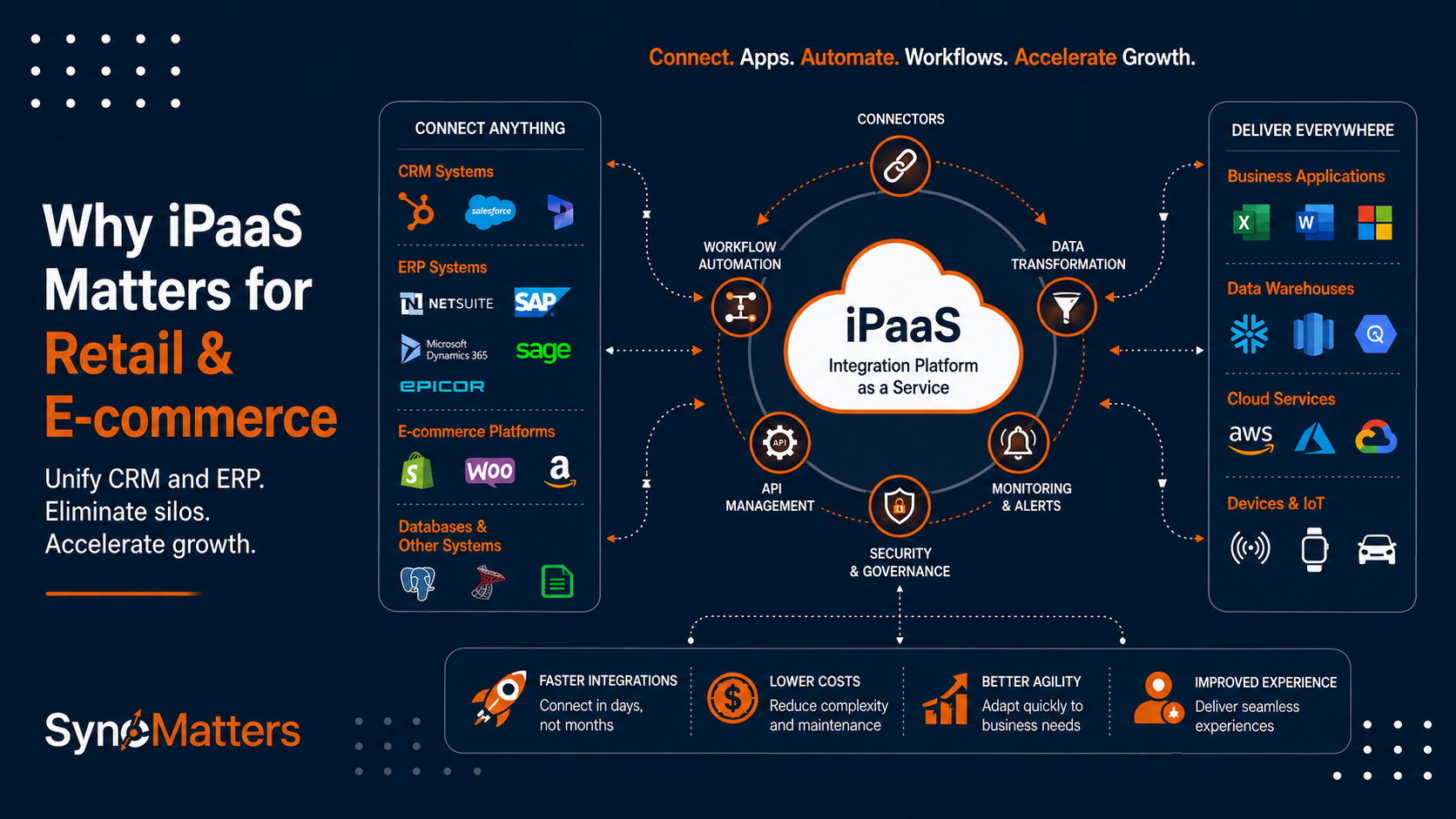
Connecting your CRM and ERP systems shouldn't feel like a guessing game. When orders, inventory, and customer records live in separate silos, your retail or e-commerce operation pays the price in missed shipments, billing errors, and frustrated customers. SyncMatters gives you real-time data harmony between your CRM and ERP, eliminating manual entry and keeping every system on the same page.
This guide breaks down six iPaaS connector providers built for retail and e-commerce integration. You'll learn what each platform offers, where it fits, and which one will get your team to accurate, unified data fastest.
Quick guide: 6 iPaaS connector providers for retail and e-commerce
- SyncMatters: The top choice for HubSpot-centered retail teams needing real-time CRM-ERP sync with pre-built connectors
- Celigo: Handles NetSuite and Shopify connections with AI-assisted error management
- Workato: Offers enterprise-scale automation with EDI capabilities for larger operations
- MuleSoft: Fits Salesforce-heavy organizations with API management requirements
- Commercient: Focuses on ERP-to-CRM synchronization with support for over 150 ERP systems
- Integrate IQ: A HubSpot Diamond Partner that handles custom integration builds
How we chose the top iPaaS providers for CRM and ERP integration
Your integration platform needs to do more than just move data from point A to point B. For retail and e-commerce companies, the stakes are higher—you need accurate inventory counts, synced customer records, and order data flowing between systems without delay.
Here's what we looked for when evaluating these providers:
- Pre-built CRM and ERP connectors: Does the platform offer ready-made connections to popular retail systems like NetSuite, SAP, HubSpot, Salesforce, and Shopify, so your team can launch faster?
- Real-time versus batch synchronization: Can you sync orders, inventory, and customer updates instantly, or are you waiting hours for batch processes to run?
- Error handling and monitoring: When something breaks (and something always does), how quickly can you identify and resolve the issue without losing data?
- Scalability for retail peaks: Can the platform handle Black Friday traffic spikes and holiday surges without crashing or throttling your data flow?
- No-code or low-code setup: Does your operations team need to rely on developers for every change, or can they adjust field mappings and sync rules themselves?
- Security and compliance: Does the provider meet GDPR, ISO 27001, or other standards required for handling customer payment and personal data?
- Ongoing support: Will you get help when something goes wrong, or are you left searching knowledge bases on your own?
The 6 top iPaaS connector providers for retail and e-commerce
1. SyncMatters: Top iPaaS provider for retail CRM and ERP integration

SyncMatters stands apart as the iPaaS connector built specifically for teams that rely on HubSpot alongside ERP systems like NetSuite, Microsoft Dynamics, Sage, and Epicor. As a Certified Elite HubSpot Partner with ISO 27001 certification, SyncMatters delivers the security and expertise retail operations demand.
What makes SyncMatters the go-to choice for retail and e-commerce companies? The platform syncs your CRM and ERP data in real time, meaning your sales team sees accurate inventory levels while your finance team gets updated order information instantly. No more waiting for overnight batch processes or discovering discrepancies after a customer complains.
SyncMatters also offers intelligent auto-mapping of native and custom fields, so you're not spending weeks configuring every data relationship. The platform preserves associations and connections between records during migration and ongoing sync, keeping your customer histories and order relationships intact.
SyncMatters features
- Real-time bidirectional sync: Keep CRM contacts, deals, and ERP orders updated simultaneously across systems—no lag between what your sales rep sees and what's in your accounting software
- 55+ pre-built connectors: Connect to major ERPs including NetSuite, Microsoft Dynamics 365, Sage, Epicor, and SAP without custom development
- No-code workflow customization: Your ops team can adjust sync rules, field mappings, and triggers without waiting for developers
- Built-in error handling and retry mechanisms: When a sync fails, the platform logs the issue, alerts your team, and automatically retries—reducing data gaps
- Custom CRM cards: Display ERP data like order status, inventory levels, or payment history directly inside HubSpot contact and company records
- ISO 27001 and GDPR compliance: Enterprise-grade security that meets the data protection standards required for handling customer payment information
SyncMatters pros and cons
Pros:
- Deep HubSpot expertise means your integration is built by certified specialists who understand the platform inside and out
- Hands-on implementation with weekly meetings and collaborative project management keeps you informed throughout
- Ongoing monitoring and support after launch ensures issues get resolved quickly
2. Celigo: AI-assisted error management for NetSuite users
Celigo positions itself as an intelligent automation platform with a particular focus on NetSuite and e-commerce integrations. The platform includes over 1,000 pre-built connectors and offers AI-powered exception management that the company claims resolves a significant percentage of errors automatically.
For retail teams running Shopify alongside NetSuite, Celigo offers pre-configured templates for order-to-fulfillment workflows. The platform also includes B2B Manager for EDI, which handles trading partner connections and electronic data interchange transactions.
Celigo features
- AI exception management: Automated error resolution keeps workflows running with less manual intervention
- NetSuite-Shopify templates: Pre-built integrations for common e-commerce workflows between these two platforms
- B2B Manager for EDI: Manage trading partner connections and EDI transactions within the same platform
Celigo pros and cons
Pros:
- NetSuite integration depth, particularly for companies already invested in that ERP ecosystem
- Extensive connector library covers many common SaaS applications
- Recognized in Gartner Peer Insights for customer satisfaction
Cons:
- Enterprise focus means the platform may include capabilities smaller retail teams don't need
- Implementation timelines vary based on the complexity of multi-system setups
- HubSpot integration options are less specialized compared to dedicated HubSpot partners
3. Workato: Enterprise automation with EDI modernization
Workato targets enterprise teams needing to orchestrate workflows across sales, marketing, finance, and supply chain systems. The platform includes Workato EDI, powered by Orderful, which handles 850/856/810 transactions and enables trading partner onboarding.
For retail and CPG companies, Workato offers use cases around omnichannel inventory synchronization and order-to-cash orchestration. The platform connects Shopify, Magento, and BigCommerce to ERPs like NetSuite and SAP for real-time order syncing.
Workato features
- EDI modernization: Replace legacy EDI with scalable B2B connectivity and AI-assisted troubleshooting
- Omnichannel inventory sync: Connect POS, e-commerce, storefronts, and warehouses for real-time inventory updates
- Customer 360 orchestration: Unify e-commerce, POS, CRM, and loyalty systems for a unified customer view
Workato pros and cons
Pros:
- Broad connector library covers over 14,000 enterprise applications
- EDI capabilities built into the same platform as application integrations
- AI agent features for automated workflow execution
Cons:
- Enterprise positioning means the platform is designed for larger organizations with complex requirements
- Feature depth may exceed what mid-market retail teams require
- HubSpot-specific expertise is not a core focus area
4. MuleSoft: API management for Salesforce ecosystems
MuleSoft, part of Salesforce, focuses on API-led connectivity and offers the Anypoint Platform for building, managing, and monitoring integrations. The platform includes a MuleSoft Accelerator for Retail with pre-built APIs and reference designs for omnichannel scenarios.
Retail and e-commerce companies using Salesforce Commerce Cloud or Salesforce CRM often evaluate MuleSoft for its native integration with the Salesforce ecosystem. The platform emphasizes high availability with claims of 99.99% uptime.
MuleSoft features
- Anypoint Exchange: Library of pre-built connectors and integration templates for reuse across projects
- Retail accelerator: Pre-configured APIs and reference designs for omnichannel retail scenarios
- Agentforce integration: Connect AI agents with order management and service workflows
MuleSoft pros and cons
Pros:
- Native Salesforce integration for organizations invested in that ecosystem
- API management capabilities for teams building their own integration layer
- High transaction volume handling for enterprise-scale operations
Cons:
- Implementation typically requires developer resources and technical expertise
- Salesforce-centric design may not align with HubSpot-first organizations
- Platform complexity can extend project timelines compared to pre-built connectors
5. Commercient: ERP-focused sync for accounting-CRM alignment
Commercient focuses specifically on synchronizing ERP data with CRM and e-commerce platforms. The SYNC product supports over 150 ERP systems and connects them to CRMs including Salesforce, HubSpot, and Zoho, plus e-commerce platforms like Shopify and BigCommerce.
For retail companies needing to get accounting data into their CRM, Commercient offers no-code, AI-powered data matching. The platform emphasizes quick deployments and claims to help sales teams see ERP data directly in their CRM interface.
Commercient pros and consPros:
- Broad ERP coverage including many industry-specific and legacy systems
- Focus on ERP-to-CRM sync addresses a specific, common integration need
- No-code approach enables faster initial setup
Cons:
- Primarily focused on accounting and sales data rather than full operational workflows
- Bidirectional sync capabilities vary by ERP and CRM combination
- Custom workflow requirements may need additional configuration
6. Integrate IQ: Custom HubSpot integrations with engineering depth
Integrate IQ operates as a HubSpot Diamond Partner focused on custom integration builds. The company handles connections between HubSpot and over 300 platforms, with a focus on engineering-led implementations for complex scenarios.
For retail and e-commerce companies with unique requirements—legacy ERPs, proprietary databases, or multi-step approval workflows—Integrate IQ offers scoped projects with senior engineers handling the build.
Integrate IQ features
- 300+ platforms integrated: Experience with a wide range of ERPs, CRMs, and custom systems
- Senior engineer-led builds: Technical depth for handling complex API integrations and custom logic
- Bi-directional sync with custom rules: Business rules implemented directly into the integration build
Integrate IQ pros and cons
Pros:
- Engineering-first approach handles edge cases other platforms may not support
- HubSpot Diamond Partner status indicates recognized expertise
- Custom builds tailored to specific business requirements
Cons:
- Project-based model means implementation timelines of 8-12 weeks for complex builds
- Custom development focus may not fit teams wanting pre-built, self-service connectors
- Services-heavy model requires upfront scoping and planning
Comparison table: Top iPaaS connectors for retail CRM and ERP integration
| Provider | Real-Time Sync | Pre-Built ERP Connectors | ISO 27001 Certified |
|---|---|---|---|
| SyncMatters | ✓ | 55+ | ✓ |
| Celigo | ✓ | 1,000+ | ✗ |
| Workato | ✓ | 14,000+ | ✗ |
| MuleSoft | ✓ | Varies | ✗ |
| Commercient | ✓ | 150+ | ✗ |
| Integrate IQ | ✓ | 300+ | ✗ |
What should you look for in an iPaaS provider for retail integration?
Choosing an iPaaS platform for your retail or e-commerce operation comes down to three questions. First, does the platform connect to your specific CRM and ERP combination without requiring months of custom development? Second, can your team manage ongoing changes to field mappings and sync rules, or will you need developer support for every adjustment?
Third, what happens when something breaks? Retail moves fast, especially during peak seasons. An integration failure during Black Friday can cost you thousands in missed orders and frustrated customers. Look for platforms with built-in error handling, monitoring dashboards, and responsive support teams.
For HubSpot users, the depth of connector expertise matters more than the total number of integrations. A platform with 14,000 connectors won't help if the one you need was built as an afterthought. SyncMatters focuses specifically on HubSpot integrations, which means your retail operation gets specialized attention rather than generic support.
How do iPaaS connectors handle retail data volume during peak seasons?
Retail and e-commerce companies face unique challenges during holiday rushes, flash sales, and promotional events. Order volume can spike by 300% or more in a single day, and your integration platform needs to keep pace without throttling or crashing.
Most enterprise iPaaS platforms handle high transaction volumes, but the question is how gracefully they degrade under pressure. Does the platform queue orders and process them with a slight delay, or does it start dropping records? What monitoring do you have to detect problems before customers notice?
SyncMatters builds integrations with retail peaks in mind, including scheduled migrations during low-activity periods and error handling that retries failed syncs automatically. This approach keeps your CRM and ERP aligned even when order volume surges unexpectedly.
Why SyncMatters is the top iPaaS connector for retail CRM and ERP integration
When your retail operation depends on accurate data flowing between HubSpot and your ERP, you need more than a generic integration platform. SyncMatters brings Elite HubSpot Partner expertise, ISO 27001 security certification, and a track record of keeping retail and e-commerce data synchronized in real time.
SyncMatters eliminates the silos that slow down retail operations. Your sales team sees current inventory levels. Your finance team gets updated order information. Your customer service reps access complete order histories. All without manual data entry or overnight batch processes.
The platform's no-code workflow customization means your operations team can adjust sync rules as your business evolves, without waiting for developer resources. And when issues arise, SyncMatters provides ongoing support and monitoring to resolve problems before they impact your customers.
Ready to connect your CRM and ERP for real-time retail data harmony? Schedule a consultation with SyncMatters to discuss your integration requirements.
FAQs about iPaaS connectors for CRM and ERP in retail
What is an iPaaS connector for retail CRM and ERP integration?
An iPaaS (integration platform as a service) connector links your CRM system to your ERP, syncing customer data, orders, inventory, and financial records between them. For retail teams, this means your sales reps see accurate inventory while your accounting team gets updated order information automatically.
SyncMatters offers iPaaS connectors that sync HubSpot with ERPs like NetSuite, Microsoft Dynamics, and Sage in real time.
How long does it take to set up an iPaaS integration for retail?
Setup time depends on the complexity of your systems and data requirements. Pre-built connectors with standard field mappings can go live in days. Custom integrations involving legacy ERPs, complex business rules, or multi-step approval workflows typically take several weeks.
SyncMatters uses a phased approach with weekly meetings, moving through discovery, design, setup, testing, and launch while keeping your team informed throughout.
Can iPaaS connectors handle bidirectional sync between CRM and ERP?
Yes, most modern iPaaS platforms support bidirectional sync, meaning changes in your CRM update your ERP and vice versa. This keeps both systems current without manual data entry.
SyncMatters builds bidirectional sync with custom rules, so you control exactly which fields flow in which direction and what triggers an update.
What security certifications should an iPaaS provider have for retail data?
Retail operations handle sensitive customer and payment data, so look for providers with ISO 27001 certification and GDPR compliance at minimum. These certifications indicate the platform meets established standards for data protection and security practices.
SyncMatters maintains ISO 27001 certification and GDPR compliance, ensuring enterprise-grade security for customer data flowing between your systems.
Do I need developers to manage an iPaaS integration?
It depends on the platform. Some iPaaS solutions require developer resources for setup and ongoing changes. Others offer no-code or low-code interfaces that let your operations team adjust field mappings, sync rules, and triggers independently.
SyncMatters provides no-code workflow customization, so your team can manage day-to-day changes while SyncMatters handles complex configuration and troubleshooting.



.svg)