Table of Contents
- Introduction
- Understanding CRM Enrichment
- Why CRM Enrichment Matters for Business Growth
- The Difference Between Data Cleansing and Data Enrichment
- Types of Data to Enrich in Your CRM
- The Business Impact of Enriched Customer Data
- Step-by-Step CRM Enrichment Process
- Data Sources for Enrichment
- Real-World Case Studies
- How SyncMatters Supports CRM Data Enrichment
- Best Practices for Successful Enrichment
- Automation and AI in CRM Enrichment
- FAQ
Introduction
Your CRM contains valuable customer information, but incomplete or outdated data limits its potential. A single contact record missing key details like phone number, job title, or company size creates friction in your sales process. Multiple such records compound the problem exponentially, undermining lead qualification, personalization, and campaign effectiveness.
CRM data enrichment solves this challenge by systematically adding relevant, verified information to your existing customer records. Rather than starting with blank data, enrichment fills gaps in your database, ensuring every contact record contains the information your sales and marketing teams need to engage effectively.
The global data enrichment market was valued at 2.37 billion dollars in 2023 and is projected to grow at 10.1 percent annually through 2030, driven by rising demand for hyper-personalization and data-driven decision-making. However, more than half of CRM data remains inaccurate across most organizations, limiting the effectiveness of enrichment investments.
This comprehensive guide explains what CRM enrichment is, why it matters, how to implement it effectively, and how it transforms incomplete contact records into revenue-generating assets. Whether you manage a small team or enterprise-scale operations, the principles and practices outlined here will help you maximize your CRM's potential.
Understanding CRM Enrichment
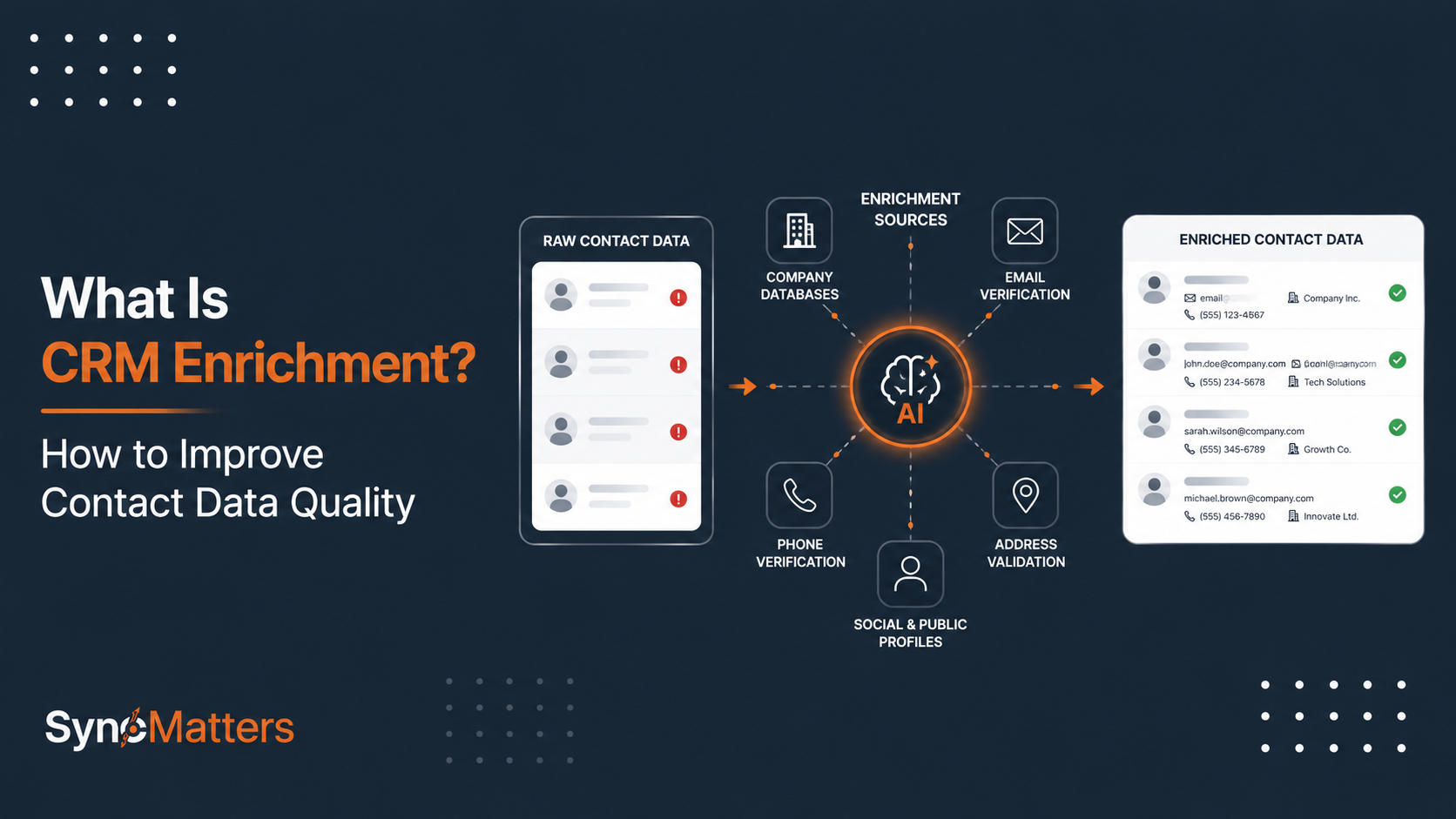
CRM data enrichment is the systematic process of enhancing and augmenting existing customer information in your CRM system with relevant, additional data from external sources. Rather than creating new records from scratch, enrichment adds depth to existing records by filling gaps, updating outdated information, and providing context that enables smarter business decisions.
The Enrichment Definition
At its core, CRM enrichment transforms incomplete or basic contact information into comprehensive customer profiles. If your CRM contains a contact's name and email address, enrichment adds professional context like current job title, company size, industry, relevant experience, technology stack, and purchase intent signals.
Think of it like furnishing a room. Your basic CRM data is the empty room. Enrichment is the furniture, lighting, and decorations that make the space functional and comfortable. Without enrichment, you have structure but limited capability. With enrichment, the same space becomes genuinely useful.
What Enrichment Is Not
It is important to distinguish enrichment from related but different data practices:
Data Cleansing focuses on fixing what is already in your database. It removes duplicates, corrects typos, standardizes formatting, and validates accuracy. Cleansing asks "is our existing data correct?"
Data Enrichment focuses on adding what is missing from your database. It supplements existing records with new information from external sources. Enrichment asks "what additional information would make these records more valuable?"
Both are essential, but they address different challenges. Cleansing prepares data for enrichment by establishing a clean foundation. Enrichment then builds on that foundation by adding valuable context.
How Enrichment Drives Revenue
Enriched data enables revenue-generating activities that incomplete data prevents:
- Smarter lead qualification - Reps quickly identify high-probability prospects based on complete firmographic and behavioral data
- Accurate segmentation - Marketing segments audiences with precision based on detailed customer attributes
- Personalized outreach - Sales and marketing teams reference specific details enabling relevant, timely communication
- Improved conversion - Meaningful conversations grounded in customer context convert at higher rates
- Enhanced customer experience - Support teams have complete context enabling personalized, efficient assistance
- Better forecasting - Accurate opportunity data enables reliable pipeline predictions and strategic planning
Enriched data removes friction from revenue operations by ensuring every team member can access the information needed for their role without spending time hunting for details or making assumptions.
Why CRM Enrichment Matters for Business Growth
Research consistently demonstrates the business impact of enriched customer data across organizations of all sizes.

The Cost of Incomplete Data
Incomplete or inaccurate CRM data carries measurable costs:
- Wasted marketing spend - Campaigns targeting audiences based on incomplete data waste budget reaching wrong prospects
- Lost sales opportunities - Sales teams cannot pursue opportunities when lacking information required to engage effectively
- Reduced productivity - Representatives spend time researching prospects instead of having complete information readily available
- Poor forecasting - Revenue predictions based on incomplete pipeline data prove inaccurate, complicating planning
- Compliance risk - GDPR, CCPA, and other regulations require accurate data; outdated information creates legal exposure
- Customer dissatisfaction - Customers frustrated by repeated requests for information or irrelevant outreach churn faster
The research data is stark: 66 percent of customers expect companies to understand their unique needs, yet 52 percent of organizations struggle to deliver personalized experiences due to incomplete customer data.
Quantifiable Benefits of Enrichment
Organizations implementing CRM enrichment strategies report significant improvements:
| Business Metric | Typical Improvement | Business Impact |
|---|---|---|
| Conversion Rates | 25-35% increase | More revenue from same pipeline |
| Email Engagement | 20-30% increase | Higher open and click rates |
| Sales Productivity | 30-50% improvement | Representatives spend less time researching |
| Lead Quality | 40-50% improvement | Fewer unqualified prospects wasting time |
| Campaign Effectiveness | 25-40% increase | Better targeting and personalization |
| Customer Experience | 15-25% improvement | More relevant, timely interactions |
| Sales Cycle Length | 10-20% reduction | Faster progression through pipeline |
The Difference Between Data Cleansing and Data Enrichment
While both practices are essential for data quality, they serve distinct purposes and require different approaches.
Data Cleansing: Fixing What You Have
Data cleansing focuses on improving the quality of information already in your system:
Cleansing Activities:
- Removing duplicate records
- Correcting spelling errors and typos
- Standardizing formatting (phone numbers, addresses, names)
- Removing invalid or fake data
- Updating obviously outdated information
- Validating email addresses and phone numbers
- Archiving unsubscribed contacts
Cleansing Goal: Ensure the data you have is accurate, complete, and properly formatted
Cleansing Focus: Internal data quality
Data Enrichment: Adding What You Need
Data enrichment focuses on supplementing existing records with additional information:
Enrichment Activities:
- Adding phone numbers to contacts
- Appending job titles and company information
- Including industry classifications
- Adding LinkedIn profile URLs and social profiles
- Appending company size and revenue data
- Adding technology stack information
- Including purchase intent signals
Enrichment Goal: Provide comprehensive customer context enabling smarter decisions
Enrichment Focus: External data integration
Why Both Are Necessary
The relationship between cleansing and enrichment is symbiotic:
- Cleanse first - Establish a clean foundation by removing duplicates and correcting errors
- Enrich second - Build on the clean foundation by adding valuable external data
- Maintain continuously - Prevent decay and keep data current through ongoing management
Organizations attempting enrichment without cleansing first waste resources enriching duplicate records and incorrect data. Organizations attempting cleansing alone never develop the complete customer profiles necessary for modern sales and marketing operations.
Types of Data to Enrich in Your CRM
Different types of enrichment address different business needs. Understanding what data types matter for your organization guides enrichment priorities.

Contact-Level Enrichment
Contact-level enrichment adds information directly about individual people:
Common Contact Enrichments:
- Phone numbers - Direct-dial numbers enabling direct outreach
- Email addresses - Personal or professional email enabling communication
- Job titles - Current role providing context for outreach approach
- Department - Functional area indicating buyer type
- Seniority level - Executive vs. individual contributor affecting decision-making authority
- Social profiles - LinkedIn, Twitter, other platforms providing professional context
- Previous employers - Career history providing relationship insights
- Education - College and degree providing background context
- Certifications - Professional credentials indicating expertise and specialization
- Skills and expertise - Technical or functional skills indicating capabilities
Company-Level Enrichment
Company-level enrichment adds information about organizations:
Common Company Enrichments:
- Company size - Employee count affecting budget and decision-making complexity
- Revenue - Financial performance indicating purchasing power
- Industry classification - Sector enabling vertical targeting
- Location - Geographic information for territory alignment
- Technology stack - Software and platforms companies use
- Company news - Recent announcements, funding, leadership changes
- Growth metrics - Expansion rates indicating growth trajectory
- Website information - Domain data, site traffic, technology
- Social presence - Followers, engagement on LinkedIn, Twitter
- Parent/subsidiary relationships - Corporate structure information
Behavioral and Intent Data
Beyond static firmographic data, behavioral enrichment captures signals of buying intent:
Behavioral Enrichment Types:
- Website behavior - Pages visited, content consumed, time on site
- Email engagement - Opens, clicks, response patterns
- Content interaction - Webinars attended, whitepapers downloaded, guides read
- Search behavior - Keywords researched, topics of interest
- Social engagement - Likes, comments, shares, content preferences
- Purchase signals - Buying patterns, product interest, budget indicators
- Job change - Career moves indicating new roles or opportunities
- Competitive activity - Engagement with competitors' content
The Business Impact of Enriched Customer Data
Enriched data catalyzes improvements across the entire customer lifecycle and organization.
Sales Impact
Sales teams are the primary beneficiaries of enriched customer data:
Lead Qualification Improvements: Enriched data enables reps to quickly identify which prospects fit their ideal customer profile. Rather than guessing based on limited information, reps see company size, industry, technology stack, and intent signals at a glance. This precision lead qualification means reps focus effort on genuinely qualified opportunities with higher conversion probability.
Personalized Outreach: Complete customer information enables conversations grounded in specific context. A rep knowing a prospect recently changed jobs can reference how others successfully transitioned to their solution. A rep understanding a company's technology stack can position compatibility and integration benefits. This specificity dramatically improves response and conversion rates compared to generic outreach.
Faster Sales Cycles: Enriched information removes research burdens from the sales process. Rather than spending time hunting for phone numbers or verifying contact information, reps immediately have the data they need. Sales cycles shorten as a result, with organizations reporting 10-20 percent reductions in time from initial contact to close.
Marketing Impact
Marketing teams leverage enriched data for improved campaign performance:
Better Segmentation: Enriched attributes enable sophisticated audience segmentation. Rather than broad campaigns targeting everyone, marketing creates highly specific segments based on industry, company size, technology usage, and other enriched attributes. Targeted campaigns outperform broad ones by 25-40 percent in engagement and conversion.
Personalized Messaging: Marketing can reference specific company characteristics, recent news, or industry trends when crafting messages. This personalization increases relevance and response. Research shows that personalized campaigns generate 2-5x higher conversion rates than generic campaigns.
Improved ROI: Better targeting and personalization mean marketing spend generates more qualified leads requiring less follow-up. Cost per acquisition decreases while conversion rates increase, improving overall marketing ROI by 25-35 percent.
Customer Success Impact
Even post-sale, enriched data improves customer success operations:
Onboarding Personalization: Customer success teams leverage enriched data to personalize onboarding approaches. Understanding company size, industry, and technology stack helps tailor implementation timelines and resource allocation appropriately. Larger enterprises may need extended implementation; smaller companies may move faster.
Proactive Support: Understanding customers' technology stack and use patterns enables proactive support identifying issues before customers experience them. Enriched data about customer industries enables solution recommendations tailored to vertical-specific best practices.
Expansion Opportunities: Enriched data reveals expansion opportunities as customers' businesses evolve. Identifying customers from growing companies or expanding teams signals readiness for account expansion conversations. Changes in technology stack reveal competitive displacement opportunities.
Step-by-Step CRM Enrichment Process
Effective enrichment follows a structured approach ensuring quality and minimizing disruption.

Step 1: Audit Current Data
Begin by assessing your existing data quality:
Assessment Activities:
- Completeness audit - Identify which required fields are missing from how many records
- Accuracy assessment - Sample records to verify accuracy of existing information
- Timeliness review - Identify how much data is outdated based on last update dates
- Duplicate analysis - Quantify duplicate records that may inflate enrichment targets
- Source analysis - Understand where existing data originated
Key Questions:
- What percentage of records have complete phone numbers?
- How many records lack job titles or company information?
- When was contact information last verified?
- Are there obvious duplicates to address before enrichment?
Step 2: Define Enrichment Priorities
Identify which data types matter most for your business:
Prioritization Factors:
- Business impact - How much does each data type affect revenue operations?
- Feasibility - How readily available is the data from enrichment sources?
- Cost - What does enrichment cost, and what is the expected ROI?
- Use frequency - How often will sales and marketing teams actually use each data type?
Sample Prioritization Matrix:
| Data Type | Business Impact | Availability | Cost | Priority |
|---|---|---|---|---|
| Phone number | High | High | Low | Highest |
| Job title | High | High | Low | Highest |
| Company size | High | High | Low | Highest |
| LinkedIn URL | Medium | High | Low | High |
| Technology stack | Medium | Medium | Medium | High |
| Revenue | Medium | Medium | Medium | Medium |
| Industry news | Low | High | Medium | Medium |
Focus first on high-impact, readily available data types that your teams will actually use.
Step 3: Select Enrichment Sources
Choose data sources appropriate for your enrichment goals:
Commercial Data Providers:
- ZoomInfo - Comprehensive B2B contact and company data
- Clearbit - B2B data enrichment and CDP
- Dun & Bradstreet - Business and company information
- Hunter - Email finder and verification
- RocketReach - Sales intelligence and prospecting
Internal Data Sources:
- Website analytics - Behavioral data and engagement
- Email systems - Engagement history and communication patterns
- Sales notes and activities - Interactions providing additional context
- Previous surveys - Customer-provided information
- Support interactions - Issues and questions indicating needs
Social and Public Data:
- LinkedIn - Professional profiles and company information
- Company websites - Business details and news
- News aggregators - Company announcements and changes
- Industry directories - Vertical-specific information
- Public records - Business registration and location
Step 4: Plan Integration and Workflow
Determine how enrichment data flows into your CRM:
Integration Approaches:
- Batch enrichment - Periodic bulk enrichment of entire database
- Real-time enrichment - Automatic enrichment as new records enter CRM
- On-demand enrichment - Sales and marketing teams trigger enrichment for specific records
- Continuous refresh - Scheduled periodic refresh of key data points
Workflow Considerations:
- How will enrichment data flow into your CRM?
- Who approves enrichment changes?
- How are conflicting data points resolved (existing vs. enriched)?
- What notifications alert teams to enriched data?
- How frequently should enrichment refresh?
Step 5: Execute Enrichment
Implement enrichment according to plan:
Execution Best Practices:
- Start with highest-priority data types
- Test on small batches before full-scale rollout
- Monitor accuracy of enriched data
- Track enrichment source for quality assessment
- Document any manual adjustments or corrections
- Verify that enriched data properly integrates into CRM
Step 6: Validate and Monitor
Ensure enriched data quality:
Validation Activities:
- Sample records to verify enrichment accuracy
- Check that enriched data displays properly in CRM
- Confirm workflows and automations function with new data
- Monitor how sales and marketing teams use enriched data
- Identify and correct any enrichment errors
Ongoing Monitoring:
- Track enrichment source quality over time
- Monitor adoption rates among team members
- Collect feedback on enrichment usefulness
- Identify additional enrichment opportunities
- Refresh data on schedule
Data Sources for Enrichment
The quality and completeness of your enrichment depends on data source selection.
Commercial Data Providers
Dedicated data enrichment platforms offer comprehensive, verified information:
Characteristics:
- Professionally maintained databases with millions of verified contacts
- Advanced matching algorithms connecting your records to authoritative data
- Regular updates keeping information current
- Compliance features supporting GDPR, CCPA, and other regulations
- API integrations enabling seamless CRM integration
Best For:
- Organizations needing comprehensive enrichment at scale
- B2B companies requiring business intelligence
- Companies willing to invest in data quality
Internal Data Sources
Your own systems contain valuable enrichment data:
Valuable Internal Sources:
- Website analytics revealing prospect behavior and interests
- Email systems tracking engagement and communication patterns
- CRM activity histories providing relationship context
- Support tickets indicating issues and needs
- Customer surveys providing preferences and requirements
Advantages:
- Zero cost beyond existing systems
- Directly relevant to your business
- Privacy-compliant since data is already owned
- Can be enriched automatically
Social and Public Sources
Publicly available information provides valuable enrichment:
Social Media Enrichment:
- LinkedIn profiles providing professional information
- Twitter following and engagement indicating interests
- Company social accounts showing organizational activity
Public Information:
- Company websites for business details
- News sources for company announcements
- Industry directories for vertical information
- Business registrations for legal information
Advantages:
- Available at minimal or no cost
- Publicly available for ethical use
- Can be monitored continuously
- Provides timely updates
Hybrid Approaches
Most organizations use combinations of sources:
Complementary Strategy:
- Use commercial providers for core contact and company data
- Supplement with internal data about customer behavior
- Layer in social and public data for timely updates
- Manually research key accounts for strategic information
Real-World Case Studies

Case Study 1: E-Commerce Company Bikester Drives Sales Growth Through Enrichment
Challenge: Bikester, an e-commerce company selling bikes and accessories, had basic customer information but lacked deeper understanding of customer preferences. Their CRM contained purchase history and contact information, but minimal behavioral or lifestyle context. Marketing campaigns targeted broad audiences rather than specific customer segments.
Approach: Bikester implemented comprehensive CRM enrichment adding:
- Customer social media activity and followers
- Biking preferences and riding styles
- Lifestyle habits and activities
- Related purchase interests
- Community engagement patterns
Execution: The company enriched existing customer records by integrating social media data, analyzing purchase patterns for lifestyle indicators, and appending behavioral data from various sources. This created rich customer profiles revealing not just what customers bought, but why they bought it and what other products would interest them.
Results:
- 30 percent increase in email campaign engagement
- 20 percent increase in overall sales within six months
- More effective product recommendations
- Improved customer satisfaction through relevant marketing
- Stronger customer loyalty through personalized engagement
Key Takeaway: Enrichment enabling deep customer understanding drives revenue growth through targeted, personalized engagement that generic campaigns cannot achieve.
Case Study 2: SaaS Startup Optimo Converts Trial Users Through Segmentation
Challenge: Optimo, a SaaS startup offering project management tools, struggled with trial-to-paid conversion rates. They attracted free trial users but lacked context about companies using the trial, making it difficult to tailor onboarding and conversion strategies appropriately.
Approach: Optimo implemented CRM enrichment adding:
- Company size and employee count
- Industry classification
- Technology stack and related tools
- Current business challenges
- Expansion stage and growth trajectory
Execution: As trial users signed up, Optimo automatically enriched their CRM records with company information. This enrichment revealed patterns about which company types and sizes were likely to convert. They identified that larger companies preferred annual plans while smaller startups preferred lower-cost upgrade paths.
Results:
- 35 percent increase in trial-to-paid conversions
- Better-targeted onboarding approaches
- Pricing strategies aligned with customer segments
- Reduced sales cycle time
- Improved customer lifetime value through better-fit matching
Key Takeaway: Enrichment enabling data-driven segmentation transforms generic offerings into targeted approaches that convert at dramatically higher rates.
Case Study 3: B2B Company UrbanCore Transforms Outreach Through Enrichment
Challenge: UrbanCore pulled thousands of contacts from events, referrals, and legacy databases. However, many records contained outdated job titles, missing phone numbers, and abandoned email addresses. Sales representatives heavily relied on email outreach, but open and reply rates continued declining.
Approach: UrbanCore implemented comprehensive contact enrichment:
- Updating job titles and employers based on LinkedIn
- Appending verified direct-dial phone numbers
- Adding LinkedIn profile URLs
- Identifying company expansion signals
- Adding decision-maker identification
Execution: The company enriched all historical contacts and implemented real-time enrichment for new leads. This transformation changed how sales conducted outreach—from email-dependent campaigns to omnichannel strategies combining email, phone, and LinkedIn touches.
Results:
- Higher connect and reply rates across all channels
- More effective phone outreach with verified numbers
- LinkedIn relationship building enabling warmer introductions
- Better targeted outreach to decision-makers
- Improved sales cycle velocity
Key Takeaway: Enrichment enabling omnichannel outreach with verified contact information dramatically improves engagement compared to single-channel approaches dependent on incomplete data.
How SyncMatters Supports CRM Data Enrichment
Clean, integrated data provides the foundation that enrichment builds upon. SyncMatters enables effective CRM enrichment through expert integration and data management services.
Data Quality Foundation for Enrichment
Enrichment is only valuable when applied to clean data. SyncMatters establishes the foundation enrichment requires:
Pre-Enrichment Cleansing:
- Deduplication removing duplicate records before enrichment
- Standardization ensuring consistent data formatting
- Validation confirming existing data accuracy
- Enrichment targeting only records worth enriching
Rather than enriching duplicate or incorrect records, SyncMatters ensures enrichment invests in high-quality data with lasting value.
Integration Enabling Enrichment
As a specialist in CRM integrations, SyncMatters connects your CRM with enrichment data sources:
Integration Capabilities:
- Connection with commercial enrichment providers (ZoomInfo, Clearbit, Hunter)
- Integration with internal data sources and systems
- Automated workflows triggering enrichment on data entry
- Real-time enrichment as new records create
- Batch enrichment processes for existing databases
- Data validation ensuring enriched information accuracy
Integration Benefits:
- Seamless enrichment data flow into your CRM
- Reduced manual data entry and duplicate effort
- Consistent application of enrichment across database
- Real-time updates keeping data current
- Automated workflows responding to enriched data
Custom Integration for Unique Requirements
Every organization has unique enrichment needs. SyncMatters provides custom solutions adapting to specific business requirements:
Customization Examples:
- Enrichment workflows specific to your sales process
- Integration with proprietary internal data sources
- Custom field mapping for unique CRM configurations
- Specialized matching logic for complex deduplication
- Industry-specific enrichment focusing on vertical data
This customization ensures enrichment strategies align with your specific business processes rather than forcing generic approaches.
Migration Supporting Enrichment
When migrating to new CRM platforms, SyncMatters preserves enriched data and enables ongoing enrichment in new systems:
Migration Services:
- Complete enrichment data transfer to new CRM
- Mapping of enriched fields to new system
- Validation confirming enrichment integrity post-migration
- Integration setup enabling ongoing enrichment
- Training on enrichment processes in new platform
As a certified Elite HubSpot partner with experience across 55+ CRM platforms, SyncMatters understands enrichment requirements across different systems and can ensure smooth transitions preserving data value.
Ongoing Support and Optimization
SyncMatters relationships extend beyond initial implementation:
Continuous Optimization:
- Monitoring enrichment data quality over time
- Identifying and correcting enrichment errors
- Updating integrations as platforms evolve
- Expanding enrichment as business needs change
- Strategic guidance on enrichment ROI
This sustained partnership ensures enrichment strategies continue delivering value as organizations grow and mature.
Best Practices for Successful Enrichment
Effective enrichment follows proven patterns that maximize impact while managing costs.
Start with What Matters Most
Not all data enrichment delivers equal value:
High-Value Enrichment:
- Contact phone numbers enabling direct outreach
- Job titles and departments indicating buyer type
- Company size and industry affecting budget and complexity
- Technology stack revealing compatibility and integration opportunities
- Purchase intent signals showing buying probability
Lower-Value Enrichment:
- Data rarely used in operations or reporting
- Information quickly becoming outdated
- Data not affecting sales or marketing decisions
- Supplementary information not essential for core activities
Focus enrichment investment on data your teams will actually use for revenue-generating activities.
Establish Data Governance
Set standards ensuring enrichment quality:
Governance Requirements:
- Define which data types matter for your business
- Establish standards for acceptable accuracy
- Set update frequencies keeping data current
- Create approval processes for bulk changes
- Assign ownership ensuring accountability
- Monitor quality metrics continuously
Strong governance prevents well-intentioned enrichment from introducing bad data.
Ensure Data Privacy and Compliance
Enrichment must respect data protection regulations:
Compliance Considerations:
- GDPR requirements for EU contacts
- CCPA requirements for California residents
- TCPA regulations on contact methods
- Consent management for enriched contact channels
- Data residency requirements for sensitive information
Verify that enrichment sources comply with applicable regulations and that enrichment processes maintain compliance.
Iterate and Improve
Enrichment is not static—continuously refine approaches:
Improvement Process:
- Monitor enrichment accuracy and quality
- Track team adoption and usage
- Collect feedback on usefulness
- Identify additional enrichment opportunities
- Refine data source selections based on quality
- Adjust enrichment priorities as business needs evolve
Regular assessment and iteration optimize enrichment ROI over time.
Automation and AI in CRM Enrichment
Modern enrichment increasingly leverages automation and artificial intelligence.
Automated Enrichment Workflows
Automation removes manual enrichment burden:
Automated Enrichment Capabilities:
- Real-time enrichment as new records create
- Scheduled batch enrichment of existing records
- Triggered enrichment based on specific events
- Conflict resolution determining which data to keep
- Error handling managing enrichment failures gracefully
Automation ensures consistent enrichment application across your entire database without requiring manual intervention.
AI and Machine Learning Enhancement
AI is transforming enrichment capabilities:
AI Applications:
- Intelligent matching connecting your records to authoritative data
- Predictive enrichment anticipating missing information
- Pattern recognition identifying enrichment opportunities
- Natural language processing extracting information from text
- Anomaly detection identifying incorrect enrichment
AI enables more sophisticated enrichment while reducing manual effort required.
Predictive Enrichment and Scoring
Beyond adding information, AI can predict customer attributes and behaviors:
Predictive Capabilities:
- Propensity scoring predicting purchase probability
- Account scoring identifying high-value opportunities
- Churn prediction identifying at-risk customers
- Expansion scoring identifying upsell opportunities
- Intent scoring identifying buyers actively researching solutions
Predictive enrichment goes beyond static information to reveal hidden patterns and future opportunities.
FAQ
What is CRM data enrichment?
CRM data enrichment is the systematic process of enhancing and augmenting existing customer information in your CRM system with relevant, additional data from external sources. Rather than creating new records from scratch, enrichment fills gaps in existing records by adding phone numbers, job titles, company information, industry classifications, social profiles, and other details that provide deeper customer context. Enrichment transforms incomplete contact records into comprehensive customer profiles enabling more effective sales, marketing, and customer success operations.
How is data enrichment different from data cleansing?
Data cleansing and enrichment serve complementary but distinct purposes. Cleansing focuses on improving the quality of data already in your CRM by removing duplicates, correcting errors, standardizing formats, and validating accuracy. Think of cleansing as tidying a room. Enrichment focuses on adding information to existing records from external sources to fill gaps and provide customer context. Think of enrichment as furnishing the room. Both are essential—cleanse first to establish a clean foundation, then enrich to build on that foundation with valuable external data.
What types of data should you enrich in your CRM?
Priority enrichment includes contact phone numbers enabling direct outreach, job titles indicating buyer type, company size and industry affecting budget and complexity, and technology stack revealing compatibility opportunities. Secondary enrichment includes LinkedIn profiles for professional context, company revenue and growth metrics, news and announcements, and behavioral/intent signals. Avoid low-value enrichment of data rarely used in operations. Focus on data types your sales and marketing teams will actually use for revenue-generating activities.
How much does CRM data enrichment cost?
Enrichment costs vary based on approach. Using internal data sources costs minimal additional expense beyond existing systems. Commercial data providers typically charge per contact or per enrichment record, with costs ranging from a few cents to dollars per record depending on data depth. At scale, comprehensive enrichment of large databases may cost hundreds to thousands of dollars. However, enrichment delivers strong ROI—improved conversion rates, shorter sales cycles, and higher productivity typically generate 5-10x return on enrichment investment within 6-12 months.
What are the benefits of enriched customer data?
Enriched data drives measurable business improvements across multiple dimensions. Sales productivity increases 30-50 percent as representatives access complete information without research time. Conversion rates improve 25-35 percent through better lead qualification and personalized outreach. Email engagement increases 20-30 percent through better segmentation. Sales cycles shorten 10-20 percent as information availability removes delays. Customer experience improves 15-25 percent through more relevant, informed interactions. Marketing ROI increases 25-40 percent through better targeting. These improvements compound to drive significant revenue growth.
How often should you enrich your CRM data?
Enrichment timing depends on your data sources and business needs. Real-time enrichment at lead entry is ideal for newly captured contacts. Existing database enrichment typically occurs in batches quarterly or semi-annually. High-decay data like job titles and company information benefit from annual refresh to keep accuracy current. Implement on-demand enrichment enabling sales and marketing to manually refresh key accounts before important outreach. The goal is balancing data freshness with practical enrichment frequency.
What are the best sources for CRM data enrichment?
Commercial data providers like ZoomInfo, Clearbit, and Dun & Bradstreet offer comprehensive, verified B2B data. Internal data sources including website analytics, email systems, and CRM activity provide behavioral context. Social and public sources like LinkedIn and company websites provide cost-effective enrichment. Most effective approaches combine sources—commercial providers for core contact and company data, internal data for behavioral context, and social sources for timely updates. Evaluate each source for accuracy, timeliness, compliance, and cost.
How do you measure enrichment success?
Track metrics demonstrating enrichment impact. Monitor adoption rates showing how many teams use enriched data. Track conversion improvements comparing conversion rates before and after enrichment. Measure sales productivity by time spent researching vs. selling. Calculate enrichment ROI by comparing investment to revenue improvements. Survey team feedback on enrichment usefulness. Monitor data quality assessing accuracy of enriched information. These metrics quantify enrichment value and justify continued investment.
What is the ROI of CRM data enrichment?
Organizations implementing enrichment strategies report strong ROI. Improved conversion rates of 25-35 percent translate directly to revenue increases. Productivity improvements of 30-50 percent reduce cost per sale. Marketing efficiency improvements of 25-40 percent reduce customer acquisition cost. Reduced sales cycle time accelerates revenue. When calculated comprehensively, enrichment typically delivers 5-10x return on investment within 12 months. For example, enriching 10,000 records at one dollar per record costs 10,000 dollars. If enrichment improves conversion by 25 percent and each conversion generates 2,000 dollars revenue, enrichment generates 500,000 dollars in incremental annual revenue—50x return.
Can enrichment improve email deliverability?
Yes, enriched data directly improves email performance. Verified email addresses from professional enrichment sources deliver at higher rates than unverified addresses. Clean, deduplicated contact lists prevent duplicate sends harming sender reputation. Accurate contact information enables better segmentation and personalization, improving engagement metrics that affect deliverability. Enriched data eliminating invalid or outdated addresses prevents bounces damaging sender score. Organizations implementing comprehensive enrichment typically see 20-30 percent improvements in email open rates and reduced bounce rates.
How does enrichment enable personalization?
Enriched data provides the context personalization requires. With complete job title and department information, sales can tailor messaging to specific buyer roles. Understanding company size informs appropriate conversation scale. Industry enrichment enables vertical-specific solution positioning. Technology stack information reveals integration opportunities. Purchase intent signals enable timely, relevant outreach. Behavioral data shows content preferences and interests. This comprehensive context enables truly personalized communication that generic campaigns cannot achieve, dramatically improving response and conversion.
What are common enrichment implementation mistakes?
Common mistakes include enriching data without first cleansing it, creating duplicate enrichment of duplicate records. Enriching low-value data types that teams rarely use wastes resources. Failing to plan integration before enrichment creates manual data entry burden. Not validating enrichment accuracy introduces bad data undermining credibility. Enriching without governance leads to inconsistent, low-quality results. Neglecting team training on enriched data under-utilizes the investment. Implementing enrichment without monitoring quality allows degradation over time. Avoid these mistakes through proper planning, validation, governance, training, and ongoing management.



.svg)