Table of Contents
- Introduction
- Understanding CRM: The Foundation of Customer Success
- The Three Types of CRM Explained
- Type 1: Operational CRM – Streamlining Daily Processes
- Type 2: Analytical CRM – Turning Data into Strategy
- Type 3: Collaborative CRM – Breaking Down Silos
- Comparing the Three CRM Types
- Real-World Examples and Case Studies
- How SyncMatters Supports All Three CRM Types
- Choosing the Right CRM Type for Your Business
- Implementing a Multi-Type CRM Strategy
- The Future: Hybrid CRM Systems
- FAQ
Introduction
Customer relationship management has evolved from simple contact databases into sophisticated systems that power every aspect of business growth. Yet many organizations struggle to maximize their CRM investments because they do not understand the fundamental differences between CRM types and how each addresses specific business challenges.
The global CRM market exceeded 88 billion dollars in 2025, with organizations reporting average returns of 9.50 dollars for every dollar invested. These impressive figures reflect CRM's transformation into an essential business platform. However, not all CRM systems serve the same purpose. Understanding the three main CRM types—operational, analytical, and collaborative—is critical for making informed technology decisions that align with your business objectives.
Growing businesses face a common dilemma: which CRM capabilities should we prioritize? Should we focus on automating daily tasks, extracting strategic insights from customer data, or improving coordination between departments? The answer is not choosing one over the others, but understanding how each type contributes to comprehensive customer management. This guide explores all three CRM types, clarifies their distinct value propositions, and provides actionable guidance for building an effective CRM strategy.
Understanding CRM: The Foundation of Customer Success
Customer Relationship Management (CRM) encompasses the strategies, processes, and technologies organizations use to manage customer interactions throughout the entire lifecycle. From initial awareness through purchase, service, and retention, CRM provides the infrastructure for building and maintaining profitable customer relationships.
Why CRM Matters for Growing Businesses
Growing businesses face unique challenges that CRM addresses directly:
- Scaling without chaos - Manual processes that work for ten customers break down at one hundred or one thousand
- Maintaining consistency - As teams grow, ensuring every customer receives the same quality experience becomes increasingly difficult
- Capturing institutional knowledge - When customer information lives in individual email inboxes and spreadsheets, employee departures create knowledge gaps
- Making data-driven decisions - Intuition suffices in early stages, but sustainable growth requires understanding what actually drives results
- Coordinating across functions - Sales, marketing, and service must work together rather than operate in isolated silos
CRM systems address these challenges by centralizing customer information, standardizing processes, enabling collaboration, and providing visibility into performance metrics.
The Three Pillars of Modern CRM
Modern CRM strategy rests on three foundational pillars, each represented by a distinct CRM type:
- Operational Excellence - Automating and optimizing customer-facing processes to improve efficiency and consistency
- Strategic Intelligence - Analyzing customer data to uncover patterns, predict behaviors, and inform strategic decisions
- Cross-Functional Collaboration - Ensuring all teams access the same customer information and coordinate their efforts
These three pillars are not competing priorities but complementary capabilities that together create comprehensive customer management infrastructure. Understanding each pillar's purpose helps organizations build CRM strategies that address immediate needs while supporting long-term growth.
The Three Types of CRM Explained

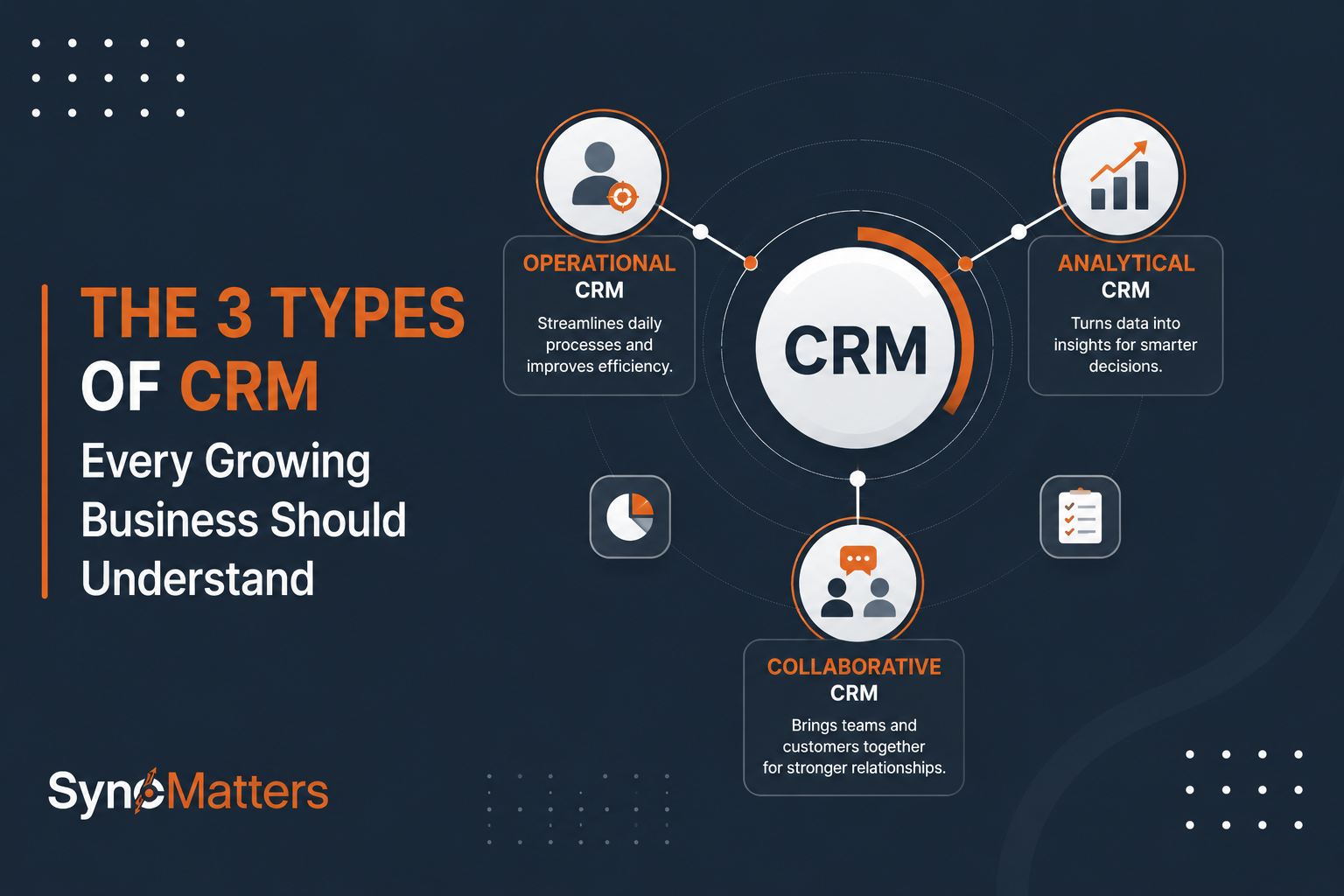
Customer relationship management systems fall into three main categories, each designed to address specific organizational needs:
| CRM Type | Primary Focus | Key Objective | Best For |
|---|---|---|---|
| Operational CRM | Process automation | Streamline daily customer interactions | Improving efficiency and productivity |
| Analytical CRM | Data insights | Transform data into strategic intelligence | Making data-driven decisions |
| Collaborative CRM | Information sharing | Enable cross-team coordination | Breaking down departmental silos |
How the Three Types Work Together
While these three CRM types serve distinct purposes, they function most effectively when integrated into a cohesive strategy:
- Operational CRM executes customer interactions and captures data about every touchpoint
- Analytical CRM processes this data to identify patterns, trends, and optimization opportunities
- Collaborative CRM ensures insights and information flow seamlessly between departments
- Strategic insights from analytical CRM inform operational process improvements
- Coordinated efforts through collaborative CRM enhance both operational efficiency and analytical accuracy
Think of operational CRM as the hands executing daily tasks, analytical CRM as the brain processing information and making strategic decisions, and collaborative CRM as the nervous system ensuring all parts communicate effectively.
Evolution of CRM Systems
Early CRM systems focused almost exclusively on operational capabilities—contact management, basic sales tracking, and simple marketing automation. As data volumes grew and analytics capabilities matured, analytical CRM emerged to extract strategic value from accumulated customer information. Collaborative CRM developed in response to organizational silos that prevented effective coordination across departments.
Today's leading CRM platforms increasingly incorporate all three types rather than forcing organizations to choose one approach. Salesforce, HubSpot, Microsoft Dynamics, and other comprehensive platforms offer operational automation, analytical capabilities, and collaborative features within unified systems. However, understanding each type's distinct purpose remains essential for effective implementation and use.
Type 1: Operational CRM – Streamlining Daily Processes
Operational CRM focuses on automating and optimizing the customer-facing processes that drive daily business operations. This CRM type serves as the operational backbone for sales, marketing, and customer service teams, handling the mechanics of customer acquisition, conversion, and retention.
Core Purpose and Objectives
Operational CRM answers fundamental questions about execution:
- How do we capture and qualify leads efficiently?
- How do we manage sales opportunities through the pipeline?
- How do we execute marketing campaigns at scale?
- How do we handle customer service requests consistently?
- How do we automate repetitive tasks that consume team bandwidth?
The primary goal is efficiency through process standardization and task automation, freeing teams to focus on activities requiring human judgment and creativity.
Key Features of Operational CRM
Operational CRM systems provide three main functional areas:
Sales Automation:
- Lead capture from multiple sources (web forms, trade shows, referrals)
- Automated lead qualification and scoring
- Contact and account management with complete interaction histories
- Opportunity tracking through defined pipeline stages
- Quote and proposal generation with approval workflows
- Activity tracking and automated follow-up reminders
- Territory and quota management
- Sales forecasting based on pipeline data
Marketing Automation:
- Multi-channel campaign planning and execution
- Email marketing with segmentation and personalization
- Landing page and form creation for lead capture
- Lead nurturing through automated drip campaigns
- Marketing performance tracking and ROI measurement
- Social media integration and management
- Event management and webinar integration
Service Automation:
- Case and ticket management from submission through resolution
- Omnichannel support across phone, email, chat, and social media
- Knowledge base creation and self-service portal management
- Service level agreement (SLA) monitoring and escalation
- Customer communication tracking and history
- Field service management and scheduling
Benefits for Growing Businesses
Organizations implementing operational CRM realize significant measurable benefits:
- 25-30% increase in sales productivity - Automation eliminates time-consuming administrative tasks
- 20-35% improvement in marketing conversion rates - Targeted campaigns and automated nurturing improve results
- 30% enhancement in customer satisfaction - Consistent, efficient service resolves issues faster
- 40-50% reduction in process errors - Standardized workflows ensure consistency
- Faster sales cycles - Streamlined processes typically reduce cycle time by 8-14 days
When Operational CRM Is Essential
Prioritize operational CRM when your organization experiences:
- Sales representatives spending more time on administration than selling
- Leads falling through the cracks due to inconsistent follow-up
- Inability to execute sophisticated marketing campaigns due to manual limitations
- Inconsistent customer service quality across representatives or channels
- Lack of visibility into sales pipeline and forecast accuracy
- Manual processes that cannot support planned growth or expansion
Operational CRM provides the foundation for scaling customer-facing operations without proportionally increasing headcount.
Type 2: Analytical CRM – Turning Data into Strategy
Analytical CRM represents the strategic intelligence layer of customer relationship management. While operational systems handle daily execution, analytical CRM extracts meaning from the data those interactions generate, transforming raw information into actionable strategic insights.
Core Purpose and Objectives
Analytical CRM addresses strategic questions that guide business direction:
- Which marketing channels and campaigns generate the highest quality leads?
- What customer characteristics predict high lifetime value or churn risk?
- Which products or services should we prioritize for development?
- How do purchasing patterns vary by segment, season, or demographic?
- What factors influence customer satisfaction and loyalty?
- Where should we allocate resources for maximum impact?
The emphasis is strategic insight rather than operational execution, informing decisions about resource allocation, product development, marketing investment, and customer experience priorities.
Key Features of Analytical CRM
Analytical CRM systems provide several sophisticated capabilities:
Data Mining and Pattern Recognition:
- Discovering hidden correlations in customer behavior and preferences
- Identifying cross-sell and upsell opportunities based on purchase patterns
- Detecting trends and anomalies that warrant attention
- Recognizing seasonal variations and cyclical patterns
- Finding characteristics that predict customer value or risk
Predictive Analytics:
- Forecasting customer behavior and future purchases
- Scoring leads based on conversion probability
- Predicting churn risk for proactive retention efforts
- Estimating customer lifetime value for prioritization
- Forecasting revenue based on pipeline and historical trends
Customer Segmentation:
- Grouping customers by demographics, behavior, value, or lifecycle stage
- Creating targeted segments for personalized marketing campaigns
- Identifying high-value customer characteristics for acquisition targeting
- Analyzing segment-specific purchasing patterns and preferences
- Developing personas based on actual behavioral data
Performance Measurement and Reporting:
- Tracking key performance indicators across all functions
- Analyzing marketing ROI and channel effectiveness
- Measuring sales productivity and conversion rates
- Monitoring customer satisfaction, retention, and lifetime value metrics
- Creating executive dashboards for strategic visibility
- Conducting cohort analysis to understand trends over time
Benefits for Strategic Decision-Making
Organizations leveraging analytical CRM capabilities gain significant advantages:
- 21-30% revenue growth - Data-driven strategies consistently outperform intuition-based approaches
- 42% improvement in forecast accuracy - Predictive analytics provide more reliable projections
- 36% higher customer retention - Churn prediction enables proactive intervention
- Optimized marketing spend - Channel and campaign analytics identify highest-performing investments
- Better product decisions - Customer insights inform development priorities
When Analytical CRM Is Essential
Prioritize analytical CRM when your organization needs:
- Strategic insights to guide resource allocation and investment decisions
- Understanding of which marketing efforts actually drive revenue
- Ability to predict customer churn before it occurs
- Customer segmentation for targeted, personalized experiences
- Competitive intelligence about market trends and customer preferences
- Data-driven justification for strategic initiatives and budget requests
Analytical CRM delivers maximum value for organizations with mature operational processes generating substantial customer data that remains underutilized for strategic purposes.
Type 3: Collaborative CRM – Breaking Down Silos
Collaborative CRM focuses on enabling seamless information sharing and coordination across all customer-facing departments. While operational CRM optimizes individual processes and analytical CRM generates strategic insights, collaborative CRM ensures everyone operates from the same information foundation.
Core Purpose and Objectives
Collaborative CRM addresses coordination challenges that fragment customer experiences:
- How do we ensure sales, marketing, and service access the same customer information?
- How do we prevent customers from repeating information to different departments?
- How do we coordinate activities when customer relationships span multiple teams?
- How do we share insights and learnings across organizational boundaries?
- How do we create unified customer experiences despite functional specialization?
The primary goal is breaking down departmental silos that cause disconnected customer experiences and operational inefficiencies.
Key Features of Collaborative CRM
Collaborative CRM systems provide several essential capabilities:
Unified Customer Records:
- Single, comprehensive customer profile accessible across all departments
- Complete interaction history from sales, marketing, and service touchpoints
- Real-time synchronization ensuring everyone sees current information
- Shared notes and communication logs visible to appropriate team members
- Document repositories for proposals, contracts, and reference materials
Communication and Interaction Management:
- Centralized email, call, meeting, and chat history
- Shared calendars for coordination and scheduling
- Internal messaging about specific accounts or opportunities
- Activity feeds showing recent developments and actions
- Notification systems alerting teams to important events or updates
Cross-Functional Workflow Automation:
- Automated handoffs when leads transition from marketing to sales
- Escalation workflows when service issues require management attention
- Approval processes spanning multiple departments
- Task assignments ensuring clear accountability across teams
- Status updates visible to all stakeholders
Document and Knowledge Sharing:
- Centralized document libraries accessible across departments
- Version control preventing confusion about current documents
- Templates and best practices available to all team members
- Case studies and success stories for sales enablement
- Knowledge bases supporting both internal teams and customers
Benefits of Breaking Down Silos
Organizations implementing collaborative CRM realize significant improvements:
- 20-30% revenue growth - Aligned teams achieve better results than siloed departments
- 36% higher customer retention - Coordinated engagement strengthens relationships
- Improved customer satisfaction - Seamless experiences across touchpoints reduce frustration
- Faster issue resolution - Shared information eliminates time wasted gathering context
- Reduced internal friction - Transparency prevents finger-pointing and blame
When Collaborative CRM Is Essential
Prioritize collaborative CRM when your organization experiences:
- Customers complaining about having to repeat information to different departments
- Sales and marketing teams misaligned on lead quality and follow-up expectations
- Service teams lacking visibility into sales context when customers have issues
- Account managers unaware of marketing campaigns reaching their customers
- Multiple teams contacting the same customer without coordination
- Information silos preventing effective handoffs between departments
Collaborative CRM is particularly valuable as organizations grow beyond the size where informal communication suffices for coordination.
Comparing the Three CRM Types

Understanding how the three CRM types differ helps organizations make informed investment decisions and build comprehensive strategies.
Side-by-Side Comparison
| Feature | Operational CRM | Analytical CRM | Collaborative CRM |
|---|---|---|---|
| Primary Users | Sales reps, marketers, service agents | Managers, executives, analysts | All customer-facing teams |
| Time Horizon | Real-time, immediate | Strategic, long-term | Ongoing coordination |
| Main Question | How do we execute? | What should we do? | How do we coordinate? |
| Key Metrics | Productivity, efficiency, response time | Trends, predictions, ROI | Alignment, visibility, satisfaction |
| Data Flow | Operational execution generates data | Processes data into insights | Shares data across functions |
| Success Indicator | Faster processes, higher output | Better decisions, improved forecasts | Seamless experiences, team alignment |
| Investment Priority | Early-stage growth, scaling operations | Mature operations with rich data | Multi-team organizations |
Complementary Relationships
The three CRM types work together in a continuous cycle:
- Operational CRM executes customer interactions and captures behavioral data
- Analytical CRM processes this data to identify patterns and generate strategic insights
- Collaborative CRM ensures insights flow to all relevant teams
- Strategic insights inform operational process improvements and marketing strategies
- Improved processes generate better data, creating a virtuous cycle
This complementary relationship means organizations ultimately benefit from all three types rather than choosing one approach exclusively.
Common Misconceptions
Several misconceptions about CRM types create confusion:
Misconception: "We must choose one type." Reality: Modern platforms increasingly incorporate all three types. The question is which capabilities to prioritize first based on current needs.
Misconception: "Analytical CRM is only for large enterprises." Reality: Growing businesses benefit from analytical insights even with modest data volumes. Cloud-based platforms make analytics accessible at all scales.
Misconception: "Operational CRM alone is sufficient." Reality: Operational efficiency without strategic insight leads to optimizing the wrong processes. Analytics ensure operational improvements target the right objectives.
Misconception: "Collaborative features are just nice-to-have." Reality: Customer experience depends heavily on coordination. Silos create friction that directly impacts satisfaction and retention.
Real-World Examples and Case Studies
Amazon: Mastering All Three CRM Types
Amazon exemplifies how the three CRM types work together to create exceptional customer experiences and drive business growth. The e-commerce giant's sophisticated approach demonstrates the power of integrated CRM strategy.
Operational CRM Excellence: Amazon's operational systems handle millions of daily transactions with remarkable efficiency. One-click ordering, streamlined checkout processes, and automated order tracking represent operational CRM at scale. The company's sophisticated warehouse automation and delivery logistics integrate seamlessly with customer-facing CRM systems.
Analytical CRM Leadership: Amazon's analytical capabilities drove over 38 percent of 2025 revenue from personalized recommendations. The recommendation engine analyzes billions of data points including browsing history, purchase patterns, wish list items, and even cursor movements to predict customer needs. Predictive analytics optimize inventory placement, forecast demand, and personalize every aspect of the shopping experience.
Collaborative CRM Integration: Amazon ensures seamless experiences across all touchpoints. Customer service representatives access complete purchase histories instantly. Marketing campaigns coordinate with order status and browsing behavior. The company's ecosystem—from Alexa voice interactions to Prime Video viewing habits—feeds into a unified customer understanding that informs all interactions.
Key Takeaway: Amazon's success demonstrates that the three CRM types are not alternatives but integrated capabilities that compound each other's value.
Spotify: Using Analytics to Drive Personalization
Spotify's CRM strategy showcases analytical CRM's power to create personalized experiences that build loyalty and reduce churn.
Analytical CRM Foundation: Spotify's personalization engine drove 34 percent of all listening hours by end of 2025, up from 31 percent in 2024. The platform analyzes listening patterns, skip behavior, playlist creation, and social connections to understand musical preferences at an individual level. Machine learning algorithms process billions of data points to predict what users want to hear next.
Operational and Collaborative Support: These analytical insights feed directly into operational systems that deliver personalized playlists like Discover Weekly and Release Radar automatically. Collaborative features share data across content licensing, artist relations, and product development teams, ensuring the entire organization leverages customer insights.
Measurable Impact: Spotify's analytical approach reduced churn rates by 18 percent. The annual "Wrapped" campaign, showcasing personalized listening statistics, generated over 425 million social shares, demonstrating how analytics can drive viral engagement.
Key Takeaway: Analytical CRM is not just about internal reporting—it powers customer-facing experiences that differentiate brands and build emotional connections.
Salesforce: Collaborative CRM Enabling Growth
Salesforce's internal use of its own platform demonstrates how collaborative CRM drives sales performance and customer success.
Collaborative Foundation: Salesforce's internal sales teams leverage collaborative features to coordinate complex enterprise deals involving multiple stakeholders. Shared opportunity records, collaborative forecasting, and integrated communication tools ensure everyone stays aligned throughout lengthy sales cycles.
Integration with Other Types: AI-powered lead scoring (analytical CRM) feeds into collaborative workflows, ensuring the right teams prioritize the right opportunities. Automated processes (operational CRM) handle routine tasks while collaborative features facilitate human coordination on complex decisions.
Performance Results: Salesforce reports 30 percent faster deal cycles and 40 percent improvement in forecast accuracy using their own AI-powered CRM capabilities. Customer success teams resolve cases 25 percent faster using integrated communication tools that provide complete customer context.
Key Takeaway: Collaborative CRM is not just about storing information—it actively facilitates coordination that accelerates results and improves outcomes.
How SyncMatters Supports All Three CRM Types
Effective CRM strategy requires clean, integrated data flowing seamlessly between all business systems. This fundamental requirement is where SyncMatters delivers exceptional value across all three CRM types. As a specialized CRM integration and migration partner, SyncMatters ensures your operational, analytical, and collaborative capabilities function on a solid data foundation.
Enabling Operational CRM Through Integration
Operational CRM effectiveness depends on real-time data flow between customer-facing systems. SyncMatters connects over 55 CRM platforms with the operational tools teams use daily:
Sales Tool Integration:
- Email platforms ensuring all correspondence logs automatically
- Calendar systems synchronizing meetings and availability
- Phone systems enabling click-to-call with automatic activity tracking
- Proposal and e-signature platforms streamlining deal closure
- Mobile applications providing field access to complete customer data
Marketing Automation Connections:
- Marketing platforms (HubSpot, Marketo, Pardot) syncing campaign data and lead information
- Email marketing systems tracking engagement and conversions
- Webinar and event platforms capturing attendee information
- Social media tools monitoring engagement and sentiment
- Analytics platforms measuring performance across channels
Service Platform Integration:
- Support ticket systems (Zendesk, Freshdesk) providing service history
- Live chat platforms capturing real-time conversations
- Knowledge base software supporting self-service
- Customer feedback tools gathering satisfaction data
- Communication platforms unifying phone, email, and messaging
This comprehensive integration ensures operational CRM systems have complete information from every customer touchpoint, enabling the automation and efficiency that makes operational CRM valuable.
Supporting Analytical CRM Through Data Quality
Analytical CRM requires clean, accurate, complete data to generate reliable insights. SyncMatters addresses data quality challenges that undermine analytical accuracy:
Data Consolidation:
- Aggregating customer information from disparate systems into unified records
- Resolving duplicate records that skew analysis
- Standardizing data formats across platforms
- Filling gaps in customer information through intelligent data enrichment
- Creating comprehensive customer timelines from multiple sources
Real-Time Synchronization:
- Ensuring analytical systems process current information rather than stale data
- Eliminating delays between operational execution and analytical processing
- Supporting real-time dashboards and reporting
- Enabling immediate response to emerging trends or issues
Historical Data Preservation:
- Maintaining complete customer histories essential for trend analysis
- Preserving interaction timelines during system migrations
- Ensuring longitudinal analysis capabilities for cohort studies
- Supporting sophisticated predictive models requiring extensive historical context
Clean, integrated data transforms analytical CRM from theoretical capability into practical strategic advantage.
Facilitating Collaborative CRM Through Unified Systems
Collaborative CRM depends entirely on information accessibility across departments. SyncMatters breaks down data silos that prevent effective collaboration:
Cross-Platform Visibility:
- Ensuring sales, marketing, and service teams access the same customer information
- Synchronizing updates instantly across all connected systems
- Eliminating "whose data is right" confusion through single source of truth
- Providing appropriate access based on role and responsibility
Workflow Integration:
- Automating handoffs between departments with complete context transfer
- Triggering notifications and tasks across systems
- Maintaining audit trails visible to all stakeholders
- Supporting approval workflows spanning multiple platforms
Communication Unification:
- Centralizing email, call, meeting, and chat histories
- Making customer interactions visible across functional boundaries
- Preserving context during team transitions
- Enabling informed, coordinated customer engagement
Expert Migration Services
Organizations hesitating to upgrade CRM capabilities often cite migration complexity as a barrier. SyncMatters specializes in migrations that maintain the data integrity essential for all three CRM types:
- Operational continuity - Teams maintain productivity during transitions
- Analytical accuracy - Complete historical data transfers for trend analysis
- Collaborative context - Interaction histories preserve institutional knowledge
As a certified Elite HubSpot partner with extensive multi-platform experience, SyncMatters brings proven expertise to migration projects of any complexity. Client testimonials consistently highlight accuracy and efficiency, with one noting that while they initially considered internal migration, calculating opportunity costs made partnering with specialists the clear choice.
Ongoing Optimization
SyncMatters relationships extend beyond initial implementation. The company provides ongoing support ensuring integrations continue performing optimally as CRM strategies evolve:
- Proactive monitoring identifying potential issues before they impact operations
- Adaptation as organizations add new systems or capabilities
- Performance optimization ensuring integrations scale with growth
- Strategic guidance on leveraging integrations for maximum value
This sustained partnership helps organizations maximize CRM investments across operational, analytical, and collaborative dimensions.
Choosing the Right CRM Type for Your Business
Determining which CRM type to prioritize depends on several factors including business stage, current challenges, and strategic objectives.
Assessment Framework
Evaluate your CRM needs across four dimensions:
1. Current Pain Points
Identify your most pressing challenges:
- Process inefficiency → Operational CRM priority
- Lack of strategic insight → Analytical CRM priority
- Departmental silos → Collaborative CRM priority
- Multiple pain points → Integrated approach
2. Business Stage
Your growth stage influences CRM priorities:
- Early stage (under 50 employees) - Focus on operational CRM to build process foundation
- Growth stage (50-500 employees) - Add collaborative CRM as coordination complexity increases
- Mature stage (500+ employees) - Leverage analytical CRM for strategic optimization
3. Data Maturity
Assess your data readiness:
- Limited customer data - Operational CRM builds the data foundation
- Substantial data, limited analysis - Analytical CRM extracts strategic value
- Siloed data across departments - Collaborative CRM unifies information
4. Team Structure
Consider organizational complexity:
- Single location, one department - Operational CRM sufficient initially
- Multiple departments or locations - Collaborative CRM increasingly important
- Complex matrix organization - All three types essential
Recommended Phased Approach
Most growing businesses benefit from a phased implementation:
Phase 1: Operational Foundation (Months 1-6)
- Implement core sales, marketing, and service automation
- Standardize processes and build data collection habits
- Achieve user adoption and process compliance
- Establish data quality standards
Phase 2: Collaborative Enhancement (Months 6-12)
- Connect previously isolated systems
- Implement cross-functional workflows and handoffs
- Establish shared visibility and communication practices
- Measure coordination improvements
Phase 3: Analytical Intelligence (Months 12-18)
- Activate advanced reporting and analytics features
- Implement predictive models and customer segmentation
- Train teams on insight interpretation and application
- Create data-driven decision-making culture
This phased approach builds capabilities progressively rather than attempting comprehensive transformation simultaneously.
Quick Decision Guide
Use this guide for rapid assessment:
Choose Operational CRM first if:
- Your team spends excessive time on manual, repetitive tasks
- Lead follow-up is inconsistent or delayed
- You cannot execute sophisticated marketing campaigns
- Sales pipeline visibility is limited or inaccurate
- Customer service quality varies significantly
Choose Analytical CRM first if:
- You have substantial customer data but limited insight into what it means
- Strategic decisions rely primarily on intuition rather than evidence
- You cannot identify which marketing efforts actually drive revenue
- Customer segmentation is rudimentary or non-existent
- You lack predictive capabilities for forecasting and churn
Choose Collaborative CRM first if:
- Customers complain about repeating information to different teams
- Sales and marketing are misaligned on priorities and processes
- Service teams lack context about customer relationships
- Multiple people contact the same customer without coordination
- Information silos prevent effective team coordination
Implementing a Multi-Type CRM Strategy
Most organizations ultimately need capabilities across all three CRM types. Effective implementation requires careful planning and execution.
Integration Requirements
Multi-type CRM strategies depend on comprehensive integration. Work with specialists like SyncMatters to ensure:
- All customer-facing systems connect to the CRM platform
- Data flows bidirectionally between integrated systems
- Real-time synchronization maintains information currency
- Data quality processes prevent degradation
- Security and compliance requirements are met
Partial integration undermines multi-type strategies by creating data gaps and inconsistencies.
Change Management Essentials
Technology alone does not deliver CRM value. Address organizational factors:
Executive Sponsorship:
- Visible leadership support reinforcing CRM importance
- Clear communication about strategic rationale
- Resource allocation demonstrating commitment
- Accountability for adoption and results
Comprehensive Training:
- Role-specific instruction on daily workflows
- Ongoing education as capabilities expand
- Best practice sharing across teams
- Support resources available when needed
Performance Measurement:
- Clear metrics aligned with CRM objectives
- Regular reporting on progress and results
- Recognition of adoption milestones and successes
- Course correction based on performance data
Common Implementation Pitfalls
Avoid these frequent mistakes:
- Over-customization - Excessive customization increases complexity and maintenance burden
- Inadequate testing - Insufficient validation before launch creates adoption-killing problems
- Poor data quality - Garbage in, garbage out applies across all CRM types
- Neglecting mobile - Modern teams need mobile access for field productivity
- Insufficient training - Technology capabilities mean nothing if teams do not use them effectively
- Lack of ongoing optimization - CRM implementation is not one-time project but continuous evolution
Working with experienced partners helps avoid these pitfalls through proven methodologies.
The Future: Hybrid CRM Systems
The boundaries between operational, analytical, and collaborative CRM are increasingly blurring as platforms converge capabilities.
Integrated Platforms
Modern CRM leaders like Salesforce, HubSpot, Microsoft Dynamics, and others offer all three types within unified platforms. This integration delivers several advantages:
- Seamless data flow - No integration required between CRM types
- Unified user experience - Teams work within single interface
- Consistent reporting - Metrics span operational and analytical dimensions
- Lower total cost - Single platform reduces licensing and maintenance costs
- Simplified administration - One system to configure and manage
However, best-of-breed approaches remain viable for organizations with specialized needs that general-purpose platforms do not address adequately.
AI and Automation Convergence
Artificial intelligence is transforming how the three CRM types interact:
- Operational AI - Automating data entry, suggesting next actions, routing intelligently
- Analytical AI - Uncovering patterns humans miss, improving prediction accuracy
- Collaborative AI - Recommending who should be involved, facilitating coordination
AI enables CRM systems to proactively suggest actions rather than passively store information.
The Composable CRM Future
Emerging architectures allow organizations to assemble CRM capabilities from modular components:
- Operational modules for specific workflows
- Analytical engines processing data from any source
- Collaborative layers unifying access across modules
- API-first designs enabling flexible integration
This composability allows organizations to optimize individual components while maintaining integrated experiences.
FAQ
What are the three types of CRM?
The three types of CRM are operational, analytical, and collaborative. Operational CRM automates and streamlines customer-facing processes across sales, marketing, and service. Analytical CRM analyzes customer data to extract strategic insights, predict behaviors, and inform decisions. Collaborative CRM facilitates information sharing and coordination between departments to ensure unified customer experiences. These three types address different organizational needs and work most effectively when integrated into comprehensive CRM strategies.
What is the difference between operational, analytical, and collaborative CRM?
Operational CRM focuses on process execution and automation, handling daily tasks like lead management, campaign execution, and case resolution. Analytical CRM focuses on data analysis and strategic insight, processing customer information to identify patterns and predictions. Collaborative CRM focuses on information sharing and team coordination, ensuring all departments access the same customer data. Operational asks "how do we execute," analytical asks "what should we do strategically," and collaborative asks "how do we coordinate across teams."
Which type of CRM is best for small businesses?
Most small businesses benefit from starting with operational CRM, which provides immediate productivity gains through process automation and standardization. As businesses grow beyond approximately 50 employees and add departments or locations, collaborative CRM becomes increasingly important to prevent silos. Analytical CRM delivers maximum value once operational processes generate substantial customer data requiring strategic interpretation. Many modern platforms offer all three types, allowing small businesses to activate capabilities progressively as needs evolve rather than implementing everything simultaneously.
Do I need all three types of CRM?
Whether you need all three types depends on business stage, size, and complexity. Early-stage companies with simple structures often find operational CRM sufficient initially. As organizations grow, collaborative capabilities become essential for coordination across expanding teams. Analytical capabilities deliver strategic advantage once operational systems generate rich customer data. However, modern integrated CRM platforms increasingly offer all three types, making the question less about choosing one type and more about which capabilities to prioritize first based on current pain points and objectives.
How do operational CRM and analytical CRM work together?
Operational and analytical CRM create a continuous improvement cycle. Operational CRM executes customer interactions and captures behavioral data about every touchpoint. Analytical CRM processes this data to identify patterns, trends, and optimization opportunities. These insights inform strategic decisions about process improvements, resource allocation, and customer targeting. Operational systems then execute these refined strategies, generating new data that analytical systems process. This virtuous cycle continuously improves both operational efficiency and strategic effectiveness when both CRM types integrate properly.
What is an example of collaborative CRM?
Collaborative CRM examples include unified customer records accessible to sales, marketing, and service teams; shared communication histories showing all emails, calls, and meetings regardless of which department managed them; cross-functional workflows that automate lead handoffs from marketing to sales with complete context; and document repositories where all teams access current proposals, contracts, and reference materials. Salesforce's account and opportunity sharing features exemplify collaborative CRM, as do HubSpot's team email and unified inbox capabilities that ensure visibility across functions.
How much does CRM cost for each type?
CRM costs vary significantly based on platform, features, and user count. Operational CRM platforms start around fifteen to twenty-five dollars per user monthly for small businesses, ranging up to several hundred dollars per user for enterprise solutions. Analytical capabilities often come as premium add-ons, adding twenty-five to one hundred dollars per user monthly depending on sophistication. Collaborative features are increasingly included in base platforms rather than priced separately. However, ROI consistently exceeds investment, with organizations reporting 9.50 dollars or more returned for every dollar spent on CRM.
Can you use multiple CRM systems for different types?
While technically possible to use separate systems for operational, analytical, and collaborative needs, this approach creates significant integration challenges. Data must flow seamlessly between systems for each type to function effectively. Operational systems generate data analytical systems need. Analytical insights should inform operational processes. Collaborative capabilities require access to both operational and analytical information. Most organizations find integrated platforms offering all three types deliver better results with lower complexity than best-of-breed multi-system approaches, though specialized needs may justify multiple systems with robust integration.
How long does CRM implementation take for each type?
Implementation timelines vary based on complexity and organizational readiness. Basic operational CRM deployments may complete within weeks for small teams, while comprehensive implementations require two to six months. Analytical CRM activation depends on data quality and typically requires one to three months beyond operational implementation. Collaborative CRM implementation often happens progressively as teams adopt operational capabilities and processes mature. However, benefits emerge gradually throughout implementation rather than waiting for completion. Organizations should expect 13 months average for positive ROI across all CRM types.
What integration does multi-type CRM strategy require?
Effective multi-type CRM strategies require comprehensive integration across the technology stack. Operational CRM needs connections to email, calendar, phone, marketing automation, and service platforms. Analytical CRM requires access to financial systems, e-commerce platforms, and business intelligence tools. Collaborative CRM depends on communication platforms, document management systems, and project management tools. All types benefit from unified data synchronization ensuring information consistency. Organizations should work with integration specialists like SyncMatters to connect entire technology stacks seamlessly, as partial integration creates data gaps undermining CRM effectiveness.
How do you measure success for each CRM type?
Success metrics differ by CRM type. Operational CRM measures focus on efficiency: sales productivity increases, lead response time reductions, conversion rate improvements, and administrative time savings. Analytical CRM metrics emphasize strategic impact: forecast accuracy improvements, customer retention increases, optimized marketing ROI, and data-driven decision quality. Collaborative CRM success shows in coordination outcomes: reduced customer friction from departmental handoffs, improved information visibility scores, faster cross-functional resolution times, and enhanced team satisfaction. Establish baseline measurements before implementation and track improvements across relevant dimensions for each CRM type.
What are the latest trends in CRM types?
CRM types are converging rather than remaining separate categories. Modern platforms increasingly offer operational, analytical, and collaborative capabilities within unified systems. Artificial intelligence is transforming all three types: operational AI automates data entry and suggests actions, analytical AI improves prediction accuracy and uncovers hidden patterns, and collaborative AI recommends team involvement and facilitates coordination. Mobile-first design ensures all CRM types support remote work. Voice interfaces reduce manual data entry burden. API-first architectures enable composable CRM where organizations assemble capabilities from modular components. The future belongs to hybrid systems offering the best of all three types.



.svg)