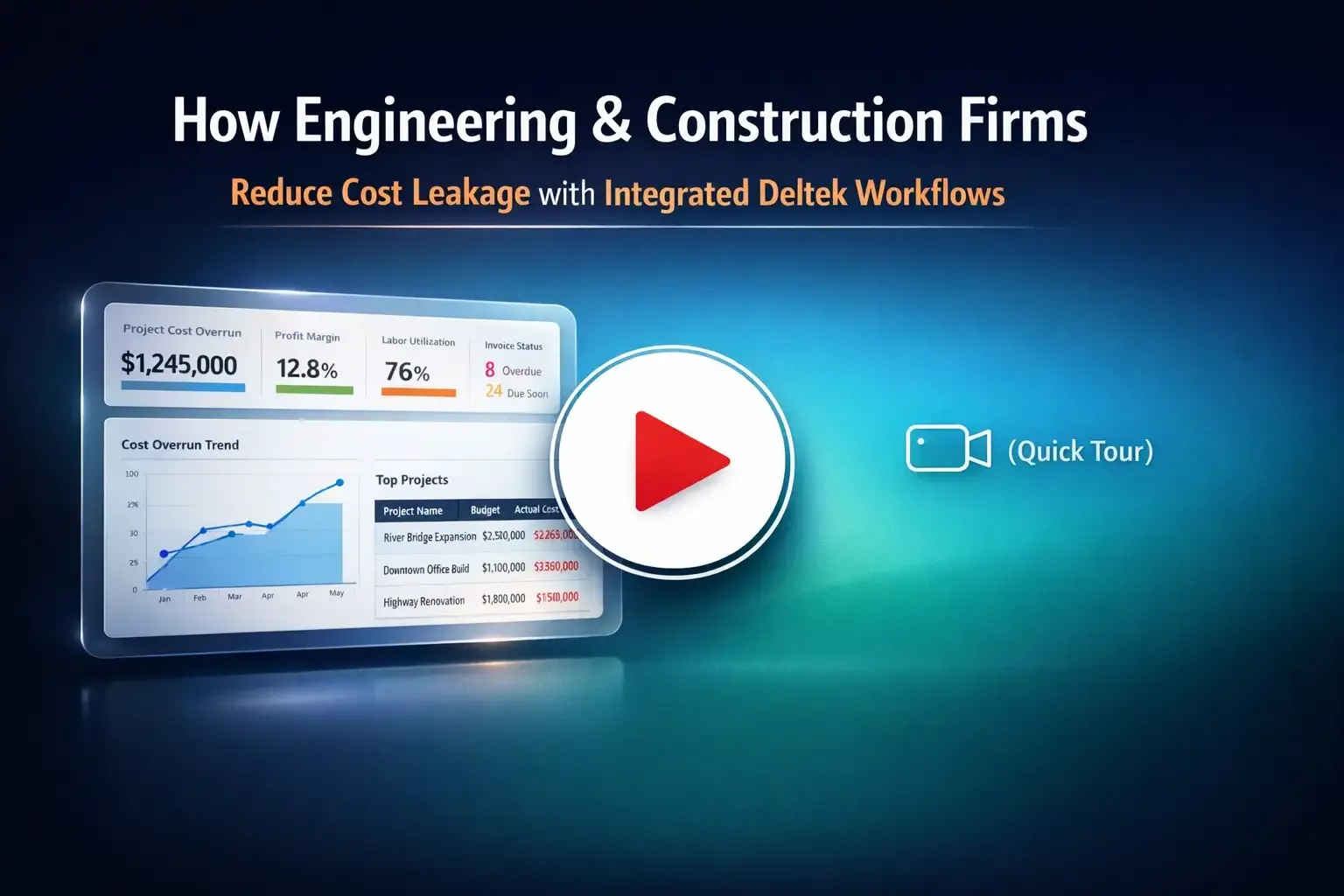
Are your engineering or construction projects quietly bleeding money?
Cost leakage is one of the most dangerous and underestimated threats facing Engineering & Construction (E&C) firms today. Unlike a single catastrophic budget overrun, cost leakage erodes profitability slowly—through disconnected workflows, missed change orders, untracked labor hours, and fragmented data across multiple systems. By the time leadership notices, margins have already shrunk significantly.
On average, businesses lose around 9% of revenue due to contract value leakage—driven by weak terms, inefficient processes, scope creep, poor supplier performance, and missed obligations. For E&C firms operating on already razor-thin margins, that number can be devastating.
Deltek, the industry-standard ERP for project-based businesses, offers powerful tools to combat this problem. But Deltek alone isn't enough. The real gains come when Deltek workflows are fully integrated with CRM, project management, accounting, and field operations systems—creating a seamless, data-driven operation where nothing falls through the cracks.
Let's explore where cost leakage hides, how integrated Deltek workflows eliminate it, and why firms that get this right see transformational improvements in profitability.
Table of Contents
- What Is Cost Leakage in Engineering & Construction?
- The 8 Most Common Sources of Cost Leakage
- Why Disconnected Systems Fuel Cost Leakage
- Deltek's Role in the E&C Technology Stack
- The Deltek Product Suite: Which Solution Fits Your Firm?
- How Integrated Deltek Workflows Eliminate Cost Leakage
- Integration Architecture: Connecting Deltek to Your Full Tech Stack
- Cost Leakage Prevention: Before and After Integration
- Real-World Results: E&C Firms That Stopped the Bleed
- Building the Business Case for Deltek Integration
- Common Mistakes to Avoid
- How SyncMatters Helps E&C Firms Maximize Deltek
- Conclusion: Integrated Workflows Are the Answer
What Is Cost Leakage in Engineering & Construction?
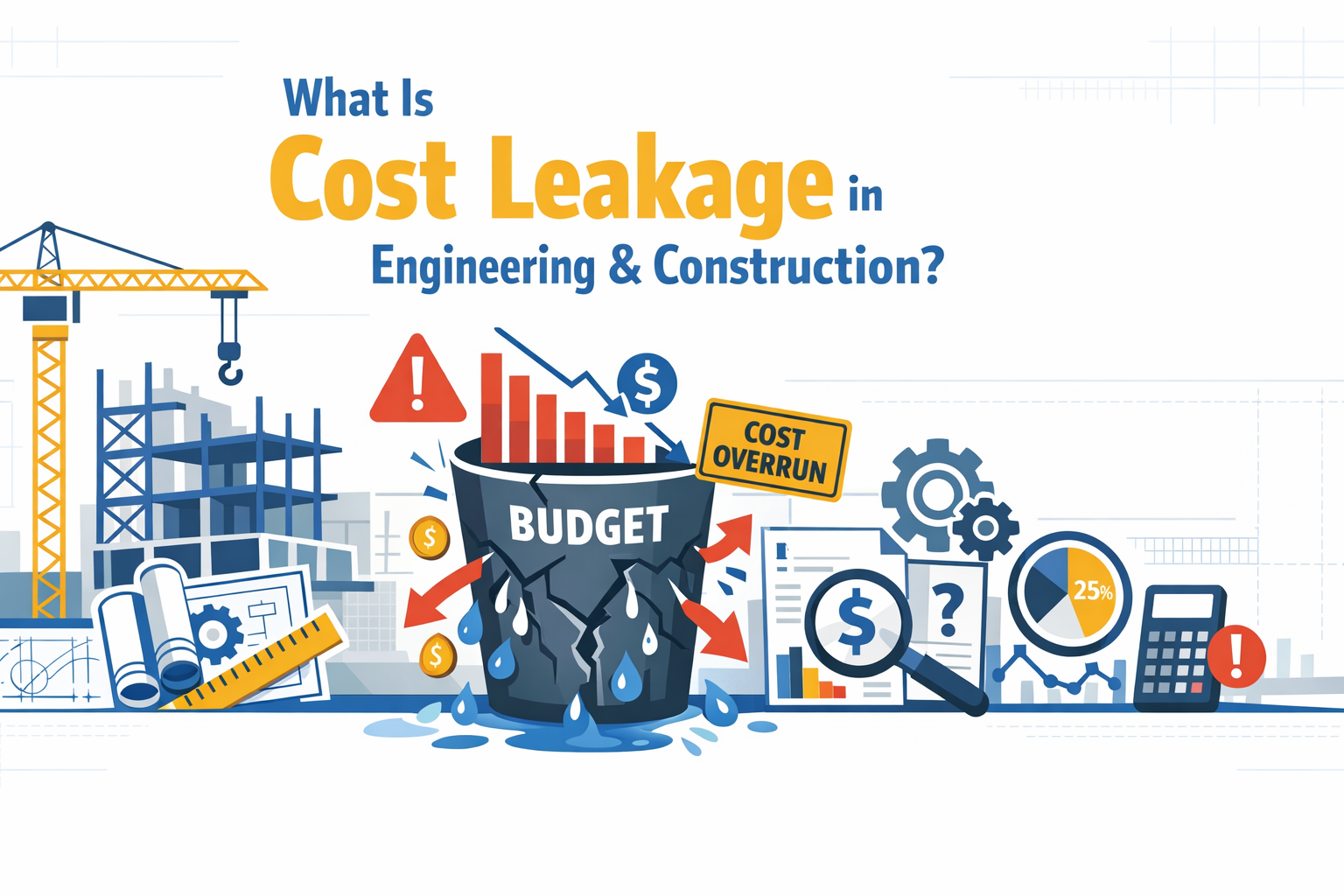
Cost leakage refers to the gradual, often unnoticed loss of revenue or unnecessary expenditure that erodes project profitability over time. Unlike a single budget overrun event, cost leakage is systemic—it's caused by broken processes, disconnected data, manual workarounds, and lack of visibility across the project lifecycle.
In E&C, cost leakage manifests across every phase of a project:
| Project Phase | Common Leakage Points | Impact |
|---|---|---|
| Pursuit & Bidding | Inaccurate cost estimations, missed indirect costs, underpriced proposals | Winning unprofitable work |
| Planning & Design | Scope gaps, incomplete budgets, missing contingencies | Budget shortfalls during execution |
| Procurement | Untracked vendor pricing changes, missed volume discounts, maverick buying | Overpayment on materials and services |
| Execution | Untracked labor hours, unapproved overtime, duplicate invoicing | Inflated project costs |
| Change Management | Unlogged change orders, unapproved scope changes, delayed pricing updates | Unrecovered costs or client disputes |
| Invoicing & Billing | Missed billable hours, incorrect rate calculations, delayed collections | Lost revenue and cash flow issues |
| Closeout | Unreconciled budgets, missed retainage collection, undocumented final costs | Revenue left on the table |
Errors in pricing strategies or billing processes can lead to revenue loss and cost leakage. This may involve underpricing products or services, miscalculations in billing, or failure to account for all relevant costs.
Why Cost Leakage Is Especially Dangerous for E&C Firms
E&C firms typically operate on project margins of 3-8%. A 9% revenue loss from cost leakage doesn't just eliminate profit—it pushes firms into the red. The stakes are compounded by:
- High project complexity: Hundreds of line items, multiple subcontractors, and long timelines create countless opportunities for data to slip through cracks.
- Distributed workforces: Field crews, subcontractors, and office staff working from different locations and systems make centralized tracking challenging.
- Regulatory requirements: Compliance demands create documentation overhead that, when managed poorly, becomes another source of inefficiency and cost.
- Client expectations: Clients demand transparent, accurate reporting. Firms that can't deliver risk losing future work and face contract disputes.
The 8 Most Common Sources of Cost Leakage
Understanding where money disappears is the first step toward stopping it. Here are the eight most prevalent cost leakage sources identified across E&C firms:
1. Untracked or Unapproved Labor Costs
Labor typically represents 30-50% of total project cost in E&C. When time tracking is manual, inconsistent, or disconnected from project budgets, firms routinely lose visibility into actual labor spend.
How it leaks:
- Field crews logging hours on paper that never enters the system
- Overtime worked but not captured against the correct project code
- Labor allocated to the wrong project or phase
- Temporary workers billed at incorrect rates
- Supervisory time not tracked at all
Cost impact: An average E&C firm loses 4-7% of labor costs to tracking errors annually.
2. Scope Creep Without Corresponding Change Orders
If the scope of work defined in the contract expands beyond its original boundaries, it can lead to increased costs and reduced value. Scope creep is a common cause of contract value leakage in construction contract management where the scope of work and associated costs can be challenging to accurately predict, resulting in unexpected costs.
How it leaks:
- Verbal agreements to perform additional work without documentation
- Design changes implemented before formal change orders are issued
- Client requests fulfilled without pricing impact assessment
- Subcontractors performing work beyond their scope without notification
Cost impact: A structured change order approval process can cut project overruns by up to 30%.
3. Procurement Inefficiencies and Maverick Buying
When purchasing decisions happen outside centralized systems, firms miss volume discounts, pay inconsistent pricing, and lose negotiation leverage.
How it leaks:
- Project managers purchasing materials independently at retail prices
- Duplicate orders placed because systems don't show existing inventory
- Vendor price changes not reflected in project budgets
- Missing purchase order documentation creating audit gaps
Cost impact: Companies with structured procurement strategies reduce material cost fluctuations by 10-15% annually.
4. Duplicate or Incorrect Invoicing
In complex projects with multiple subcontractors and suppliers, invoice errors are alarmingly common.
How it leaks:
- Subcontractors billing for work not yet completed
- Duplicate invoices processed due to lack of tracking
- Invoices paid without matching to approved purchase orders
- Incorrect tax calculations or surcharges not caught during review
Cost impact: Industry studies suggest 5-10% of invoices in E&C contain errors, with an average overcharge of 3-5% per incorrect invoice.
5. Missed or Delayed Client Billings
Revenue leakage occurs not only from overspending but also from failing to bill clients promptly and accurately.
How it leaks:
- Billable milestones reached but not invoiced on time
- Retainage not tracked and collected at project closeout
- Change order costs not included in client invoices
- Percentage-of-completion calculations using outdated data
Cost impact: Delayed billing extends cash conversion cycles by an average of 15-25 days, representing significant opportunity cost.
6. Contract and Compliance Gaps
Most leakage happens after signing, not before. Missed renewals, unmanaged obligations, auto-renewals, and lack of contract visibility erode value during performance—especially when contracts are stored as static documents with no tracking or reminders.
How it leaks:
- Contract terms not enforced during project execution
- Insurance and bonding requirements missed, leading to penalties
- Regulatory compliance violations resulting in fines
- Subcontractor certifications lapsing without notification
Cost impact: Compliance violations in E&C can result in penalties ranging from $5,000 to $500,000+ per incident depending on severity and jurisdiction.
7. Resource Underutilization
When skilled labor and equipment sit idle due to poor scheduling or allocation, firms absorb fixed costs without generating revenue.
How it leaks:
- Engineers and skilled trades waiting on approvals or materials
- Equipment idle between project phases due to poor scheduling
- Crews assigned to low-priority work while high-value tasks wait
- Seasonal workforce not optimally deployed across project portfolio
Cost impact: Industry benchmarks suggest E&C firms lose 8-15% of labor productivity to underutilization and scheduling inefficiencies.
8. Inaccurate Cost Estimating and Bidding
Winning work at unprofitable prices creates built-in cost leakage from day one.
How it leaks:
- Historical cost data not available or not used during estimating
- Indirect costs (overhead, equipment depreciation) underallocated
- Risk contingencies set too low based on incomplete information
- Subcontractor quotes not validated against market rates
Cost impact: Firms bidding without accurate historical data win projects at margins 2-4% below actual achievable profitability.
Why Disconnected Systems Fuel Cost Leakage
A study found that 77% of construction projects experience significant delays due to inefficient planning and coordination. Most of these delays—and the cost leakage they create—stem from fragmented technology ecosystems.
A typical mid-sized E&C firm uses 15-25 different software systems:
Common E&C Technology Stack:
| Category | Common Systems | Data Produced |
|---|---|---|
| ERP / Project Accounting | Deltek, Sage, Oracle | Budgets, costs, invoices, financials |
| Project Management | Procore, Primavera P6, Microsoft Project | Schedules, tasks, milestones |
| CRM / Business Development | HubSpot, Salesforce | Opportunities, client data, proposals |
| Estimating | Timberline, Bluebeam, ProEst | Bids, takeoffs, cost models |
| Field Operations | Fieldwire, PlanGrid, CoConstruct | Daily logs, photos, RFIs, submittals |
| Accounting | QuickBooks, Xero, Sage | GL, AP/AR, payroll |
| Document Management | Buildertrend, Aconex, SharePoint | Contracts, drawings, specifications |
| HR & Payroll | ADP, Paylocity, Gusto | Employee data, timesheets, benefits |
| Equipment Tracking | GPS tracking, telematics platforms | Location, utilization, maintenance |
| Safety & Compliance | iAudit, Intelex, custom systems | Inspections, incidents, certifications |
When these systems operate in silos, cost leakage is inevitable:
- Budget data in Deltek doesn't reflect schedule changes in Primavera P6
- Change orders approved in Procore don't automatically update project budgets
- Labor hours tracked in the field don't reconcile with payroll
- Vendor invoices arrive but can't be matched to purchase orders
- Client milestones are reached but billing systems aren't notified
Many projects rely on disconnected software tools for budgeting, scheduling, and resource allocation, leading to data silos and inefficiencies. The solution is integrated workflows that connect every system to a single source of truth.
Deltek's Role in the E&C Technology Stack
For project-based businesses—whether in government contracting, architecture and engineering, consulting, or manufacturing—the complexity of operations demands solutions that can deliver real-time insights, drive efficiency, and ensure compliance. Deltek is a global leader in software and information solutions for project-focused businesses.
What sets Deltek apart is its commitment to developing software solutions that are purpose-built for project-based businesses. Unlike traditional ERP systems that are designed with generic workflows, Deltek's offerings are engineered specifically for business needs in E&C and related industries.
Why Deltek Is the Anchor System
Deltek serves as the financial and operational backbone for E&C firms because it handles the most critical project data:
- Project accounting: Real-time cost tracking against budgets at every level of the work breakdown structure
- Revenue recognition: Accurate percentage-of-completion and milestone-based revenue calculations
- Multi-project visibility: Portfolio-level dashboards showing profitability across all active projects
- Compliance tracking: Built-in tools for regulatory, contractual, and audit requirements
- Resource planning: Labor allocation and utilization optimization across the firm
When Deltek is properly integrated with the rest of your technology stack, it becomes the hub through which all financial and operational data flows—creating the visibility and control needed to stop cost leakage at its source.
The Deltek Product Suite: Which Solution Fits Your Firm?
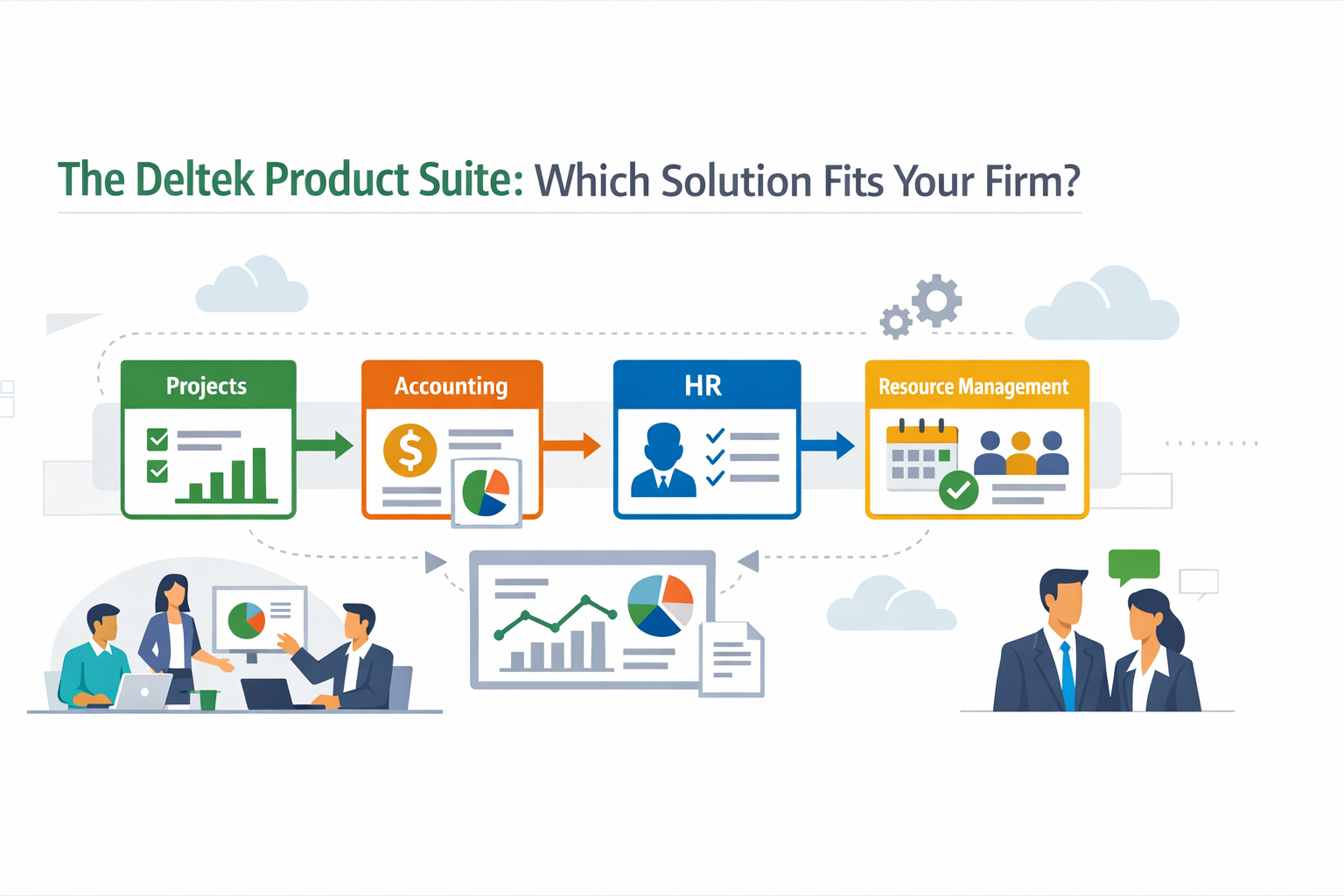
Deltek offers several products tailored to different firm sizes and complexities within E&C:
| Product | Target Firm Size | Key Capabilities | Best For |
|---|---|---|---|
| Deltek Ajera | Small firms (50-200 employees, $1M-$10M revenue) | Project-based accounting, WIP reporting, invoicing, payroll | Small A&E firms outgrowing spreadsheets |
| Deltek Vantagepoint | Mid-sized firms (200-2,000 employees) | Full ERP with CRM, project management, resource planning, financial management | Growing A&E firms needing unified operations |
| Deltek Costpoint | Large firms & government contractors | Advanced project accounting, DCAA compliance, business intelligence | Government contractors and large enterprises |
| Deltek Maconomy | Global professional services firms | Cloud ERP, multi-entity, multi-currency, compliance | International firms with complex structures |
| Deltek Acumen | All sizes (schedule & cost focused) | Schedule analysis, cost estimation, risk management | Firms needing accurate cost modeling and risk |
For architecture and engineering firms, Deltek Vantagepoint offers a modern, intuitive platform that integrates CRM, project management, resource planning, and financial management into one solution. Vantagepoint empowers firms to better manage their project pipelines, allocate resources effectively, and gain actionable insights—all from a single source of truth.
Deltek Ajera is an ERP software designed for the architecture, engineering, and construction industry. It combines project management with accounting capabilities, making it easier to budget, schedule, and keep initiatives on track. It also includes modules for payroll, general ledger, and accounts payable/receivable for accurate financial tracking.
How Integrated Deltek Workflows Eliminate Cost Leakage
The real power of Deltek emerges when its workflows connect seamlessly with the systems your teams use daily. Here's how integration eliminates cost leakage at each critical touchpoint:
Project Accounting & Budget Control
The leakage problem:
Budgets created during pursuit don't reflect actual project conditions. Cost codes aren't standardized. Spending happens outside the system.
Integrated workflow solution:
Step 1: Estimating system (ProEst, Timberline) generates detailed cost model during bidding.
Step 2: Upon contract award, cost model automatically imports into Deltek, creating the project budget with correct cost codes, phases, and line items.
Step 3: As work progresses, all costs—labor, materials, equipment, subcontracts—post to Deltek in real-time from connected systems.
Step 4: Automated alerts trigger when any cost category approaches or exceeds budget thresholds.
Step 5: Finance team sees real-time variance reports comparing budgeted vs. actual at every level.
Leakage eliminated:
- Budget-to-actual visibility from day one
- No manual re-entry of cost data between systems
- Instant alerts prevent uncontrolled spending
- Standardized cost codes across all projects and systems
| Budget Control Metric | Before Integration | After Integration |
|---|---|---|
| Time to detect budget overrun | 2-4 weeks | Real-time (minutes) |
| Cost code accuracy | 78% | 99%+ |
| Manual data entry hours/week | 15-25 hours | <2 hours |
| Budget variance at closeout | 8-12% | 2-4% |
Change Order Management
The leakage problem:
Change orders are approved verbally, logged inconsistently, and often not reflected in project budgets or client invoices until weeks later—or never.
Integrated workflow solution:
Step 1: Field team identifies scope change in Procore or equivalent field system.
Step 2: Change request automatically creates a workflow in the project management system requiring PM and client approval.
Step 3: Upon approval, Deltek automatically updates the project budget—adding costs to the correct phase and cost code.
Step 4: The change order is flagged for inclusion in the next client invoice cycle.
Step 5: All documentation, approvals, and pricing are stored and linked to the project record.
Change Order Integration Checklist:
- [ ] Every scope change triggers a formal change request
- [ ] Cost impact calculated before approval is requested
- [ ] Client approval documented digitally before work proceeds
- [ ] Deltek budget updates automatically upon approval
- [ ] Change order included in next billing cycle without manual intervention
- [ ] Full audit trail maintained for all changes
Labor & Resource Tracking
The leakage problem:
Field crews track time on paper or disconnected apps. Hours don't reconcile with payroll. Labor costs post to wrong projects or phases.
Integrated workflow solution:
Step 1: Field workers log time through mobile app, selecting project, phase, and task from Deltek-synced dropdown lists.
Step 2: Supervisor approves timesheets in the field app, which syncs immediately to Deltek.
Step 3: Deltek posts labor costs against the correct project and phase in real-time.
Step 4: Payroll system pulls approved hours from Deltek, eliminating duplicate entry.
Step 5: Utilization and productivity reports update automatically, flagging underperforming areas.
Labor Tracking: Before vs. After Integration
| Metric | Manual/Disconnected | Integrated Workflow |
|---|---|---|
| Time entry accuracy | 82-88% | 97-99% |
| Hours lost to wrong project codes | 3-6% of total hours | <0.5% of total hours |
| Payroll processing time | 8-12 hours/cycle | 2-3 hours/cycle |
| Labor cost visibility | End of pay period | Real-time |
| Overtime detection | After the fact | As it occurs |
| Productivity benchmarking | Monthly (manual) | Daily (automated) |
Procurement & Vendor Management
The leakage problem:
Purchasing happens outside centralized systems. Vendor pricing is inconsistent. Volume discounts are missed. Duplicate orders inflate costs.
Integrated workflow solution:
Step 1: Project manager submits purchase request through integrated procurement portal, linked to specific project and budget line.
Step 2: System checks existing inventory and open orders to prevent duplicates.
Step 3: Approved vendors are pre-loaded with negotiated pricing; system flags any deviation.
Step 4: Purchase order issues automatically in Deltek, reserving budget.
Step 5: Upon receipt, goods are matched to PO and invoice for three-way matching before payment.
Step 6: Vendor performance and pricing data feeds back into future estimating.
Procurement Controls Framework:
| Control Level | Description | System Integration |
|---|---|---|
| Authorization | Only approved personnel can create POs | Role-based access in Deltek + procurement system |
| Budget Check | PO cannot exceed available budget | Real-time budget validation from Deltek |
| Vendor Validation | Only approved vendors at negotiated rates | Vendor master synced across all systems |
| Duplicate Prevention | System detects duplicate orders | Cross-system order matching |
| Three-Way Match | Invoice matched to PO and receipt before payment | Automated matching in Deltek |
| Reporting | Full procurement analytics and trend analysis | Dashboard pulling from all connected systems |
Contract & Compliance Management
The leakage problem:
Contracts stored as static documents. Deadlines missed. Insurance lapses go unnoticed. Regulatory requirements tracked manually.
Integrated workflow solution:
Step 1: New contract entered into document management system with all key dates, obligations, and compliance requirements extracted.
Step 2: System automatically creates deadline reminders and syncs to Deltek project timeline.
Step 3: Insurance and certification expiration dates trigger renewal alerts 30/60/90 days in advance.
Step 4: Compliance checklists auto-populate based on project type, jurisdiction, and contract terms.
Step 5: Audit-ready reports generate automatically showing compliance status across all active projects.
Contract & Compliance Dashboard Metrics:
- Total active contracts by project and value
- Upcoming renewal and expiration dates
- Outstanding obligations and deadlines
- Insurance and certification status (current/expiring/expired)
- Compliance checklist completion rates
- Penalty exposure and risk assessment
Real-Time Reporting & Dashboards
The leakage problem:
Leadership makes decisions based on outdated reports compiled manually from multiple systems. By the time data is compiled, the situation has changed.
Integrated workflow solution:
Real-time dashboards pulling live data from Deltek and all connected systems provide instant visibility into:
Executive Dashboard:
- Portfolio profitability (planned vs. actual across all projects)
- Cash flow forecast vs. actual
- Revenue pipeline and billing status
- Risk exposure and contingency utilization
- Top and bottom performing projects
Project Manager Dashboard:
- Budget vs. actual by phase and cost code
- Schedule performance and critical path
- Change order status and pending approvals
- Resource utilization and productivity
- Subcontractor billing and performance
Finance Dashboard:
- Accounts receivable aging and collection forecast
- Work-in-progress (WIP) and unbilled revenue
- Vendor payment status and upcoming obligations
- Cash flow by project and consolidated
- Retainage tracking and expected collection
Integration Architecture: Connecting Deltek to Your Full Tech Stack
Achieving seamless Deltek integration requires a well-designed architecture that connects all systems while maintaining data integrity, security, and performance.
Recommended Integration Architecture
Tier 1: Core System Connections (Must Have)
These integrations deliver the highest ROI and should be implemented first:
| Integration | Systems Connected | Data Flow | Priority |
|---|---|---|---|
| Estimating → Deltek | ProEst/Timberline → Deltek | Budget import on contract award | Critical |
| Field Time → Deltek | Mobile time app → Deltek | Real-time labor posting | Critical |
| Payroll ↔ Deltek | ADP/Paylocity ↔ Deltek | Bidirectional employee and hours sync | Critical |
| Project Management ↔ Deltek | Procore/P6 ↔ Deltek | Schedule and milestone sync | Critical |
| Invoicing ↔ Deltek | Billing system ↔ Deltek | Revenue recognition and AR updates | Critical |
Tier 2: Extended Connections (High Value)
These integrations significantly enhance visibility and control:
| Integration | Systems Connected | Data Flow | Priority |
|---|---|---|---|
| CRM → Deltek | HubSpot/Salesforce → Deltek | Opportunity to project conversion | High |
| Change Orders ↔ Deltek | Procore/field system ↔ Deltek | Approved changes update budget | High |
| Document Management ↔ Deltek | SharePoint/Aconex ↔ Deltek | Contract and compliance document linking | High |
| Procurement ↔ Deltek | Procurement portal ↔ Deltek | PO creation and budget reservation | High |
| Equipment Tracking → Deltek | GPS/telematics → Deltek | Equipment costs posted to projects | High |
Tier 3: Advanced Connections (Strategic Value)
These integrations optimize the firm for long-term growth and competitiveness:
| Integration | Systems Connected | Data Flow | Priority |
|---|---|---|---|
| Safety & Compliance → Deltek | iAudit/Intelex → Deltek | Incident costs and compliance tracking | Medium |
| Analytics ↔ Deltek | BI tools ↔ Deltek | Predictive analytics and benchmarking | Medium |
| Subcontractor Portal ↔ Deltek | Subcontractor systems ↔ Deltek | Billing and performance integration | Medium |
| HR ↔ Deltek | HR system ↔ Deltek | Employee lifecycle and cost allocation | Medium |
Integration Security Requirements
E&C firms handle sensitive financial, contractual, and personnel data. Integration architecture must maintain:
- End-to-end encryption for all data in transit and at rest
- Role-based access controls ensuring users only see data relevant to their function
- Complete audit trails logging every data exchange and modification
- API key rotation on regular schedules to prevent credential compromise
- Compliance certifications meeting industry and contractual requirements
- Data residency controls keeping sensitive data within required jurisdictions
Cost Leakage Prevention: Before and After Integration
The following comparison illustrates the measurable impact of integrated Deltek workflows on cost leakage across key metrics:
| Metric | Before Integration | After Integration | Improvement |
|---|---|---|---|
| Budget variance at project closeout | 8-15% | 2-4% | 60-75% reduction |
| Unrecovered change order costs | 12-18% of CO value | <3% of CO value | 75-83% reduction |
| Labor cost tracking accuracy | 82-88% | 97-99% | 12-18% improvement |
| Procurement cost overruns | 5-10% above negotiated | <2% above negotiated | 60-80% reduction |
| Invoice error rate | 8-12% of invoices | <1% of invoices | 88-92% reduction |
| Client billing delays | 10-20 days average | 2-3 days average | 80-90% reduction |
| Retainage collection rate | 78-85% | 95-98% | 15-20% improvement |
| Time to detect budget issues | 2-4 weeks | Real-time | Near-instant detection |
| Staff hours on manual data entry | 15-25 hours/week | 2-4 hours/week | 80-85% reduction |
| Overall project margin improvement | Baseline | +3-6 percentage points | Significant profitability gain |
Real-World Results: E&C Firms That Stopped the Bleed
Case Study 1: Mid-Sized Engineering Firm (150 Employees)
Challenge:
A 150-person engineering firm managing 40+ concurrent projects found that 11% of project budgets were overrunning due to disconnected systems. Labor hours tracked on paper didn't match payroll. Change orders were approved verbally but never entered into the financial system. Client invoices were delayed an average of 18 days after milestones were reached.
Solution:
Full integration of Deltek Vantagepoint with Procore (project management), a mobile time tracking app, ADP (payroll), and HubSpot (CRM for business development).
Results:
- Budget overruns reduced from 11% to 3.2% in first year
- Labor tracking accuracy improved from 84% to 98%
- Change order recovery rate increased from 72% to 96%
- Client invoicing cycle reduced from 18 days to 3 days
- Annual savings: $1.2 million in recovered costs and efficiency gains
Case Study 2: Construction Firm (300 Employees, $85M Annual Revenue)
Challenge:
A growing construction firm with $85M in annual revenue discovered through an internal audit that cost leakage across procurement, labor, and change management was eroding 7-9% of project margins. Purchasing happened in multiple disconnected systems. Subcontractor invoices were frequently duplicated or incorrect. Equipment utilization data was not connected to project costs.
Solution:
Integrated Deltek Costpoint with procurement portal, subcontractor billing system, equipment GPS tracking, and field operations platform. Custom middleware developed to handle complex data transformations between systems.
Results:
- Procurement savings of $2.3M annually through negotiated pricing enforcement and duplicate elimination
- Subcontractor invoice errors reduced by 91%
- Equipment utilization improved by 23%, reducing idle time costs
- Overall margin improvement of 4.2 percentage points
- ROI achieved in 7 months
Case Study 3: A&E Firm Transitioning to Deltek Vantagepoint
Challenge:
A mid-sized architecture and engineering firm was transitioning from a legacy accounting system to Deltek Vantagepoint. They needed to migrate years of historical project data while simultaneously integrating with their existing CRM, project management, and document management systems—all without disrupting active projects.
Solution:
Expert-led migration and integration using SyncMatters and MigrateMyCRM for data migration, combined with custom integration development connecting Deltek Vantagepoint to the firm's full technology stack.
Results:
- Zero data loss during migration of 5+ years of project history
- Full integration operational within 12 weeks
- Staff reported 40% reduction in administrative workload within first month
- Partner dashboards providing real-time portfolio visibility for the first time
- Client satisfaction scores improved due to faster, more accurate billing
Building the Business Case for Deltek Integration
Securing budget and executive support for integration projects requires a compelling business case. Here's a framework for quantifying the value:
ROI Calculation Framework
Step 1: Quantify current cost leakage
Gather data on current performance across these metrics:
- Average budget variance at project closeout (%)
- Unrecovered change order costs ($)
- Labor tracking error rate and associated costs ($)
- Procurement overruns vs. negotiated pricing ($)
- Invoice error rate and associated rework costs ($)
- Billing delays and cash flow impact ($)
- Staff hours spent on manual data entry (hours × hourly cost)
Step 2: Estimate improvement based on benchmarks
| Area | Conservative Improvement | Aggressive Improvement |
|---|---|---|
| Budget variance reduction | 40% | 70% |
| Change order recovery | 50% | 85% |
| Labor accuracy improvement | 10% | 18% |
| Procurement savings | 40% | 75% |
| Invoice error reduction | 70% | 92% |
| Staff time savings | 60% | 85% |
Step 3: Calculate total annual benefit
Sum all quantified improvements to determine total annual benefit from integration.
Step 4: Compare against investment
Typical integration investment ranges:
| Scope | Setup Cost | Annual Ongoing | Payback Period |
|---|---|---|---|
| Basic (3-5 integrations) | $15,000 - $40,000 | $8,000 - $18,000 | 3-6 months |
| Mid-range (6-10 integrations) | $40,000 - $90,000 | $18,000 - $36,000 | 4-8 months |
| Enterprise (10+ integrations) | $90,000 - $200,000 | $36,000 - $72,000 | 6-12 months |
Step 5: Present compelling ROI summary
For a firm with $50M annual revenue and 7% average cost leakage ($3.5M lost annually):
- Conservative integration recovery: 40% of leakage = $1.4M/year recovered
- Staff efficiency savings: $200,000 - $350,000/year
- Total first-year benefit: $1.6M - $1.75M
- Mid-range integration investment: $58,000 setup + $27,000 ongoing = $85,000
- First-year ROI: 1,782% - 1,959%
- Payback period: 5-6 weeks
Common Mistakes to Avoid
Even well-intentioned integration projects can fail if common pitfalls aren't addressed:
Mistake 1: Implementing Without a Data Governance Strategy
The problem:
Connecting systems without defining who owns which data, what the standards are, and how conflicts are resolved creates chaos rather than clarity.
The solution:
- Define a single source of truth for each data element
- Establish naming conventions and coding standards
- Create data quality rules enforced at entry points
- Assign data stewards responsible for each domain
- Document governance policies before going live
Mistake 2: Trying to Integrate Everything at Once
The problem:
Attempting to connect 15 systems simultaneously creates an unmanageable project with too many variables, leading to delays, errors, and stakeholder frustration.
The solution:
- Prioritize integrations by ROI and business impact
- Implement in phases, starting with highest-value connections
- Validate each phase before moving to the next
- Celebrate early wins to maintain momentum and support
Mistake 3: Ignoring Change Management
The problem:
Even perfect technology fails if users don't adopt it. Field crews resistant to mobile time entry, project managers bypassing procurement controls, and finance staff continuing manual workarounds undermine integration value.
The solution:
- Involve end users in design and testing
- Communicate the "why" behind changes clearly
- Provide role-specific training before go-live
- Identify champions within each team to support adoption
- Address resistance with patience and ongoing feedback loops
- Measure and celebrate adoption milestones
Mistake 4: Underestimating Data Migration Complexity
The problem:
Moving historical data from legacy systems into Deltek is far more complex than expected. Inconsistent historical data, missing fields, and format differences create migration failures.
The solution:
- Conduct thorough data audit before migration begins
- Clean and standardize historical data proactively
- Use proven migration tools and expert guidance
- Run multiple test migrations before production
- Have a rollback plan in case of issues
- Budget adequate time—rushing migrations creates costly errors
Mistake 5: Neglecting Ongoing Maintenance
The problem:
Integrations are set up and forgotten. API updates break connections. New business requirements aren't reflected in workflows. Performance degrades over time.
The solution:
- Schedule regular integration health checks (monthly)
- Monitor for errors and performance issues continuously
- Budget for ongoing optimization and enhancement
- Stay informed about API and platform updates
- Assign someone responsible for integration maintenance
- Review and update integrations when business processes change
Mistake 6: Choosing the Wrong Integration Partner
The problem:
Generic IT consultants lack E&C industry knowledge. They connect systems technically but miss the business logic that makes integrations truly valuable.
The solution:
- Choose partners with demonstrated E&C experience
- Require case studies from similar firms
- Verify Deltek partnership and certification status
- Evaluate understanding of industry-specific workflows
- Look for partners who offer ongoing support, not just implementation
How SyncMatters Helps E&C Firms Maximize Deltek
SyncMatters specializes in connecting project-based businesses with their critical systems, delivering integrated workflows that eliminate cost leakage and maximize profitability.
Our E&C Integration Expertise
Deep understanding of E&C workflows:
Our team understands the unique challenges facing engineering and construction firms—from percentage-of-completion accounting to subcontractor management to compliance requirements. We don't just connect APIs; we optimize the business processes that drive your profitability.
Proven Deltek integration experience:
With extensive experience integrating Deltek products including Vantagepoint, Costpoint, and Ajera, SyncMatters delivers tested, reliable connections between Deltek and your broader technology stack.
Comprehensive service offerings:
- Custom Integrations — Tailored middleware connecting Deltek to your specific systems and workflows
- HubSpot Integration — Seamless connection between your CRM and Deltek for pipeline-to-project visibility
- Data Migration — Expert-led migration of historical data when transitioning to or upgrading Deltek
- Implementation Services — Strategic guidance on integration architecture and phased rollout
- Ongoing Support — Continuous monitoring, optimization, and enhancement of your integrated workflows
Our Approach
Discovery and assessment:
We start by mapping your current technology stack, identifying cost leakage points, and designing an integration architecture that addresses your specific challenges and priorities.
Phased implementation:
We implement integrations in priority order, delivering value quickly while building toward a fully connected operation. Each phase is thoroughly tested before moving to the next.
Training and enablement:
We ensure your team is equipped to use integrated systems effectively, with role-specific training and documentation tailored to your workflows.
Ongoing partnership:
We monitor your integrations continuously, proactively addressing issues and recommending optimizations as your business evolves.
Ready to Stop the Cost Leakage?
Every day without integrated workflows, your E&C firm is losing money it doesn't know it's losing. The firms that get integration right don't just survive—they thrive, winning more work, delivering better margins, and scaling with confidence.
Contact SyncMatters today to discuss how integrated Deltek workflows can transform your firm's profitability.
Explore more resources:
- View integration case studies
- Learn about data migration
- Calculate your HubSpot ROI
- Read our integration blog
Conclusion: Integrated Workflows Are the Answer
Cost leakage is not a single problem with a single fix. It's a systemic issue caused by fragmented systems, manual processes, and lack of real-time visibility. For E&C firms operating on thin margins, even small improvements in cost control translate directly to bottom-line profitability.
Deltek provides the financial and operational backbone that E&C firms need. But Deltek's power is multiplied exponentially when its workflows connect seamlessly with every other system in your technology stack—from field operations and project management to CRM, procurement, and payroll.
The Bottom Line
Integrated Deltek workflows deliver:
- Real-time budget visibility eliminating the weeks-long delay in detecting overruns
- Automated change order management recovering costs that previously disappeared
- Accurate labor tracking closing the gap between what's worked and what's paid
- Controlled procurement enforcing negotiated pricing and preventing duplicates
- Faster client billing improving cash flow and reducing collection cycles
- Compliance automation reducing penalty risk and audit burden
- Executive dashboards enabling data-driven decisions across the project portfolio
The firms that implement these integrations don't just reduce cost leakage—they build a competitive advantage that compounds over time. Better data leads to better bids, which leads to more profitable work, which leads to sustainable growth.
The question isn't whether your firm can afford to integrate. The question is whether your firm can afford not to.
About the Author: The SyncMatters Integration Team brings extensive experience in project-based business integration, Deltek implementation, and E&C workflow optimization. Our team has helped numerous engineering and construction firms reduce cost leakage and maximize profitability through strategic system integration.



.svg)