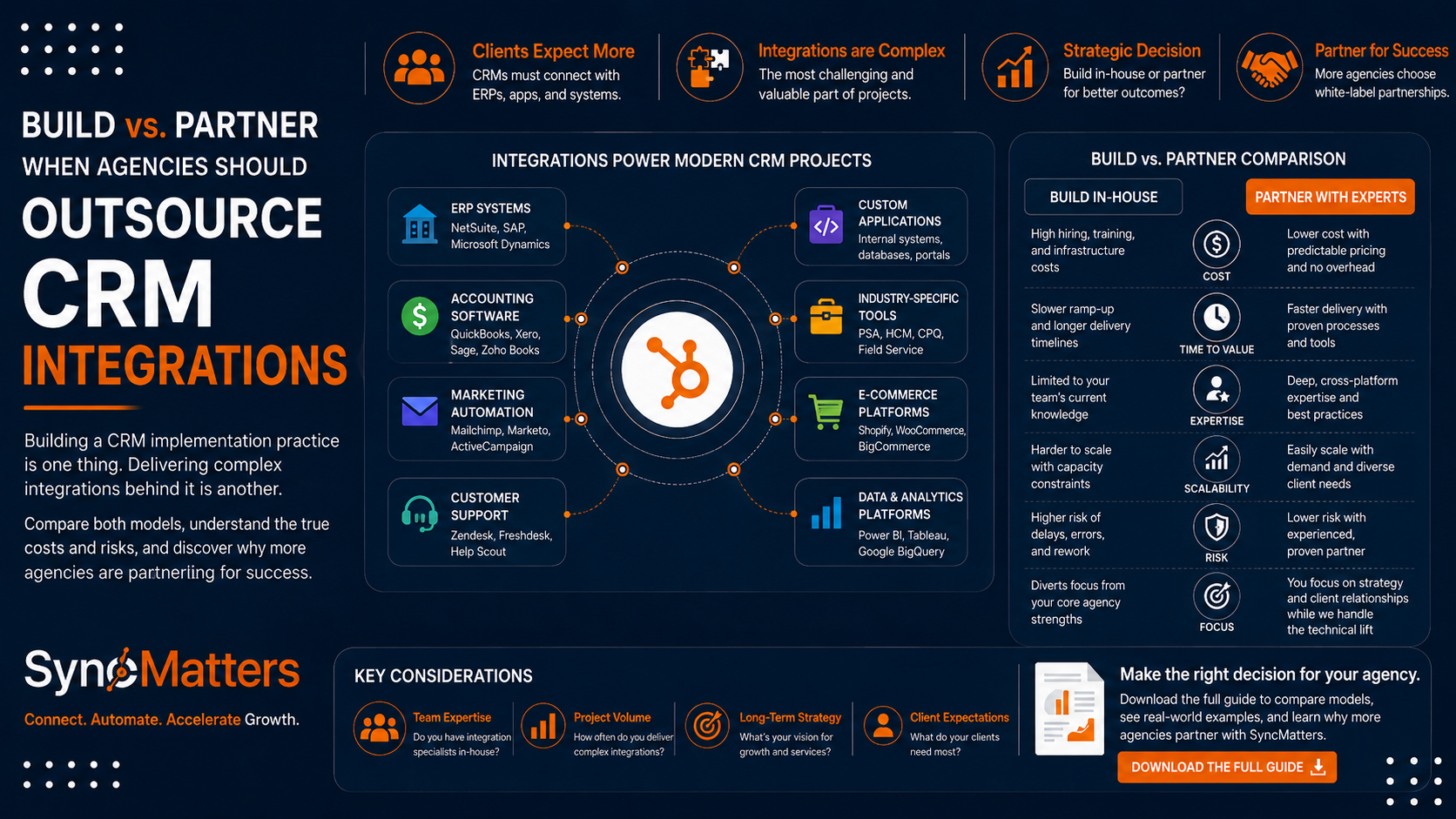
Building a CRM implementation practice is one thing. Delivering complex integrations behind it is another.
Today's clients expect far more than a CRM setup. They want HubSpot CRM connected to their ERP, accounting software, marketing automation platform, customer support system, custom applications, and industry-specific tools. In many projects, the integration is the most technically challenging and most valuable part of the engagement.
That leaves agencies with an important decision: should you build an internal integration team or partner with an experienced CRM integration partner?
There isn't a universal answer. The right approach depends on your team's expertise, project volume, long-term strategy, and the type of clients you serve. In this guide, we'll compare both models, explore the true costs and risks involved, and explain why more agencies are choosing white-label technical partnerships.
Why CRM Integration Demand Continues to Grow
CRM systems have become the operational hub of modern businesses. Instead of simply storing customer records, they now power sales, marketing, customer service, finance, and reporting. As a result, companies expect data to flow automatically between every critical business system.
Typical integration projects today include:
- HubSpot and NetSuite
- HubSpot and Microsoft Dynamics 365 Business Central
- HubSpot and Epicor
- HubSpot and Sage
- HubSpot and Salesforce
- HubSpot and ConnectWise PSA
- HubSpot and Deltek Vantagepoint
- HubSpot and CCH Axcess
- CRM platforms and ecommerce systems
- CRM platforms and custom databases
- CRM platforms and finance applications
Businesses are replacing spreadsheets, manual imports, and disconnected systems with automated workflows that provide real-time visibility across the organization.
For agencies, this trend creates a tremendous opportunity—but also introduces a level of technical complexity that many implementation teams weren't originally built to support.
Agencies Are Looking for Technical Partners
One of the most interesting findings from our recent partner survey was that agencies recognize the growing importance of integrations but don't always want to build deep technical capabilities internally.
While respondents expressed confidence in CRM implementation projects, confidence dropped when discussions shifted toward advanced integrations involving APIs, ERP systems, middleware, and custom development.
This isn't surprising. Modern integration projects often require expertise in:
- REST APIs
- OAuth authentication
- Webhooks
- Data transformation
- Error handling
- API rate limits
- ERP business processes
- Security and compliance
- Monitoring and long-term maintenance
Most agencies excel at CRM strategy, onboarding, implementation, and customer success. Building expertise across dozens of enterprise applications requires a completely different investment.
Build vs. Partner: Which Model Is Right?
The decision isn't simply about outsourcing development. It's about deciding where your agency creates the greatest value.
If your competitive advantage is consulting, customer relationships, and CRM strategy, maintaining integrations across dozens of software platforms may not be the best use of your resources.
| Build In-House | Partner with a CRM Integration Partner |
|---|---|
| Hire and train developers | Immediate access to experienced specialists |
| High fixed costs | Flexible project-based costs |
| Longer onboarding | Faster project delivery |
| Maintain technical knowledge internally | Leverage an established delivery methodology |
| Scale by hiring | Scale on demand |
| Responsible for ongoing maintenance | Ongoing support available through the partner |
Many successful agencies ultimately adopt a hybrid approach. They deliver CRM consulting internally while partnering on technically demanding integration projects.
The True Cost of Building an Internal Integration Team
When agencies evaluate internal development, they often compare only developer salaries.
In reality, that's just the beginning.
Hiring Specialized Talent
Integration engineers with experience across HubSpot, Salesforce, NetSuite, Microsoft Dynamics, Epicor, Sage, and other enterprise platforms are difficult to recruit.
Demand continues to outpace supply, making hiring both expensive and time-consuming.
Training and Knowledge Transfer
Even experienced developers need time to understand your delivery processes, customer environments, and internal standards.
As APIs evolve, continuous learning becomes part of the ongoing operational cost.
Infrastructure and Operations
Successful integration teams require more than developers.
You'll also need:
- Development environments
- Testing environments
- Monitoring tools
- Deployment pipelines
- Documentation standards
- Security processes
- Support procedures
These investments often remain hidden during initial budgeting.
Utilization Challenges
One of the biggest operational challenges is keeping highly specialized developers fully utilized.
If your agency delivers only a handful of integration projects each month, maintaining a dedicated team can quickly become inefficient.
Working with a CRM integration partner allows you to scale technical resources only when projects require them.
The Risks of Handling Every Integration Internally
Cost is only one factor.
Integration projects also introduce technical and business risks that many agencies underestimate.
API Changes
Software vendors continuously update their APIs.
Authentication methods, endpoints, and supported functionality evolve over time, requiring integrations to be monitored and maintained.
Data Integrity
Poor mapping or synchronization logic can create:
- Duplicate records
- Missing relationships
- Inconsistent reporting
- Inaccurate customer data
These issues often become expensive to resolve after deployment.
Security and Compliance
Enterprise customers increasingly ask detailed questions about:
- Data encryption
- Authentication
- Audit logging
- GDPR
- ISO 27001
- Secure hosting
Your technical delivery process needs to be just as mature as your CRM implementation methodology.
Project Delays
When internal teams encounter unfamiliar APIs or business systems, implementation timelines often grow unexpectedly.
Longer projects reduce profitability and can affect customer satisfaction.
When Outsourced CRM Development Makes Sense
Not every project requires outside expertise.

However, agencies often benefit from outsourced development when projects involve:
- Enterprise ERP integrations
- Custom APIs
- Bidirectional synchronization
- Multiple business systems
- Complex business logic
- Large datasets
- Strict security requirements
- Long-term support
Rather than building expertise from scratch, agencies can leverage experienced specialists while continuing to own the customer relationship.
The Benefits of White-Label Integration Delivery
White-label partnerships have become increasingly popular because they allow agencies to expand their service offerings without dramatically increasing overhead.
Under a white-label model:
- Your agency remains the primary client contact.
- Your branding stays front and center.
- The technical work is completed behind the scenes.
- Clients receive enterprise-level expertise without knowing another team is involved.
This approach helps agencies pursue larger, more complex opportunities while maintaining a lean internal team.
What to Look for in a CRM Integration Partner
Not all technical partners offer the same level of expertise.
Here are the qualities that matter most.
Multi-Platform Experience
Look for a partner with experience integrating a wide variety of business systems rather than specializing in only one CRM.
This becomes increasingly valuable as your clients adopt new software over time.
Proven Delivery Methodology
Reliable integration partners should have a documented process covering:
- Discovery
- Solution architecture
- Field mapping
- Testing
- Validation
- Deployment
- Documentation
- Ongoing monitoring
A structured methodology significantly reduces project risk.
Security and Compliance
Technical capability alone isn't enough.
Your partner should understand enterprise security requirements and demonstrate mature operational processes.
Long-Term Support
Integrations aren't one-time projects.
APIs evolve, business processes change, and customer requirements grow.
Choose a partner capable of supporting integrations well beyond the initial implementation.
Strong Communication
The best partnerships feel like an extension of your own team.
Project managers, consultants, and developers should collaborate seamlessly while keeping the client experience consistent.
Why Agencies Choose SyncMatters
For more than a decade, SyncMatters has helped agencies and enterprise organizations connect CRM platforms with ERP systems, finance software, marketing platforms, customer support tools, and industry-specific applications.
As a trusted HubSpot integration partner, we specialize in designing, building, and maintaining integrations that help businesses eliminate manual work and improve data quality.
Our team supports projects involving HubSpot, NetSuite, Microsoft Dynamics, Epicor, Sage, ConnectWise, Deltek, CCH Axcess, Salesforce, and many other platforms.
We also provide white-label delivery, allowing agencies to expand their technical capabilities without increasing internal headcount.
Whether you need assistance during pre-sales, solution architecture, implementation, or long-term support, our team can become a seamless extension of yours.
Build or Partner? A Simple Decision Checklist
Building an internal integration practice makes sense if:
- Integration work is a core part of your business.
- You consistently deliver high volumes of technical projects.
- You have experienced integration engineers.
- You're prepared to invest in ongoing maintenance and training.
Partnering with a CRM integration partner is often the better choice if:
- Integration projects are occasional.
- Your strength is CRM consulting and implementation.
- You want to scale without hiring.
- You need expertise across multiple enterprise platforms.
- You want to reduce delivery risk while expanding your service portfolio.
Many successful agencies combine both strategies—handling straightforward CRM implementations internally while relying on technical specialists for advanced integration work.
Final Thoughts
Client expectations continue to grow. Businesses no longer want disconnected systems—they expect their CRM to communicate seamlessly with every important application across their organization.


Building an internal integration team can certainly be the right investment for some agencies, but it also requires significant hiring, training, infrastructure, and ongoing maintenance.
For many others, partnering with an experienced CRM integration partner provides a faster, more flexible, and lower-risk path to growth.
At SyncMatters, we've helped agencies successfully deliver complex CRM and ERP integration projects for more than ten years. Through our white-label model, partners can confidently take on larger opportunities while keeping client relationships entirely their own.
If you're looking for a trusted HubSpot integration partner to support your next project, we'd love to help.
Explore our Integration Services, learn more about our Partner Program, or schedule a conversation with one of our integration experts to see how SyncMatters can become an extension of your team.

Frequently Asked Questions
Should my agency build CRM integrations in-house or partner with an integration specialist?
The right choice depends on your business model and project volume. If CRM integrations are a core service and you have a steady pipeline of complex projects, building an internal team may make sense. However, many agencies find that partnering with a specialized CRM integration partner provides faster delivery, lower overhead, and access to expertise across multiple platforms without the cost of hiring and maintaining a dedicated development team.
What are the benefits of working with a CRM integration partner?
A CRM integration partner helps agencies deliver complex projects without expanding their internal engineering team. Benefits include access to experienced integration specialists, faster project delivery, reduced technical risk, white-label implementation, ongoing support, and expertise across platforms such as HubSpot, Salesforce, Microsoft Dynamics 365, NetSuite, Epicor, Sage, and many others.
When does outsourced CRM development make the most sense?
Outsourced CRM development is often the best option when projects involve enterprise ERP systems, custom APIs, bidirectional data synchronization, complex business rules, large datasets, or ongoing maintenance. It also makes sense for agencies that only handle advanced integration projects occasionally and want to scale without hiring additional developers.
Can a white-label CRM integration partner work directly with my clients?
Yes. Many CRM integration partners, including SyncMatters, offer white-label delivery. This allows your agency to remain the primary point of contact while the technical work is completed behind the scenes. Your clients receive a seamless experience, and your agency can expand its service offerings without increasing internal headcount.
How do I choose the right HubSpot integration partner?
Look for a partner with proven experience integrating HubSpot with ERP, finance, marketing, and business applications. Evaluate their technical expertise, security practices, delivery methodology, communication process, and long-term support capabilities. It's also worth reviewing case studies, client testimonials, and the range of systems they support to ensure they can meet both your current and future integration needs.



.svg)