Table of Contents
- Introduction
- Understanding CRM Types: The Foundation of Customer Management
- What Is Operational CRM?
- What Is Analytical CRM?
- Key Differences: Operational CRM vs Analytical CRM
- Core Components of Operational CRM
- Benefits of Operational CRM
- Real-World Examples and Case Studies
- How SyncMatters Powers Operational CRM Success
- Choosing Between Operational and Analytical CRM
- Implementing Operational CRM: Best Practices
- The Future of Operational CRM
- FAQ
Introduction
Customer relationship management systems have evolved far beyond simple contact databases. Today's CRM platforms serve diverse organizational needs, from automating daily tasks to uncovering strategic insights. Yet this diversity often creates confusion when businesses evaluate CRM options. Should you prioritize operational efficiency or analytical capabilities? The answer depends on understanding what each CRM type delivers.
The global CRM market surpassed 88 billion dollars in 2025, with organizations reporting ROI exceeding 9.50 dollars for every dollar invested. These impressive returns reflect CRM's transformation from basic contact management to comprehensive business platforms. However, not all CRM systems target the same objectives. The distinction between operational and analytical CRM represents one of the most fundamental choices businesses face when selecting customer management technology.
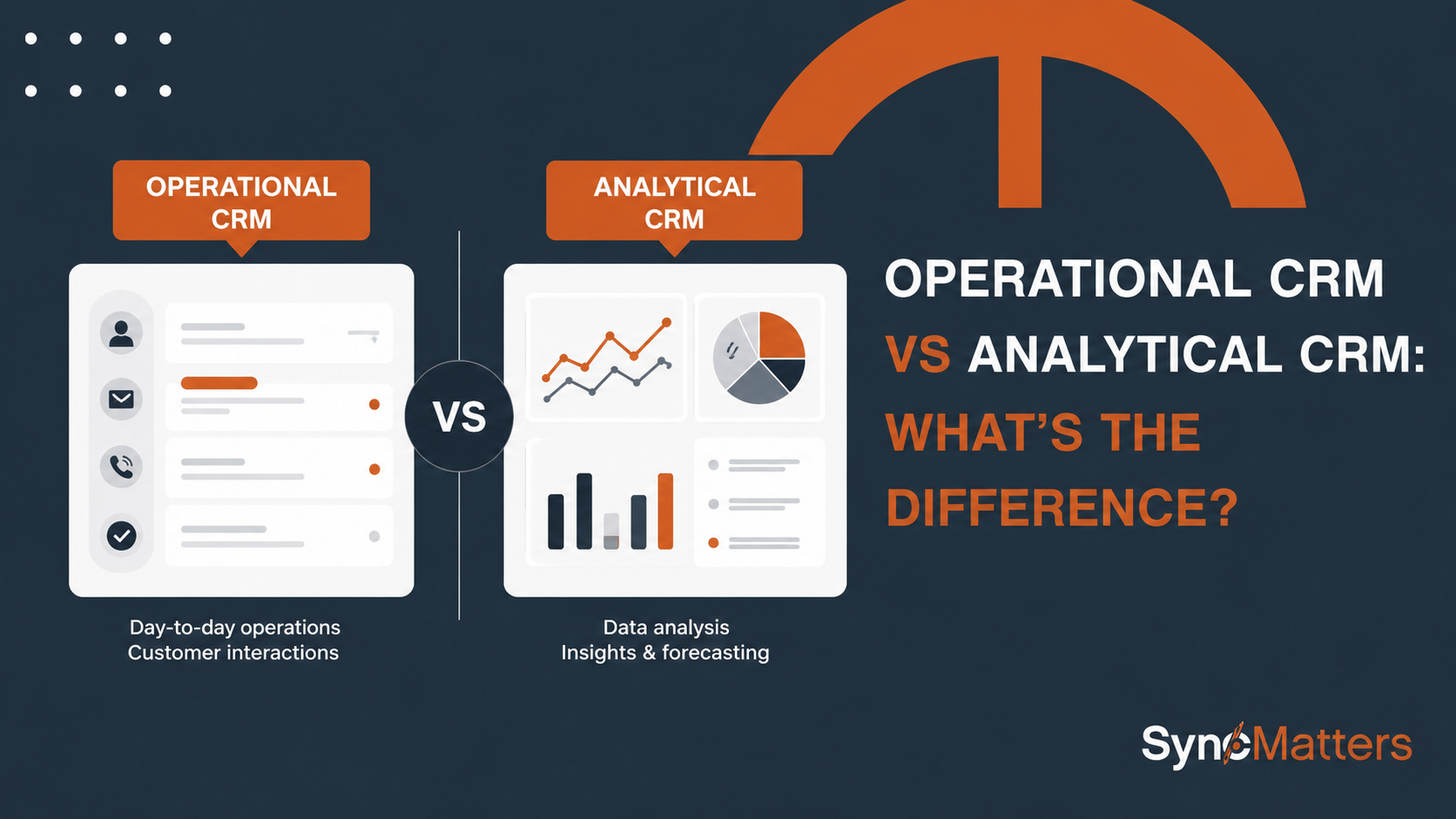
Operational CRM focuses on automating and streamlining customer-facing processes across sales, marketing, and service departments. Analytical CRM emphasizes extracting insights from customer data to inform strategic decisions. While these approaches complement each other, understanding their differences helps organizations invest in the right capabilities at the right time. This comprehensive guide explores both CRM types, clarifies their distinct value propositions, and provides actionable guidance for implementation success.
Understanding CRM Types: The Foundation of Customer Management
Customer relationship management systems generally fall into three main categories, each designed to address specific business challenges:
| CRM Type | Primary Purpose | Key Focus Areas | Ideal For |
|---|---|---|---|
| Operational CRM | Process automation and efficiency | Sales automation, marketing campaigns, customer service | Daily task management and customer interactions |
| Analytical CRM | Data analysis and insights | Predictive analytics, customer segmentation, reporting | Strategic decision-making and trend identification |
| Collaborative CRM | Information sharing across teams | Unified customer records, communication coordination | Breaking down departmental silos |
Operational CRM handles the mechanics of customer interactions. It automates repetitive tasks, manages sales pipelines, executes marketing campaigns, and streamlines service workflows. The primary goal is efficiency through process optimization.
Analytical CRM transforms customer data into actionable intelligence. It identifies patterns, predicts behaviors, segments audiences, and measures performance. The emphasis is strategic insight rather than operational execution.
Collaborative CRM facilitates information sharing between departments. It ensures sales, marketing, and service teams access the same customer information, enabling coordinated engagement. The focus is communication and alignment.
These three types are not mutually exclusive. Leading CRM platforms increasingly incorporate all three dimensions, though individual systems often emphasize one approach based on their target market and design philosophy.
What Is Operational CRM?
Operational CRM is customer relationship management software designed to automate and optimize customer-facing business processes. This CRM type serves as the operational backbone for sales, marketing, and customer service teams, handling the day-to-day tasks that drive customer acquisition, conversion, and retention.
The Core Mission
At its foundation, operational CRM answers a fundamental business question: how can we make customer interactions more efficient, consistent, and scalable? The system achieves this by automating routine tasks, standardizing workflows, and providing teams with tools to manage high volumes of customer engagements without sacrificing quality.
Three Pillars of Operational CRM
Operational CRM systems organize around three primary functional areas:
Sales Automation
- Lead capture and qualification
- Opportunity tracking and pipeline management
- Contact and account management
- Quote and proposal generation
- Sales forecasting and territory management
- Activity tracking and follow-up reminders
Marketing Automation
- Campaign planning and execution
- Email marketing and drip campaigns
- Lead scoring and nurturing
- Landing page and form creation
- Marketing performance tracking
- Multi-channel campaign coordination
Service Automation
- Case and ticket management
- Knowledge base creation and maintenance
- Service level agreement monitoring
- Customer communication tracking
- Self-service portal management
- Escalation workflow automation
The Automation Advantage
Automation represents operational CRM's defining characteristic. These systems eliminate manual, repetitive tasks that consume team bandwidth without adding strategic value. Lead assignments route automatically based on territory or expertise. Follow-up emails send on predefined schedules. Service tickets escalate when resolution times exceed thresholds. This automation frees teams to focus on activities requiring human judgment, creativity, and relationship-building skills.
Real-Time Operational Focus
Operational CRM operates in real time, supporting immediate customer interactions rather than long-term strategic planning. When a sales representative receives an inbound lead, operational CRM instantly provides context about the prospect's website activity, content downloads, and previous interactions. When a service agent answers a customer call, the system displays open tickets, purchase history, and communication preferences. This real-time information enables personalized, informed engagement at every touchpoint.
What Is Analytical CRM?
Analytical CRM represents the strategic intelligence layer of customer relationship management. While operational systems handle daily interactions, analytical CRM extracts meaning from the data those interactions generate. The focus shifts from "what tasks need completing" to "what patterns emerge from our customer data" and "what insights should guide our strategy."
The Strategic Mission
Analytical CRM addresses questions like: Which marketing channels generate the highest quality leads? What characteristics predict customer churn? Which customer segments deliver the greatest lifetime value? How do buying patterns vary by demographic or geographic factors? These insights inform strategic decisions about resource allocation, product development, marketing investment, and customer experience priorities.
Core Analytical Capabilities
Analytical CRM systems provide several key capabilities:
Data Mining and Pattern Recognition
- Discovering hidden correlations in customer data
- Identifying behavioral trends and anomalies
- Detecting cross-sell and upsell opportunities
- Recognizing seasonal patterns and cyclical trends
Predictive Analytics
- Forecasting future customer behavior
- Scoring leads based on conversion probability
- Predicting churn risk for proactive retention
- Estimating customer lifetime value
Customer Segmentation
- Grouping customers by demographics, behavior, or value
- Creating targeted segments for personalized marketing
- Identifying high-value customer characteristics
- Analyzing segment-specific purchasing patterns
Performance Measurement
- Tracking key performance indicators across functions
- Analyzing campaign ROI and channel effectiveness
- Measuring sales productivity and conversion rates
- Monitoring customer satisfaction and retention metrics
The Intelligence Loop
Analytical CRM creates a continuous intelligence loop. Operational systems capture customer interactions and behaviors. Analytical systems process this data to identify patterns and predictions. These insights inform strategic decisions about campaigns, resource allocation, and process improvements. Operational systems execute these strategies, generating new data that feeds back into analytical processes. This cycle continuously refines customer understanding and business performance.
Strategic Rather Than Tactical
Unlike operational CRM's real-time focus, analytical systems operate on longer time horizons. Analysis might examine quarterly trends, annual patterns, or multi-year customer lifecycle data. The outputs inform strategic planning rather than immediate execution. Analytical CRM tells organizations where to focus operational efforts for maximum impact.
Key Differences: Operational CRM vs Analytical CRM

Understanding the distinctions between operational and analytical CRM helps organizations make informed technology investments. Here are the fundamental differences:
| Aspect | Operational CRM | Analytical CRM |
|---|---|---|
| Primary Purpose | Automate customer-facing processes | Extract insights from customer data |
| Time Horizon | Real-time and immediate | Strategic and long-term |
| Focus | Efficiency and execution | Intelligence and planning |
| Users | Sales reps, marketers, service agents | Managers, executives, analysts |
| Key Questions | What tasks need completing? How do we execute efficiently? | What patterns exist? What should we do strategically? |
| Core Features | Contact management, workflow automation, task tracking | Data mining, predictive modeling, advanced reporting |
| Success Metrics | Response times, conversion rates, productivity | Forecast accuracy, segment performance, trend identification |
| Integration Needs | Email, calendar, communication tools | Business intelligence platforms, data warehouses |
Purpose and Objectives
Operational CRM exists to make customer interactions more efficient. It automates repetitive tasks, standardizes processes, and helps teams manage high volumes of customer engagements. Success means faster response times, shorter sales cycles, and higher productivity.
Analytical CRM exists to make customer strategies smarter. It uncovers patterns in customer behavior, predicts future trends, and identifies optimization opportunities. Success means more accurate forecasts, better-targeted campaigns, and data-driven decision-making.
User Perspectives
Operational CRM serves frontline teams executing daily customer interactions. Sales representatives use it to manage their pipelines. Marketers use it to execute campaigns. Service agents use it to resolve tickets. These users need systems that integrate seamlessly into their workflows without creating administrative burden.
Analytical CRM serves managers, executives, and analysts developing strategy. Marketing directors use it to evaluate channel effectiveness. Sales leaders use it to forecast revenue. Product managers use it to understand feature demand. These users need systems that transform raw data into clear, actionable insights.
Process vs. Insight
Operational CRM asks "how" questions. How do we capture leads efficiently? How do we automate follow-ups? How do we route service tickets appropriately? The emphasis is process optimization and execution excellence.
Analytical CRM asks "why" and "what if" questions. Why do certain campaigns outperform others? What characteristics predict high-value customers? What will happen if we adjust our pricing strategy? The emphasis is understanding causation and predicting outcomes.
Complementary Rather Than Competitive
These differences do not make operational and analytical CRM competing alternatives. They represent complementary capabilities addressing different organizational needs. Operational systems generate the customer data that analytical systems process. Analytical insights inform the strategies that operational systems execute. Organizations achieve optimal results when both capabilities work together rather than in isolation.
Core Components of Operational CRM
Operational CRM systems comprise several integrated components working together to streamline customer-facing processes:
Sales Force Automation
Sales force automation represents the most widely adopted operational CRM capability. Key features include:
- Lead Management - Capture leads from multiple sources, qualify based on predefined criteria, assign to appropriate representatives, and track progression through qualification stages
- Contact and Account Management - Maintain comprehensive customer and prospect records including demographics, interactions, preferences, and relationship histories
- Opportunity Management - Track deals through pipeline stages, associate contacts and activities, forecast close probabilities, and manage quotes and proposals
- Activity Tracking - Log calls, emails, meetings, and tasks automatically or manually, set reminders for follow-ups, and maintain complete engagement timelines
- Territory and Quota Management - Define sales territories, assign accounts appropriately, establish quotas, and track performance against targets
Marketing Automation
Marketing automation capabilities enable coordinated, multi-channel campaigns at scale:
- Campaign Management - Plan, execute, and track marketing campaigns across email, social media, webinars, events, and other channels
- Email Marketing - Design templates, segment audiences, schedule sends, track opens and clicks, and trigger automated follow-ups based on engagement
- Lead Nurturing - Create drip campaigns that automatically deliver relevant content based on prospect behaviors and qualification stages
- Lead Scoring - Assign point values to behaviors and characteristics, automatically calculate lead scores, and route high-scoring prospects to sales
- Landing Pages and Forms - Create conversion-optimized landing pages, embed forms for lead capture, and integrate submissions directly into the CRM
Service Automation
Service automation streamlines customer support and issue resolution:
- Case Management - Create, route, track, and resolve customer service cases from submission through closure
- Knowledge Base - Build searchable repositories of help articles, FAQs, troubleshooting guides, and best practices for self-service support
- Omnichannel Support - Handle customer inquiries across phone, email, chat, social media, and web portals from a unified interface
- SLA Management - Define service level agreements, monitor response and resolution times, escalate cases approaching deadlines automatically
- Customer Portal - Provide customers with self-service interfaces to submit tickets, track case status, access knowledge articles, and view account information
Workflow and Process Automation
Automation capabilities span all functional areas:
- Workflow Rules - Define if-then logic that automatically triggers actions based on field changes, time intervals, or specific events
- Assignment Rules - Automatically route leads, opportunities, and cases to appropriate team members based on criteria like geography, product expertise, or workload
- Approval Processes - Create multi-step approval workflows for quotes, discounts, contracts, or other items requiring authorization
- Email Templates - Design reusable templates for common communications, insert dynamic fields, and trigger automated sends
- Task Automation - Automatically create follow-up tasks, send reminders, and manage recurring activities
Benefits of Operational CRM
Organizations implementing operational CRM realize numerous tangible benefits that directly impact efficiency, revenue, and customer satisfaction:
| Benefit Category | Specific Advantages | Typical Impact |
|---|---|---|
| Sales Efficiency | Faster lead response, automated follow-ups, streamlined proposals | 25-30% productivity increase |
| Marketing Effectiveness | Targeted campaigns, automated nurturing, better lead quality | 20-35% higher conversion rates |
| Service Quality | Faster resolution, consistent processes, proactive support | 30% satisfaction improvement |
| Process Standardization | Repeatable workflows, reduced errors, predictable outcomes | 40-50% error reduction |
| Visibility and Accountability | Real-time pipeline visibility, activity tracking, performance metrics | Improved forecast accuracy |
| Customer Experience | Personalized interactions, faster response, seamless handoffs | Higher retention and loyalty |
Enhanced Sales Productivity
Sales teams spend less time on administrative tasks and more time selling. Automated lead assignment ensures immediate follow-up. Contact management eliminates time wasted searching for information. Opportunity tracking provides clear visibility into deal status without manual reporting. Email templates and quote generation reduce repetitive document creation. These efficiency gains typically increase sales productivity by 25 to 30 percent.
Improved Marketing ROI
Marketing automation enables sophisticated campaigns previously requiring extensive manual effort. Segmentation targets the right messages to the right audiences. Lead scoring focuses sales attention on prospects most likely to convert. Automated nurturing keeps prospects engaged without constant manual intervention. Multi-touch attribution clarifies which channels drive results. Organizations using marketing automation report conversion rate improvements of 20 to 35 percent.
Faster Customer Service Resolution
Service automation accelerates issue resolution through intelligent routing, self-service options, and knowledge base access. Cases route automatically to representatives with relevant expertise. Customers find answers independently through portals and knowledge articles. Service agents access complete customer histories instantly, eliminating information gathering delays. These improvements typically reduce resolution times by 25 to 40 percent while increasing customer satisfaction by approximately 30 percent.
Consistent Process Execution
Operational CRM standardizes how teams execute critical processes. Every lead progresses through the same qualification workflow. All service cases follow established resolution procedures. Marketing campaigns deploy consistent messaging across channels. This standardization reduces errors, ensures compliance, and creates predictable outcomes. Organizations report error reductions of 40 to 50 percent after implementing standardized CRM workflows.
Comprehensive Visibility
Managers gain real-time visibility into team activities and pipeline health without requiring manual status reports. Dashboards display key metrics automatically. Executives monitor progress toward targets instantly. Forecasting accuracy improves when based on actual pipeline data rather than representative estimates. This transparency enhances decision-making quality and enables proactive course corrections.
Scalable Growth
Operational CRM provides the infrastructure to scale operations without proportionally increasing headcount. Automation handles growing volumes of leads, campaigns, and service requests. New team members onboard faster with standardized processes and comprehensive customer histories. Organizations expand into new markets or launch new products without rebuilding customer management infrastructure.
Real-World Examples and Case Studies
Coca-Cola Germany: Enhancing Service Operations
Coca-Cola Germany, managing significant European market operations, faced increasing customer service demands as the business expanded. The company needed to improve response speed while enhancing internal collaboration between service, sales, and marketing teams. The lack of integrated systems made tracking customer issues across departments challenging.
The Implementation
Coca-Cola Germany implemented Salesforce CRM with a focus on operational service capabilities:
- Instant customer history access - Service representatives could immediately view complete customer backgrounds, enabling personalized and efficient interactions
- Robust issue tracking - Comprehensive logging and tracking tools ensured problems received appropriate attention through resolution
- Mobile accessibility - The distributed service team stayed connected and productive regardless of location
- Cross-functional collaboration - Integration improved coordination between service, sales, and marketing departments
The Results
The operational CRM implementation delivered measurable improvements:
- Significantly enhanced customer satisfaction through faster, more informed responses
- Streamlined processes reduced issue resolution time
- Improved collaboration prevented customers from experiencing disconnected service
- Mobile capabilities increased field team productivity
The transformation demonstrated how operational CRM converts service operations from isolated problem-solving into coordinated customer experience management.
AM Foods Group: Streamlining Food Distribution
AM Foods Group, a leading food and beverage distributor, sought a scalable CRM to harmonize customer and distributor interactions, streamline the sales cycle, and improve field team productivity across an expanding geographic footprint.
The Challenges
- Fragmented sales process - Sales representatives relied on spreadsheets and phone logs, leading to inconsistent follow-ups and lost opportunities
- Limited pipeline visibility - Leadership lacked insights into lead sources, aging opportunities, and conversion rates
- Field team constraints - No mobile access meant representatives could not update records or capture orders on the go
The Solution
The company deployed Microsoft Dynamics 365 Sales and Customer Service with operational features:
- Centralized database - Unified customer and distributor profiles with product-line segmentation
- Mobile CRM application - Offline-capable mobile access for order entry, activity logging, and route planning
- Opportunity management - Pipeline tracking, quoting, and order integration
- Customer service integration - Case tracking for distributor inquiries and complaints
- Automated reminders - Scheduled follow-ups and task assignments ensuring no lead fell through the cracks
The Results
- 50 percent faster lead-to-order conversion through standardized processes and proactive follow-ups
- 18 percent improvement in customer retention via automated reminders and personalized engagement
- Real-time dashboards empowered executives with accurate sales forecasts
- 25 percent reduction in administrative work freed representatives to spend more time selling
VK Ventures: Managing E-Commerce Growth
VK Ventures, an active player in the e-commerce and fintech sectors, operated with an 80-member sales team using an outdated CRM system lacking essential features. The company struggled to manage the large team effectively and track leads from various marketing campaigns.
The Implementation
VK Ventures implemented Kylas CRM to address operational challenges:
- Comprehensive customer view - Consolidated database with customer names, addresses, financial information, and more
- Lead tracking - Efficient capture and management of leads from multiple marketing sources
- Team management - Tools for monitoring and coordinating the 80-person sales team
- Campaign attribution - Tracking which marketing efforts generated specific leads
The Impact
The operational CRM significantly enhanced organizational agility. Sales teams gained visibility into lead sources and customer information, enabling more effective follow-up and conversion. Management could monitor team performance and campaign effectiveness from a unified platform, supporting data-driven decisions about resource allocation and marketing investment.
Omega Financial: Boosting Productivity
Omega Financial, a financial distribution company focusing on mutual fund investments, handles bulk transactions and processes daily. Every transaction follows its distinct path and involves various customer touchpoints.
The Challenge
Prior to CRM implementation, Omega Financial struggled with transaction tracking and customer engagement management. The complexity of financial products and the volume of daily transactions made manual processes unsustainable.
The Solution and Results
Implementing Kylas CRM proved transformative for Omega Financial:
- Streamlined processes - Teams worked more efficiently with clear workflows for transaction management
- Enhanced collaboration - Departments coordinated seamlessly around customer accounts
- 45 percent sales growth - Measurable productivity improvements across the organization
- Performance tracking - Weightage point system for quantifying deal closures increased from 500-600 points to consistently exceeding 1500 points per executive
The operational CRM converted fragmented transaction management into a coordinated system supporting rapid growth in a competitive financial services market.
How SyncMatters Powers Operational CRM Success
Operational CRM effectiveness depends fundamentally on clean, integrated data flowing seamlessly between all business systems. This critical foundation is where SyncMatters delivers exceptional value. As a specialized CRM integration and migration partner, SyncMatters addresses the technical and operational challenges that often undermine operational CRM success.
Comprehensive System Integration
SyncMatters connects over 55 CRM systems with the operational tools businesses use daily:
Sales Tools Integration:
- Email platforms (Gmail, Outlook)
- Calendar systems for meeting management
- Phone systems for click-to-call functionality
- Proposal and quoting software
- E-signature platforms for contract execution
Marketing Platform Connections:
- Marketing automation systems (HubSpot, Marketo, Pardot)
- Email marketing platforms
- Social media management tools
- Webinar and event platforms
- Analytics and tracking systems
Customer Service Integration:
- Support ticket systems (Zendesk, Freshdesk)
- Live chat platforms
- Knowledge base software
- Customer portal systems
- Communication channels (phone, email, SMS)
Business System Connections:
- Financial platforms (QuickBooks, NetSuite)
- E-commerce systems
- Inventory management
- Project management tools
- Document management platforms
This comprehensive integration ensures operational CRM systems receive complete information from every customer touchpoint, enabling the real-time visibility and automation that makes operational CRM valuable.
Expert Data Migration Services
Organizations hesitating to upgrade operational CRM capabilities often cite migration complexity as a primary concern. SyncMatters specializes in data migrations that maintain the historical information essential for operational effectiveness:
- Complete history preservation - All customer interactions, transaction records, and communication histories transfer accurately
- Data quality improvement - Migration process identifies and resolves duplicate records, inconsistent formatting, and incomplete information
- Minimal disruption - Carefully planned migrations allow teams to maintain productivity during transitions
- Validation and testing - Rigorous verification ensures data accuracy before systems go live
As a certified Elite HubSpot partner with extensive multi-platform experience, SyncMatters brings deep expertise to migration projects of any complexity. Customer testimonials consistently highlight migration accuracy and efficiency, with one client noting that while they initially considered handling migration internally, calculating opportunity costs made partnering with specialists the clear choice.
Real-Time Data Synchronization
Operational CRM requires current information to support immediate customer interactions. SyncMatters ensures real-time synchronization across connected systems:
- When sales representatives update opportunity stages, marketing sees pipeline changes instantly
- When service teams log customer issues, account managers receive immediate visibility
- When customers make purchases, all systems reflect updated transaction histories simultaneously
- When marketing campaigns generate leads, sales representatives receive instant notifications
This synchronized accuracy eliminates the "whose data is right" confusion that plagues operational efforts and ensures every team member works from current information.
Custom Integration Solutions
Every organization has unique operational workflows and system requirements. SyncMatters' custom integration services adapt to specific business needs rather than forcing organizations into rigid templates:
- Workflow-specific integrations - Connections designed around actual business processes rather than generic templates
- Industry-specific requirements - Solutions addressing regulatory, compliance, or industry-standard needs
- Scalable architectures - Integrations that grow with organizational needs and system additions
- Specialized tool connections - Integration with niche platforms specific to particular industries or functions
Implementation Without Disruption
Business operations cannot pause for technology implementations. SyncMatters designs integration and migration solutions that deliver operational CRM benefits without disrupting daily work:
- Most integration projects complete within two to three months
- Teams maintain full productivity during implementation
- Phased rollouts minimize learning curves and adjustment periods
- Comprehensive training ensures teams leverage new capabilities immediately
Client testimonials emphasize smooth implementation experiences, with one noting that milestones were reached on schedule with clear communication throughout. Another highlighted that a previous provider's failed implementation cost over one hundred thousand dollars, while SyncMatters delivered working integrations in six weeks.
Ongoing Support and Optimization
SyncMatters relationships extend beyond initial implementation. The company provides ongoing support ensuring integrations continue performing optimally as business needs evolve:
- Proactive monitoring - Regular system health checks identify potential issues before they impact operations
- Update management - Handling CRM platform updates and ensuring integrations remain functional
- Expansion support - Adding new system connections as technology stacks evolve
- Performance optimization - Continuous refinement of integration performance and data flow efficiency
This sustained partnership helps organizations maximize operational CRM investments over time rather than treating implementations as one-time projects.
Choosing Between Operational and Analytical CRM
Organizations evaluating CRM investments often wonder whether to prioritize operational or analytical capabilities. The decision depends on several factors:
When Operational CRM Is the Priority
Choose operational CRM when your organization needs:
- Process efficiency - Manual tasks consume excessive team time and reduce productivity
- Sales pipeline visibility - Managers lack clear understanding of deal progression and forecast accuracy
- Marketing campaign execution - Current tools make executing sophisticated campaigns difficult or impossible
- Service consistency - Customer support quality varies significantly between representatives or channels
- Team coordination - Handoffs between sales, marketing, and service create friction and lost opportunities
- Scalability - Current manual processes cannot support planned growth or expansion
Operational CRM is particularly valuable for organizations new to CRM or those upgrading from basic contact management systems. It provides immediate productivity benefits and creates the data foundation necessary for future analytical capabilities.
When Analytical CRM Is the Priority
Choose analytical CRM when your organization needs:
- Strategic insights - Decisions rely too heavily on intuition rather than data-driven analysis
- Performance understanding - Unclear which marketing channels, campaigns, or sales strategies deliver the best results
-
- Customer segmentation - Need to identify and target high-value customer groups more effectively
- Churn prediction - Reactive retention efforts after customers already decided to leave
- Forecast accuracy - Revenue projections consistently miss targets due to inadequate predictive capabilities
- Market intelligence - Competitive pressure requires deeper understanding of customer preferences and trends
Analytical CRM delivers maximum value for organizations with mature operational processes generating substantial customer data. The analytical capabilities extract strategic intelligence from this data to inform resource allocation and strategy development.
The Integrated Approach
Most organizations eventually need both operational efficiency and analytical insight. Rather than choosing one over the other, consider a phased approach:
Phase 1: Operational Foundation Implement operational CRM to standardize processes, improve efficiency, and generate clean customer data. This foundation creates immediate productivity gains while building the data repository analytical capabilities require.
Phase 2: Analytical Enhancement Add analytical capabilities once operational processes generate sufficient quality data. Use analytical insights to optimize operational processes, creating a continuous improvement cycle.
Phase 3: Advanced Integration Fully integrate operational and analytical capabilities so insights automatically inform operational execution. Predictive lead scoring flows into sales workflows. Churn predictions trigger proactive retention campaigns. Segment analysis drives automated marketing personalization.
Many modern CRM platforms incorporate both operational and analytical capabilities, though they often emphasize one approach. Salesforce and HubSpot, for example, provide strong operational foundations with increasingly sophisticated analytical features. Select platforms aligning with current priorities while supporting future capability expansion.
Implementing Operational CRM: Best Practices
Successful operational CRM implementations follow proven best practices that maximize adoption and value realization:
1. Start with Process Documentation
Before selecting technology, document current processes including:
- Sales workflows - How leads progress from initial contact through closed deals
- Marketing campaigns - How campaigns plan, execute, and measure across channels
- Service procedures - How customer issues escalate, resolve, and close
- Handoff protocols - How customer relationships transition between teams
This documentation clarifies which processes operational CRM should automate and standardize.
2. Define Clear Objectives and Success Metrics
Establish specific, measurable goals for operational CRM implementation:
- Reduce average sales cycle length by specific number of days
- Increase lead response time to within defined hours
- Improve first-contact resolution rates to target percentage
- Decrease administrative time by quantifiable hours per representative
- Achieve specific user adoption rates within defined timeframes
Clear objectives guide system configuration decisions and provide benchmarks for measuring success.
3. Prioritize User Adoption
Technology alone does not deliver operational benefits. Focus on adoption through:
- Comprehensive training - Role-specific instruction on daily workflows and best practices
- Change management - Clear communication about why changes occur and what benefits they bring
- Executive sponsorship - Visible leadership support reinforcing implementation importance
- Early wins - Quick victories demonstrating value and building momentum
- Ongoing support - Resources available when users encounter questions or challenges
Organizations with adoption rates below 50 percent realize minimal CRM value regardless of technology sophistication.
4. Ensure Complete Integration
Operational CRM effectiveness depends on comprehensive integration. Work with specialists like SyncMatters to connect:
- All customer communication channels (email, phone, chat)
- Marketing automation and campaign management tools
- Customer service and support platforms
- Financial systems for order and payment information
- Industry-specific tools essential to operations
Partial integration creates data gaps that undermine operational efficiency.
5. Start Simple and Expand Gradually
Avoid overwhelming users with excessive features at launch. Implement core capabilities first:
- Phase 1 - Contact management, basic pipeline tracking, email integration
- Phase 2 - Workflow automation, advanced reporting, mobile access
- Phase 3 - Advanced features like AI-powered recommendations, predictive capabilities
Gradual expansion allows teams to build competency before adding complexity.
6. Maintain Data Quality Standards
Operational CRM value depends on accurate, complete data. Establish standards including:
- Required fields - Minimum information necessary for effective operations
- Data validation - Rules preventing invalid entries
- Deduplication - Processes identifying and merging duplicate records
- Regular audits - Periodic reviews identifying and correcting quality issues
Make data entry as frictionless as possible through automation, templates, and mobile access to encourage compliance.
7. Monitor Performance and Iterate
Continuously evaluate operational CRM performance against defined objectives:
- Which processes show the greatest efficiency improvements?
- Where do teams still experience friction or workarounds?
- What additional automation opportunities exist?
- How are adoption rates trending across teams?
Use these insights to refine configurations, provide additional training, and prioritize enhancements.
The Future of Operational CRM
Operational CRM continues evolving rapidly as new technologies emerge and customer expectations rise. Several trends will shape operational CRM's future:
Artificial Intelligence Integration
AI is transforming operational CRM from passive tools into active assistants:
- Intelligent routing - AI algorithms assign leads and cases to representatives most likely to succeed based on expertise, workload, and past performance
- Predictive next actions - Systems recommend optimal next steps for sales opportunities or service cases
- Automated data entry - AI extracts information from emails, calls, and documents, eliminating manual entry
- Sentiment analysis - Natural language processing evaluates customer emotions to prioritize urgent issues
- Smart recommendations - AI suggests relevant content, products, or solutions based on customer context
Organizations combining traditional operational CRM with AI capabilities report 30 to 40 percent better pipeline visibility and 5 to 10 hours saved per representative weekly.
Voice-First Interfaces
Voice technology is reducing operational CRM's manual data entry burden:
- Representatives speak meeting notes, update opportunity stages, and log calls through voice commands
- Voice-to-CRM solutions eliminate the administrative burden that traditionally hampered adoption
- Organizations using voice data capture achieve 85 to 95 percent data completeness versus 40 to 50 percent industry average
These voice interfaces make documentation effortless, dramatically improving data quality without increasing user burden.
Mobile-First Design
As remote work and field sales expand, operational CRM increasingly prioritizes mobile experiences:
- Full-featured mobile applications providing complete functionality, not just data viewing
- Offline capabilities allowing work without constant connectivity
- Mobile-optimized interfaces designed for smaller screens and touch interaction
- Location-aware features providing context based on representative geography
Mobile-first design ensures operational CRM supports teams regardless of where they work.
Automation Expansion
Automation continues extending into more complex workflows:
- Multi-step workflows - Sophisticated if-then logic handling complex business rules
- Cross-system automation - Workflows spanning multiple platforms and applications
- Intelligent triggers - Automation launching based on behavioral signals and pattern recognition
- Exception handling - Systems managing workflow variations and edge cases automatically
These advances allow organizations to automate increasingly sophisticated processes previously requiring manual intervention.
Unified Customer Experiences
Operational CRM is expanding beyond internal process optimization toward creating seamless customer experiences:
- Omnichannel consistency - Customers experience the same quality regardless of channel
- Journey orchestration - Automated coordination of touchpoints across the entire customer lifecycle
- Personalization at scale - Individualized experiences for thousands or millions of customers
- Real-time responsiveness - Immediate adaptation to customer behaviors and preferences
This evolution reflects operational CRM's maturation from internal efficiency tool to customer experience platform.
FAQ
What is operational CRM?
Operational CRM is customer relationship management software designed to automate and optimize customer-facing business processes across sales, marketing, and customer service. It handles day-to-day tasks including lead management, campaign execution, opportunity tracking, case resolution, and workflow automation. The primary goal is improving efficiency through process standardization and task automation. Operational CRM serves frontline teams managing direct customer interactions, providing tools to handle high volumes of engagements consistently and efficiently.
What is the difference between operational CRM and analytical CRM?
Operational CRM focuses on automating and streamlining customer-facing processes, handling the mechanics of daily interactions across sales, marketing, and service. Analytical CRM focuses on extracting insights from customer data to inform strategic decisions through predictive analytics, customer segmentation, and advanced reporting. Operational CRM asks "how do we execute efficiently" while analytical CRM asks "what patterns exist and what should we do strategically." They complement rather than compete with each other, with operational systems generating the data analytical systems process.
What are the three types of CRM?
The three main types of CRM are operational, analytical, and collaborative. Operational CRM automates customer-facing processes across sales, marketing, and service. Analytical CRM analyzes customer data to uncover patterns, predict behaviors, and inform strategic decisions. Collaborative CRM facilitates information sharing and coordination between departments to ensure unified customer experiences. These three types address different organizational needs and increasingly converge within comprehensive CRM platforms offering all three capabilities.
What are examples of operational CRM systems?
Leading operational CRM systems include Salesforce Sales Cloud, which provides comprehensive sales automation and pipeline management; HubSpot CRM, offering user-friendly interfaces for sales and marketing automation; Microsoft Dynamics 365 Sales, integrating deeply with Microsoft business tools; Zoho CRM, delivering flexible workflow automation and customization; Pipedrive, focusing on visual pipeline management for sales teams; and Freshsales, combining sales automation with service capabilities. Each platform emphasizes operational efficiency while offering varying degrees of analytical and collaborative features.
How does operational CRM improve sales productivity?
Operational CRM improves sales productivity by automating repetitive tasks that consume representative time without adding value. Automated lead assignment ensures immediate follow-up. Contact management eliminates time searching for customer information. Opportunity tracking provides pipeline visibility without manual reporting. Email templates and quote generation reduce document creation time. Activity tracking maintains engagement histories automatically. These efficiency gains typically increase sales productivity by 25 to 30 percent, allowing representatives to focus on relationship-building and deal progression rather than administrative work.
What is the ROI of operational CRM?
Organizations implementing operational CRM report ROI exceeding 9.50 dollars for every dollar invested, with some seeing returns above 30 dollars per dollar spent. Specific benefits include 25 to 30 percent sales productivity increases, 20 to 35 percent marketing conversion improvements, 30 percent customer satisfaction enhancements, and 40 to 50 percent error reductions through process standardization. ROI timelines vary based on implementation scope, but organizations typically see positive returns within 13 months. The key is ensuring high user adoption rates, as organizations with adoption below 50 percent realize minimal value.
How long does operational CRM implementation take?
Implementation timelines vary based on system complexity, integration requirements, and organizational size. Basic operational CRM deployments for small teams may complete within weeks. Mid-market implementations with moderate integration needs typically require two to three months. Enterprise deployments involving complex data migrations and extensive integrations may extend six months or longer. However, operational benefits often emerge progressively rather than waiting for complete implementation. Teams begin working more efficiently as soon as core automation and pipeline management capabilities become available, even before all features activate or integrations complete.
What integration does operational CRM require?
Effective operational CRM requires integration with systems teams use daily. Sales automation needs email platforms, calendar systems, phone systems, and proposal software. Marketing automation requires marketing platforms, email systems, webinar tools, and analytics. Service automation needs support ticket systems, knowledge base platforms, and communication channels. All functional areas benefit from integration with financial systems, e-commerce platforms, and industry-specific tools. Comprehensive integration ensures operational CRM receives complete customer information from every touchpoint. Organizations should work with integration specialists like SyncMatters to connect their entire technology stack seamlessly.
How do you measure operational CRM success?
Measure operational CRM success through metrics aligned with implementation objectives. Sales metrics include pipeline velocity, lead response time, win rates, and deal cycle length. Marketing metrics include campaign conversion rates, lead quality scores, marketing-generated pipeline, and ROI. Service metrics include first-contact resolution rates, average handling time, customer satisfaction scores, and ticket resolution time. Adoption metrics include user login frequency, data quality scores, and mobile utilization rates. Establish baseline measurements before implementation and track improvements over defined periods to quantify impact and identify optimization opportunities.
Can small businesses benefit from operational CRM?
Small businesses often gain proportionally greater benefits from operational CRM than larger organizations. Smaller teams require more efficiency as each person typically handles multiple roles. Operational CRM prevents common small business problems like lost follow-ups, duplicate customer contacts, and missing information during team transitions. Modern cloud-based platforms make sophisticated operational capabilities accessible and affordable for organizations of any size, with solutions starting around fifteen to twenty-five dollars per user monthly. The key is selecting systems appropriate for team size rather than enterprise-scale complexity that overwhelms users.
What are common operational CRM implementation mistakes?
Organizations frequently make several implementation mistakes. Selecting overly complex platforms that overwhelm users rather than streamlining operations is common. Inadequate training and change management lead to poor adoption regardless of technology quality. Partial integration leaves some systems connected while others remain isolated, creating new data silos. Failing to document current processes before implementation means systems do not align with actual workflows. Neglecting data quality allows incomplete, inconsistent information to undermine automation effectiveness. Focusing on technology features rather than business outcomes causes implementations to drift from original objectives. Working with experienced partners like SyncMatters helps avoid these pitfalls through proven methodologies.
How does operational CRM support remote teams?
Operational CRM is particularly valuable for remote and distributed teams who cannot coordinate through office conversations. Cloud-based systems provide universal access from any location and device. Mobile applications enable field teams to access customer information and update records in real time. Automated workflows ensure consistent processes without requiring constant supervision. Activity tracking maintains transparency about team progress without micromanagement. Communication integration logs emails, calls, and meetings automatically regardless of location. Remote work increases operational CRM's importance by providing structured processes and information access that replace informal office interactions.
What is the difference between CRM and operational CRM?
CRM is the broad category encompassing all customer relationship management systems and strategies. Operational CRM is a specific type of CRM focused on automating customer-facing processes across sales, marketing, and service. Think of CRM as the umbrella term covering operational CRM, analytical CRM, and collaborative CRM. When people reference "CRM" generically, they often mean operational CRM since it represents the most widely adopted category. However, comprehensive customer relationship management involves operational efficiency, analytical insight, and collaborative coordination working together rather than any single type in isolation.



.svg)