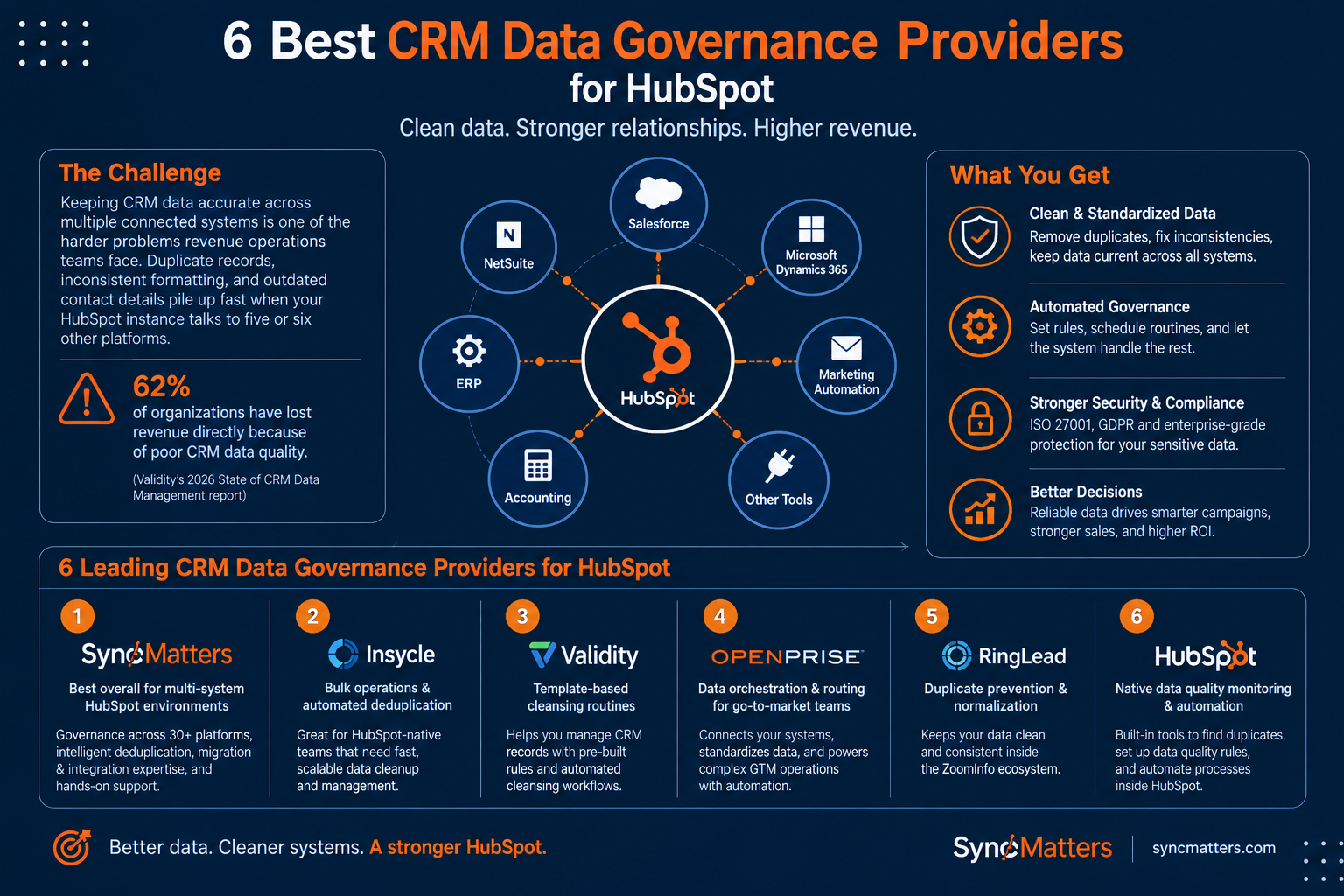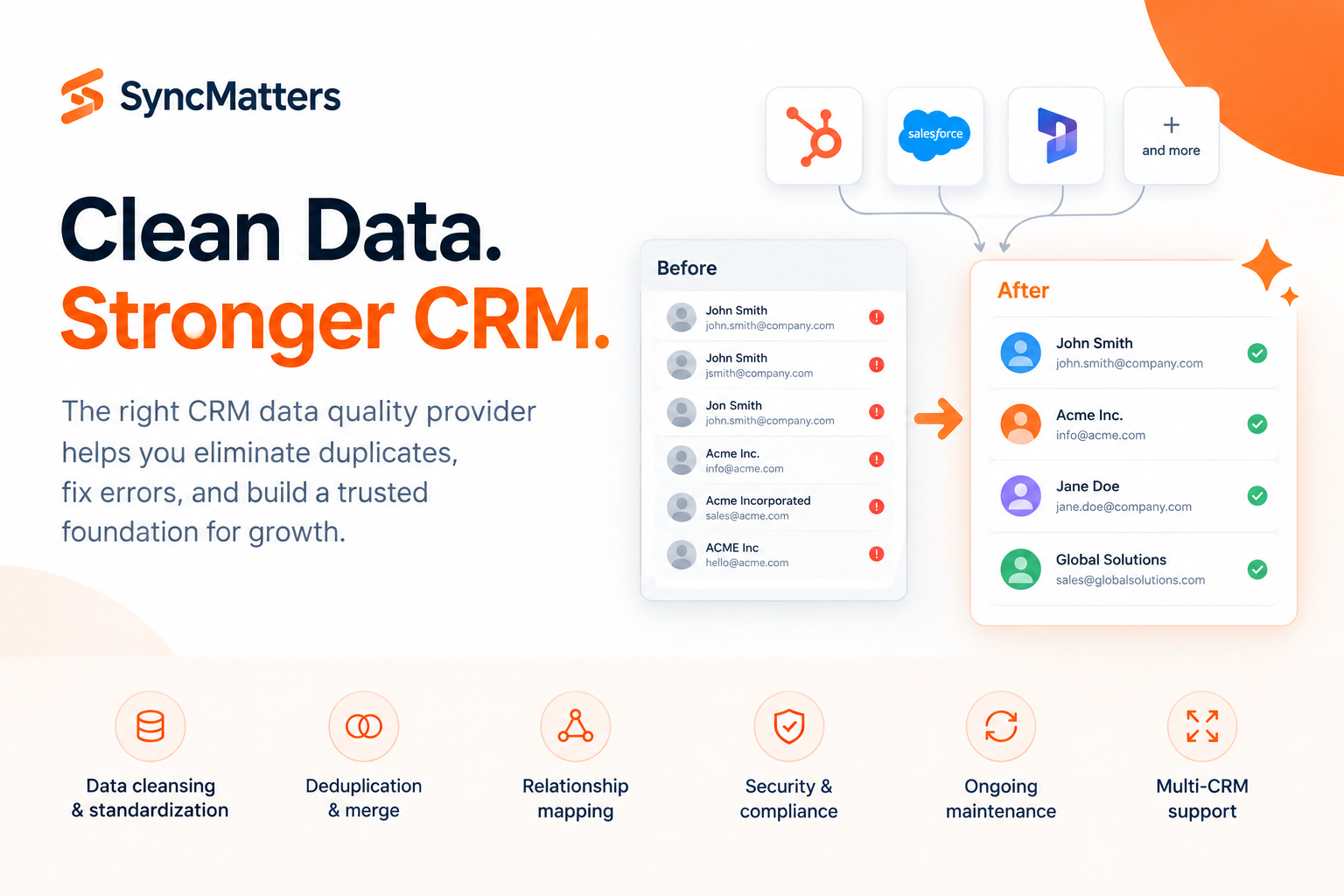
Are you struggling to connect HubSpot with your essential business systems?
Middleware connectors act as the bridge between HubSpot and the dozens of applications your business relies on daily. Whether you're connecting accounting software, e-commerce platforms, ERP systems, or custom databases, the right middleware solution can transform disconnected tools into a unified, efficient technology ecosystem.
Discover why robust middleware integration matters and how to find the perfect connector solution for your HubSpot environment.
Table of Contents
- What is HubSpot Middleware?
- Why Your Business Needs Robust HubSpot Middleware
- Types of HubSpot Integrations Explained
- Key Features of Robust Middleware Connectors
- Evaluating Middleware Solutions for HubSpot
- Popular HubSpot Middleware Platforms Compared
- Common HubSpot Middleware Use Cases
- SyncMatters: Your Comprehensive HubSpot Middleware Solution
- Custom vs. Pre-Built Middleware: Making the Right Choice
- Best Practices for HubSpot Middleware Integration
- The Future of HubSpot Middleware in 2026
- Conclusion: Choosing the Most Robust Solution
What is HubSpot Middleware?
HubSpot middleware is software that sits between HubSpot and other applications, enabling them to communicate and share data seamlessly. Think of middleware as a translator that speaks multiple languages—it takes information from one system, transforms it into the format another system understands, and ensures the data flows correctly in both directions.
Middleware doesn't directly integrate into HubSpot's core platform. Instead, it facilitates interaction between different software systems through connectors, which act as connection functions. This approach allows you to create bridges between two systems, define rules for data exchange, automate workflows, and ensure data consistency across your entire technology stack.
How HubSpot Middleware Works
The middleware integration process follows a systematic workflow:
Step 1: Connection establishment
Middleware connects to HubSpot's API and the target application's API, establishing secure communication channels between both systems.
Step 2: Data mapping
Fields from one system are mapped to corresponding fields in another. For example, a customer email in Shopify maps to a contact email in HubSpot.
Step 3: Transformation rules
Data is transformed as needed—dates reformatted, currencies converted, values calculated, or text modified to match requirements.
Step 4: Sync execution
Data transfers according to defined triggers (real-time, scheduled, or event-based), ensuring information stays current across platforms.
Step 5: Error handling
The middleware monitors for errors, logs issues, sends alerts, and in advanced systems, automatically retries failed operations.
Step 6: Ongoing monitoring
Continuous monitoring ensures integrations remain functional despite API updates, system changes, or increased data volumes.
Why Your Business Needs Robust HubSpot Middleware
Modern businesses operate with increasingly complex technology ecosystems. A typical mid-sized company might use 20-50 different software applications across marketing, sales, customer service, finance, operations, and HR. Without proper integration, these systems create data silos that hamper efficiency and decision-making.
The Cost of Disconnected Systems
Time waste from manual data entry:
Employees spend an average of 8-12 hours weekly on redundant data entry when systems aren't integrated. At $30-50 per hour for administrative staff, this represents $12,480-$31,200 annually per person. For companies with 10+ staff handling data entry, annual costs exceed $125,000.
Data accuracy issues:
Manual entry introduces errors. Studies show human error rates of 1-4% for data entry tasks. In a database of 10,000 customer records, this means 100-400 incorrect entries, leading to failed deliveries, customer service issues, and lost revenue.
Missed opportunities:
Sales teams lacking real-time inventory data might promise products that aren't available. Marketing teams without current customer purchase history can't personalize campaigns effectively. Support teams without complete interaction history provide slower, less effective service.
Strategic blind spots:
Executives need comprehensive dashboards showing metrics across all business functions. Disconnected systems make it impossible to see the complete picture without manual report compilation, delaying decisions and reducing competitive responsiveness.
Benefits of Robust Middleware Integration
Operational efficiency gains:
Automation eliminates repetitive tasks, freeing staff for higher-value work. Companies report 30-50% time savings in departments with well-integrated systems.
Improved data accuracy:
Automated synchronization reduces errors by 90%+ compared to manual entry, improving customer satisfaction and reducing costly mistakes.
Enhanced customer experience:
Complete customer data enables personalized interactions across all touchpoints. Support teams see complete history, sales teams understand customer needs, and marketing delivers relevant content.
Better decision-making:
Real-time dashboards combining data from all systems provide insights that drive strategic decisions. Leaders can spot trends faster and respond to market changes with agility.
Scalability for growth:
As businesses add new tools, middleware enables quick integration without custom development for each connection. This flexibility supports rapid scaling and adaptation.
Types of HubSpot Integrations Explained
Understanding the three main types of HubSpot integrations helps you choose the right approach for each use case.
Native Integrations
Native integrations are built directly into HubSpot by HubSpot's development team. These represent the deepest level of integration, functioning almost as extensions of the CRM itself.
Advantages of native integrations:
- Quick and easy setup, often just a few clicks
- Deep connections into HubSpot's core functionality
- Automatic updates when either platform changes
- No additional software or subscription costs
- Highest reliability and performance
- Best user experience with seamless workflows
Popular HubSpot native integrations:
- Gmail and Outlook for email integration
- Google Calendar and Office 365 for meeting scheduling
- Facebook, LinkedIn, and Instagram for social media
- Zoom for video conferencing
- Shopify for e-commerce (in some regions)
- WordPress for content management
Limitations:
Native integrations only exist for HubSpot's strategic partners. Most business applications don't have native integrations, requiring other approaches.
Third-Party App Integrations
Third-party integrations are built by other companies specifically for HubSpot and listed in the HubSpot App Marketplace. These apps connect to HubSpot through official APIs and provide specialized functionality.
Advantages of third-party integrations:
- Broader coverage of business applications
- Often include advanced features beyond basic data sync
- Regularly updated by dedicated development teams
- Available through HubSpot's marketplace for easy discovery
- Usually include support from the integration provider
Common third-party integration categories:
- E-commerce platforms (WooCommerce, Magento, BigCommerce)
- Accounting software (QuickBooks, Xero, NetSuite)
- Payment processors (Stripe, PayPal)
- Survey tools (Typeform, SurveyMonkey)
- Webinar platforms (GoToWebinar, WebEx)
- SMS and communication tools (Twilio, RingCentral)
Considerations:
Third-party apps typically charge subscription fees separate from HubSpot. Pricing varies based on features, data volume, and support level.
Middleware Integration Platforms
Middleware platforms provide the most flexible integration option, connecting HubSpot to virtually any application with an API or data source.
Advantages of middleware platforms:
- Connect to thousands of applications
- Customizable workflows and data transformations
- Both pre-built templates and custom configurations
- Handle complex multi-step processes
- Support conditional logic and branching
- Enable integrations for proprietary or niche software
Types of middleware platforms:
iPaaS (Integration Platform as a Service):
Cloud-based platforms offering visual workflow builders, pre-built connectors, and managed infrastructure. Examples include Zapier, Make (formerly Integromat), Workato, and Tray.io.
API management platforms:
Focus on API connectivity, rate limiting, and monitoring. Examples include MuleSoft, Boomi, and Jitterbit.
Custom middleware:
Tailored solutions developed specifically for unique business requirements, often using HubSpot's Operations Hub or custom code.
Key Features of Robust Middleware Connectors
When evaluating middleware solutions for HubSpot, certain features distinguish robust, enterprise-ready platforms from basic automation tools.
Comprehensive Connector Library
The best middleware platforms offer extensive connector libraries with hundreds or thousands of pre-built integrations. Look for:
Breadth of coverage:
- CRM and sales platforms
- Marketing automation tools
- E-commerce and payment systems
- Accounting and ERP software
- Customer support platforms
- Project management tools
- Communication and collaboration apps
- Database systems (SQL, NoSQL)
- File storage and document management
- Analytics and business intelligence tools
Quality of connectors:
- Support for all major features of each platform
- Regular updates when APIs change
- Comprehensive documentation
- Active maintenance and bug fixes
Custom connector capabilities:
- Ability to connect to proprietary systems
- Support for REST, SOAP, and GraphQL APIs
- Database connectivity options
- Webhook support for real-time triggers
Advanced Data Transformation
Robust middleware doesn't just move data—it intelligently transforms it to meet each system's requirements.
Essential transformation capabilities:
| Feature | Description | Business Value |
|---|---|---|
| Field mapping | Match fields between systems with different naming | Ensures data lands in correct locations |
| Data type conversion | Convert between strings, numbers, dates, booleans | Maintains data integrity across platforms |
| Value transformation | Apply formulas, calculations, or lookups | Derive new insights from existing data |
| Data enrichment | Add information from external sources | Enhance records with additional context |
| Conditional logic | Apply if/then rules to data processing | Handle complex business rules automatically |
| Multi-step workflows | Chain multiple operations together | Automate sophisticated processes |
| Error handling | Manage exceptions and edge cases | Prevent data corruption from unexpected inputs |
| Data validation | Check data quality before syncing | Stop bad data from entering systems |
Flexible Sync Options
Different data types require different synchronization approaches. Robust middleware supports multiple sync methods:
Real-time synchronization:
Changes trigger immediate updates in connected systems, ensuring data is always current. Critical for:
- Customer service interactions requiring complete contact history
- Sales processes where timing matters for follow-up
- E-commerce orders needing immediate processing
- Payment confirmations and transaction updates
Scheduled synchronization:
Data syncs at defined intervals (hourly, daily, weekly), suitable for:
- Bulk data updates that don't require immediate action
- Reporting and analytics data compilation
- Backup and archival processes
- Resource-intensive operations best run during off-peak hours
Event-based triggers:
Specific events in one system initiate actions in others, enabling:
- Workflow automation (new deal creates project in project management tool)
- Notification systems (payment received triggers thank-you email)
- Stage-based processes (opportunity closed triggers onboarding workflow)
Bidirectional synchronization:
Data flows both ways, keeping both systems as the source of truth for different data types. Essential when:
- Multiple teams work in different systems
- Different systems own different data elements
- You need redundancy for business continuity
Robust Error Handling and Monitoring
Production integrations inevitably encounter issues. The difference between good and great middleware is how it handles problems.
Critical error handling features:
Automatic retry mechanisms:
When syncs fail due to temporary issues (network glitches, API rate limits, system maintenance), robust middleware automatically retries with intelligent back-off strategies.
Detailed error logging:
Every error records with complete context—what data was being processed, what went wrong, when it happened, and which systems were involved. This enables quick troubleshooting.
Intelligent alerting:
Notifications go to appropriate teams when issues arise, with severity levels ensuring critical problems get immediate attention while minor issues queue for batch review.
Partial failure handling:
If syncing 1,000 records and 10 fail, robust middleware completes the 990 successful operations and clearly identifies the 10 failures for review, rather than failing the entire batch.
Data integrity protection:
Validation rules prevent corrupted or incomplete data from entering systems, maintaining database quality even when source data has issues.
Monitoring dashboards:
Visual dashboards show sync status, success rates, processing times, and trends, enabling proactive problem identification before users notice issues.
Enterprise-Grade Security
Security is non-negotiable when middleware handles your business-critical data.
Essential security features:
| Security Layer | Requirements | Why It Matters |
|---|---|---|
| Data encryption | TLS 1.2+ in transit, AES-256 at rest | Protects sensitive information from interception |
| Authentication | OAuth 2.0, API keys, MFA support | Prevents unauthorized access to systems |
| Access controls | Role-based permissions, least privilege | Limits who can create or modify integrations |
| Audit logging | Complete activity tracking | Enables compliance and forensic investigation |
| Data residency | Control where data is processed/stored | Meets regulatory requirements (GDPR, etc.) |
| Compliance certifications | SOC 2, ISO 27001, HIPAA (if applicable) | Demonstrates security program maturity |
| Secrets management | Secure storage of API credentials | Prevents credential exposure in code |
| Network security | IP whitelisting, VPN support | Additional layers of protection |
Evaluating Middleware Solutions for HubSpot
Choosing the right middleware requires systematic evaluation of multiple factors. Here's a comprehensive framework for assessing solutions:
Integration Capabilities 🔗
At the core of any middleware evaluation is its ability to connect the specific applications your business uses.
Evaluation checklist:
- [ ] Does it have pre-built connectors for all your critical systems?
- [ ] How many total connectors are available in its library?
- [ ] Can it connect to custom or proprietary applications?
- [ ] Does it support various integration methods (REST, SOAP, webhooks, databases)?
- [ ] What data formats does it handle (JSON, XML, CSV, EDI)?
- [ ] Does it support both real-time and batch processing?
- [ ] Can it handle large data volumes efficiently?
Red flags:
- Limited connector library requiring extensive custom development
- No support for critical systems you currently use
- Poor documentation for connector capabilities
- Frequent connector deprecation or lack of maintenance
Scalability and Flexibility 📈
Your middleware must grow with your business without becoming a bottleneck.
Scalability assessment:
| Factor | Questions to Ask | What Good Looks Like |
|---|---|---|
| Data volume | How much data can it process hourly/daily? | Handles 10x current volume without performance issues |
| Concurrent integrations | How many integrations can run simultaneously? | Supports 100+ active integrations without slowdown |
| API rate limit management | How does it handle rate limits? | Intelligent throttling and automatic retry logic |
| Infrastructure | Can it scale automatically during peaks? | Cloud-native architecture with auto-scaling |
| Geographic distribution | Does it support multi-region deployment? | Data processing near your users for lower latency |
Flexibility evaluation:
- Can you add new systems without disrupting existing integrations?
- Does it support both cloud and on-premises applications?
- Can workflows be modified without starting from scratch?
- Does it accommodate changing business rules without recoding?
Ease of Use and Deployment ⚙️
User-friendly middleware empowers business users and reduces IT dependency.
Usability factors:
Visual workflow builder:
Drag-and-drop interface allowing non-technical users to create integrations visually rather than writing code.
Template library:
Pre-built integration templates for common use cases accelerate implementation. Look for:
- HubSpot to QuickBooks accounting sync
- E-commerce order to HubSpot deal creation
- Support ticket to HubSpot service ticket sync
- Lead capture to HubSpot contact creation
Testing capabilities:
Ability to test integrations with sample data before deploying to production prevents costly mistakes.
Deployment speed:
- How quickly can you go from concept to production?
- Is there a sandbox environment for safe testing?
- Can you deploy changes with zero downtime?
- Is there a rollback capability if problems occur?
Learning curve:
- How long does it take new users to become productive?
- Is training required or is it intuitive enough for self-service?
- What documentation and learning resources are available?
Customization Options 🛠️
Every business has unique requirements that standard templates can't fully address.
Customization capabilities to evaluate:
Custom scripting:
Ability to write custom code for complex logic using languages like JavaScript, Python, or proprietary scripting languages.
Advanced data mapping:
- Multi-field lookups (finding records based on multiple criteria)
- Conditional mappings (different rules based on data values)
- Aggregation functions (sum, average, count across records)
- String manipulation (parsing, concatenation, regex)
Custom API connections:
Support for connecting to any system with an API, not just pre-built connectors.
Custom workflow logic:
- Loops and iterations for processing multiple records
- Branching based on complex conditions
- Error handling with custom retry logic
- Parallel processing for performance
UI customization:
Some platforms allow building custom interfaces for specific integration management needs.
Security and Compliance 🔒
Data security breaches can be catastrophic. Middleware must meet or exceed your security requirements.
Security evaluation framework:
Data protection:
- What encryption standards are used?
- Where is data stored during processing?
- How long is data retained in middleware systems?
- Can you control data residency by geography?
Access control:
- What authentication methods are supported?
- Can you implement role-based access control?
- Is multi-factor authentication available?
- Can you integrate with your SSO provider?
Compliance:
- What certifications does the vendor hold?
- Do they undergo regular security audits?
- Can they provide compliance documentation for your industry?
- How do they handle data privacy regulations?
Audit and monitoring:
- Is all activity logged for audit purposes?
- Can you track who accessed or modified integrations?
- Are there alerts for suspicious activity?
- Can logs be exported to your SIEM system?
Performance and Reliability ⚡
Downtime in critical integrations can halt business operations.
Performance metrics to evaluate:
| Metric | Industry Standard | Questions to Ask |
|---|---|---|
| Uptime SLA | 99.9% or higher | What's guaranteed uptime? What's actual historical uptime? |
| Processing speed | <5 seconds for real-time | How long from trigger to completion? |
| Latency | <100ms API response | What's typical delay in data appearing? |
| Throughput | 1000+ records/minute | How many records can process per hour? |
| Error rate | <0.1% | What percentage of operations fail? |
Reliability features:
- Redundant infrastructure across multiple availability zones
- Automatic failover if primary systems fail
- Load balancing to distribute processing
- Status page showing real-time system health
- Historical performance metrics and trends
Disaster recovery:
- What's the recovery time objective (RTO) after major failure?
- What's the recovery point objective (RPO) for data loss?
- Are backups automated and tested regularly?
- Is there a documented disaster recovery plan?
Vendor Support 📞
Even the best middleware requires support for implementation, troubleshooting, and optimization.
Support evaluation criteria:
Availability:
- What are support hours? (24/7, business hours, time zone specific)
- What's the response time SLA for different severity levels?
- Is support included in base pricing or an add-on?
Channels:
- Email support with ticketing system
- Live chat for immediate assistance
- Phone support for urgent issues
- Dedicated customer success manager (enterprise plans)
- Community forums for peer assistance
Quality indicators:
- Average time to resolution for typical issues
- Customer satisfaction scores for support
- Percentage of issues resolved on first contact
- Escalation procedures for complex problems
Resources:
- Comprehensive documentation with examples
- Video tutorials and training courses
- Certification programs for advanced users
- Regular webinars on best practices
- Active user community and knowledge base
Proactive support:
- Monitoring and alerts for your integrations
- Recommendations for optimization
- Notification of upcoming API changes
- Assistance with platform migrations
Total Cost of Ownership 💰
Looking beyond initial pricing to understand true costs over time is critical.
TCO components:
Subscription fees:
| Plan Level | Typical Monthly Cost | What's Included |
|---|---|---|
| Starter | $50-300 | Limited integrations, basic features, community support |
| Professional | $300-1,000 | More integrations, advanced features, email support |
| Business | $1,000-3,000 | Unlimited integrations, all features, priority support |
| Enterprise | $3,000-10,000+ | Custom limits, dedicated support, SLAs |
Variable costs:
- Per-operation charges (some platforms charge per sync operation)
- Data transfer fees for high volumes
- Additional user licenses
- Premium connector access
- Storage fees for data retention
Implementation costs:
- Initial setup and configuration: $2,000-20,000
- Custom development for unique requirements: $5,000-50,000+
- Training for staff: $1,000-5,000
- Ongoing maintenance and optimization: 10-20% of setup cost annually
Hidden costs:
- Staff time managing integrations
- Downtime impact when issues occur
- Migration costs if switching platforms later
- Opportunity cost of delayed integration projects
ROI calculation example:
Mid-sized company with 50 employees:
- Manual data entry time saved: 5 hours/week × 50 employees = 250 hours/week
- At $40/hour average: $10,000/week = $520,000/year in productivity gains
- Middleware cost: $2,500/month × 12 = $30,000/year
- Setup and training: $15,000 one-time
- First year net benefit: $520,000 - $30,000 - $15,000 = $475,000
- First year ROI: 1,056%
Popular HubSpot Middleware Platforms Compared
Several middleware platforms have emerged as leaders for HubSpot integration. Here's an objective comparison:
Comparison Table
| Platform | Best For | Strengths | Limitations | Starting Price |
|---|---|---|---|---|
| SyncMatters | HubSpot-focused integrations | Deep HubSpot expertise, custom solutions, white-glove service | Focused on B2B, may be overkill for simple needs | Custom pricing |
| Zapier | Small businesses, simple automations | Easiest to use, huge app library, free tier | Limited complex logic, can get expensive at scale | Free-$30/mo |
| Make | Power users wanting advanced features | Visual builder, powerful logic, good pricing | Steeper learning curve than Zapier | Free-$10/mo |
| Workato | Enterprise companies | Robust enterprise features, strong security | Expensive, requires technical expertise | $10,000+/year |
| Tray.io | Complex automation needs | Extremely powerful, flexible | Very expensive, complex setup | $15,000+/year |
| HubSpot Operations Hub | HubSpot-centric workflows | Native to HubSpot, deep integration | Limited to HubSpot ecosystem, requires Professional | $720/year |
| Jitterbit | Legacy system integration | Strong with older enterprise systems | Older interface, steeper learning curve | Custom pricing |
| MuleSoft | Large enterprises with complex needs | Extremely robust, handles any scenario | Very expensive, requires IT team | $50,000+/year |
Detailed Platform Analysis
SyncMatters:
Specialized in HubSpot integrations with over 10,000 successful app installations. As an Elite HubSpot partner, SyncMatters brings deep platform knowledge and strategic integration expertise. They focus on delivering comprehensive solutions rather than just connecting APIs, with particular strength in complex B2B scenarios involving multiple systems. Best for companies wanting expert guidance and custom integration development rather than DIY approaches.
Zapier:
The most popular choice for small to mid-sized businesses due to its simplicity and extensive app directory of 5,000+ applications. Zapier's strength is speed—you can create basic integrations in minutes without technical knowledge. However, complex multi-step workflows with branching logic can become expensive, and performance sometimes lags for high-volume data processing.
Make (formerly Integromat):
Offers more advanced features than Zapier at lower prices, with visual workflow builder showing the complete integration flow. Make excels at complex scenarios requiring loops, iterators, and advanced data transformations. The learning curve is steeper but worthwhile for power users wanting more control without custom coding.
Workato:
Enterprise-focused platform emphasizing security, governance, and scalability. Workato's recipe-based approach combines pre-built templates with extensive customization capabilities. Strong API management and monitoring make it suitable for large organizations with complex integration requirements and dedicated integration teams.
Common HubSpot Middleware Use Cases
Understanding how other businesses use middleware helps identify opportunities in your own operations.
E-Commerce Integration
Scenario: Online retailer using Shopify for their store and HubSpot for marketing and customer service.
Integration requirements:
- New Shopify customers automatically create as HubSpot contacts
- Order data syncs to HubSpot for customer service context
- Abandoned carts trigger HubSpot email recovery workflows
- Product purchases update contact properties for segmentation
- Customer lifetime value calculates from order history
Business impact:
- Marketing can segment by purchase history and behavior
- Customer service sees complete order history during interactions
- Automated campaigns based on purchase patterns increase repeat sales
- Single source of truth for customer data across teams
Middleware features utilized:
- Bidirectional sync between Shopify and HubSpot
- Data transformation to match field types between systems
- Workflow triggers based on order status changes
- Custom properties creation for e-commerce metrics
Accounting System Synchronization
Scenario: Professional services firm using QuickBooks for accounting and HubSpot for CRM and business development.
Integration requirements:
- New HubSpot clients automatically create as QuickBooks customers
- Invoices from QuickBooks sync to HubSpot for visibility
- Payment status updates in real-time
- Service codes from time tracking inform cross-selling opportunities
- Financial metrics display in HubSpot dashboards
Business impact:
- Sales team sees client payment status during conversations
- Finance team doesn't manually enter customer data
- Partners get real-time visibility into cash flow and AR
- Business development identifies services clients haven't purchased
Middleware features utilized:
- Scheduled synchronization for financial data
- Real-time updates for critical information like payments
- Field mapping between different data structures
- Custom calculations for derived metrics
Multi-Platform Lead Management
Scenario: SaaS company capturing leads from website forms, webinar platforms, trade show apps, and advertising platforms, all needing to flow into HubSpot.
Integration requirements:
- Leads from all sources create as HubSpot contacts
- Source tracking for marketing attribution
- Duplicate prevention across platforms
- Lead scoring based on engagement across channels
- Automatic list assignment based on lead characteristics
Business impact:
- Complete view of lead journey across all touchpoints
- Accurate ROI measurement for marketing channels
- No leads fall through cracks between systems
- Sales team gets timely, qualified leads
Middleware features utilized:
- Multiple source integrations converging on HubSpot
- Intelligent duplicate detection and merging
- Conditional logic for lead routing
- Data enrichment from third-party sources
Customer Support Workflow Automation
Scenario: Technology company using Zendesk for support tickets and HubSpot for customer success and sales.
Integration requirements:
- Support tickets from Zendesk create HubSpot service tickets
- Customer interactions visible to entire team
- Escalation workflows trigger customer success outreach
- Product issues inform development priority
- Support metrics display in customer health scores
Business impact:
- Customer success proactively addresses at-risk accounts
- Sales team aware of support issues before renewal conversations
- Product team prioritizes based on customer feedback volume
- Complete customer history across all departments
Middleware features utilized:
- Bidirectional ticket synchronization
- Webhook triggers for real-time updates
- Complex workflow logic for escalations
- Data aggregation for reporting
SyncMatters: Your Comprehensive HubSpot Middleware Solution
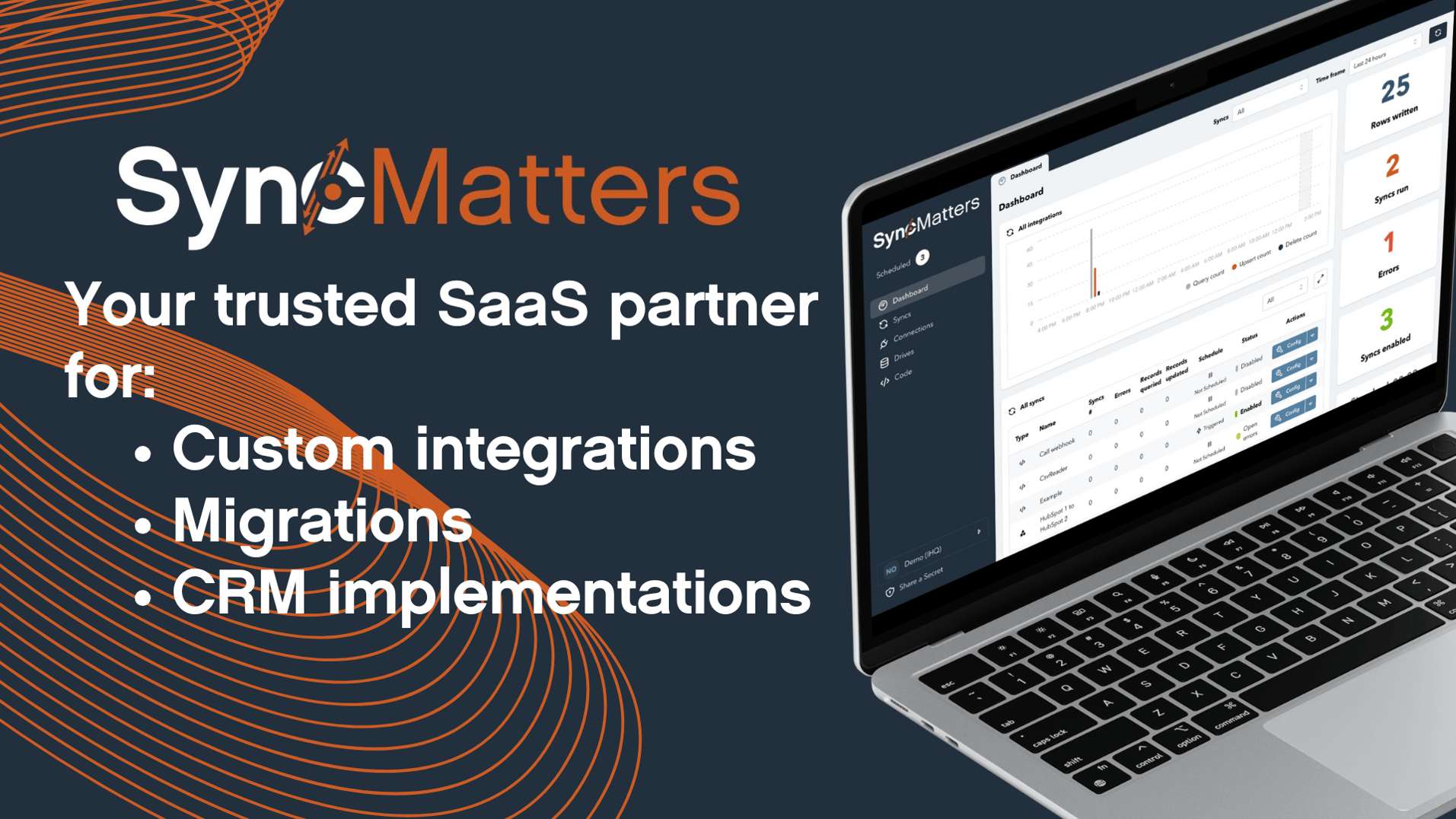
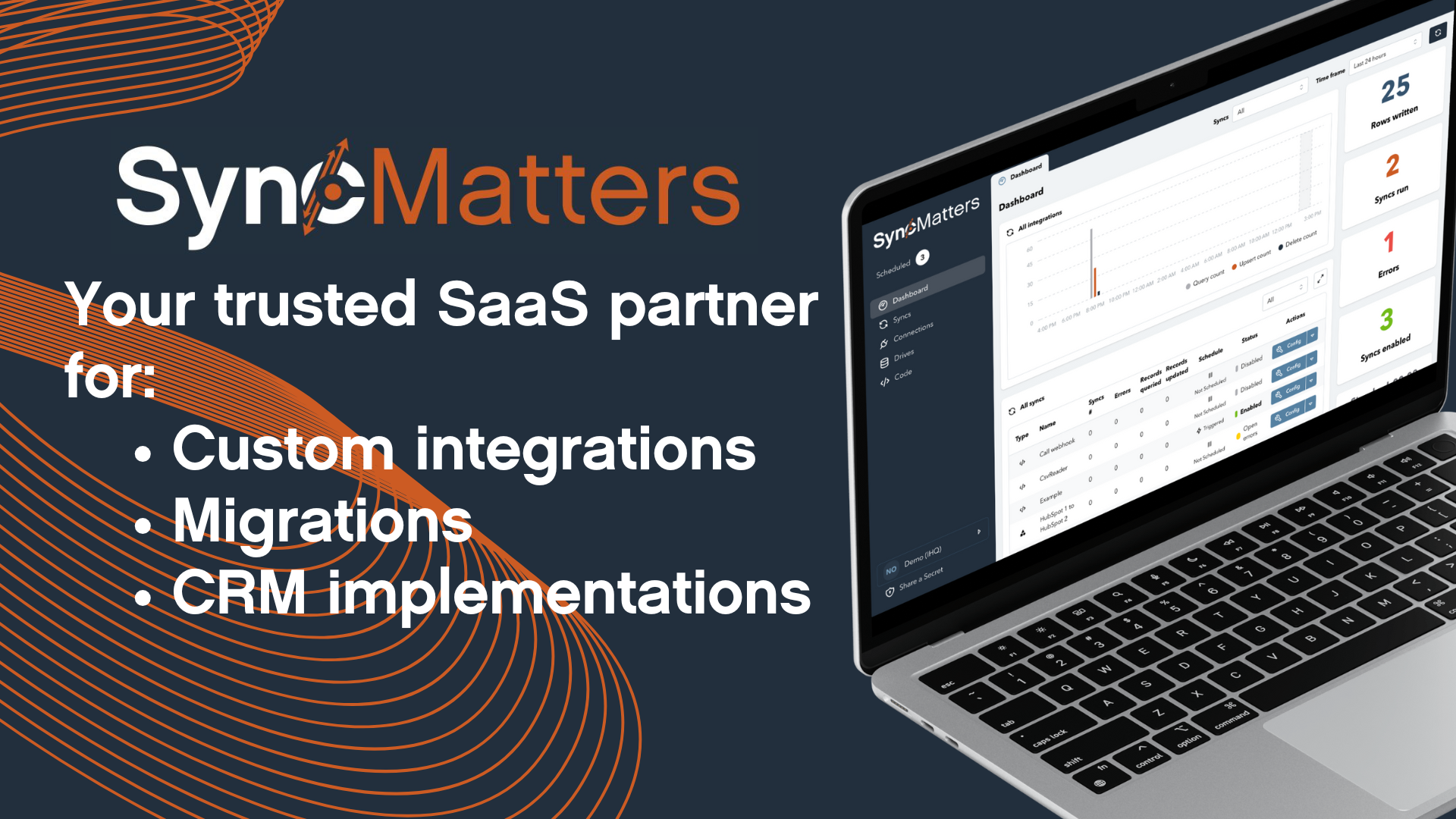
When your business depends on HubSpot and needs robust, reliable middleware integration, SyncMatters delivers comprehensive solutions combining platform expertise, custom development, and ongoing support.
Why SyncMatters Stands Out
Elite HubSpot partnership:
As a certified Elite HubSpot partner with specialized accreditations in Integration and Data Migration, SyncMatters brings proven HubSpot expertise to every project. This partnership provides:
- Direct access to HubSpot engineering teams for complex scenarios
- Early access to new features and beta programs
- Deep platform knowledge beyond standard documentation
- Proven track record with 10,000+ successful app installations
Comprehensive service approach:
SyncMatters doesn't just connect APIs—they optimize your entire CRM ecosystem. Services include:
- Custom integrations tailored to unique business requirements
- HubSpot implementations for complete platform setup
- HubSpot migrations from legacy systems
- HubSpot onboarding for team enablement
Technical excellence:
The SyncMatters team combines strategic thinking with technical execution:
- 100+ sales and marketing certifications across the team
- Experience with complex B2B integration scenarios
- Custom middleware development using modern architectures
- API expertise across hundreds of platforms
Customer-centric methodology:
Client testimonials consistently highlight SyncMatters' commitment to exceptional service. One marketing manager noted the team "took the experience to another level and made the whole project much less stressful," while helping find solutions that truly served their customers.
SyncMatters Integration Capabilities
Pre-built connectors:
Extensive library of tested connectors for popular business applications including:
- CRM platforms (Salesforce, Pipedrive, Zoho)
- Accounting systems (QuickBooks, Xero, NetSuite, Sage)
- E-commerce platforms (Shopify, WooCommerce, Magento)
- Marketing tools (Mailchimp, ActiveCampaign, Marketo)
- Communication platforms (Slack, Microsoft Teams, Zoom)
- Project management (Asana, Monday.com, Jira)
- And hundreds more
Custom middleware development:
When pre-built solutions don't fit, SyncMatters develops custom middleware specifically for your use case:
- Connection to proprietary or legacy systems
- Complex data transformations matching business logic
- Advanced workflow automation beyond platform limits
- High-performance solutions for large data volumes
- Secure architecture meeting compliance requirements
Integration architecture:
Strategic planning ensures integrations scale with business growth:
- Technology roadmap alignment
- Future-proofing for planned system changes
- Performance optimization for efficiency
- Security and compliance by design
- Documentation for long-term maintainability
The SyncMatters Difference
Industry expertise:
Specialized knowledge in B2B sectors including SaaS, professional services, manufacturing, and technology ensures SyncMatters understands your business context, not just technical requirements.
White-glove service:
Dedicated project management, regular communication, and responsive support throughout implementation and beyond.
Proven track record:
Thousands of successful integrations with 4.9/5 customer satisfaction rating demonstrate consistent delivery of quality solutions.
Long-term partnership:
SyncMatters builds lasting relationships, providing ongoing optimization, support for new requirements, and proactive recommendations as your business evolves.
Ready to Transform Your HubSpot Integrations?
If you're ready to move beyond basic automation and implement robust middleware solutions that truly optimize your business operations, contact SyncMatters for a consultation. Our team will assess your integration needs, recommend optimal approaches, and deliver solutions that drive measurable business value.
Custom vs. Pre-Built Middleware: Making the Right Choice
One critical decision in your middleware journey is whether to use pre-built platforms or invest in custom development.
Pre-Built Middleware Platforms
When to choose pre-built:
- Standard integration requirements matching common use cases
- Need for rapid deployment (weeks instead of months)
- Limited technical resources or budget for custom development
- Multiple integrations needed simultaneously
- Ongoing platform updates and maintenance included
- Strong community support and documentation available
Advantages:
- Lower upfront investment
- Faster time to value
- Proven reliability through extensive user testing
- Regular updates and new features included
- Visual interfaces reducing technical barriers
- Support infrastructure already established
Limitations:
- Less flexibility for unique business logic
- May not support all required systems
- Ongoing subscription costs compound over time
- Dependent on vendor roadmap for new features
- Potential performance constraints with large data volumes
- Limited control over infrastructure and security
Custom Middleware Development
When to choose custom:
- Highly specific business requirements that platforms don't address
- Integration with proprietary or legacy systems without APIs
- Need for maximum performance and optimization
- Strict security or compliance requirements
- Complex data transformations requiring specialized logic
- Long-term strategy to own integration infrastructure
Advantages:
- Complete control over functionality and features
- Optimized specifically for your exact requirements
- No per-operation or subscription costs after development
- Integration of business logic directly into data flows
- Maximum performance through custom optimization
- Full ownership of code and intellectual property
Limitations:
- Higher upfront development costs ($50,000-$500,000+ for complex systems)
- Longer development timeline (months to over a year)
- Ongoing maintenance responsibility
- Need for specialized technical expertise
- Updates and improvements require additional development
- Scaling requires infrastructure planning and investment
Hybrid Approach: Best of Both Worlds
Many successful businesses use a hybrid strategy:
Use pre-built platforms for:
- Standard integrations between popular applications
- Rapid prototyping and testing of integration concepts
- Non-critical integrations with low data volumes
- Temporary integrations during transitions
Invest in custom development for:
- Core business-critical integrations
- Competitive differentiators in customer experience
- High-volume data processing requiring optimization
- Proprietary systems without alternative options
- Complex workflows embodying unique business processes
This approach balances speed and cost-effectiveness for standard needs with strategic investment in custom solutions for competitive advantage.
Best Practices for HubSpot Middleware Integration
Successful middleware implementations follow proven practices that maximize value and minimize risks.
Planning Phase Best Practices
1. Document current state thoroughly:
- Map all existing systems and data flows
- Identify data owners and stakeholders for each system
- Document current pain points and inefficiencies
- Quantify manual effort and error rates
- Understand compliance and security requirements
2. Define clear objectives and success metrics:
- Specific integration goals tied to business outcomes
- Measurable KPIs for integration success
- Timeline with milestones and checkpoints
- Budget allocation across implementation phases
- ROI targets and tracking methodology
3. Prioritize integrations strategically:
- Start with highest-value integrations showing quick wins
- Consider dependencies between integrations
- Balance quick victories with long-term strategic needs
- Factor in complexity and resource requirements
- Plan sequencing to minimize disruption
4. Engage stakeholders early:
- Include representatives from all affected departments
- Get executive sponsorship for change management
- Identify integration champions within user groups
- Communicate vision and benefits broadly
- Address concerns and resistance proactively
Implementation Phase Best Practices
5. Start with thorough data mapping:
- Document all fields requiring synchronization
- Define transformation rules for data format differences
- Establish data governance policies
- Create data dictionary for consistent terminology
- Plan for data quality improvement during migration
6. Build in phases with testing:
- Implement one integration completely before starting next
- Test extensively in sandbox environment
- Run parallel processing during transition periods
- Validate data accuracy at each milestone
- Gather user feedback before full rollout
7. Handle errors gracefully:
- Design robust error handling from the beginning
- Implement automated retry logic for temporary failures
- Create clear escalation paths for persistent issues
- Log all errors with sufficient detail for troubleshooting
- Set up monitoring and alerting for critical failures
8. Document everything:
- Integration architecture diagrams
- Data flow documentation
- Field mapping specifications
- Error handling procedures
- User guides for each integration
- Troubleshooting references
Ongoing Management Best Practices
9. Monitor proactively:
- Regular review of integration performance metrics
- Monitoring of sync success rates and timing
- Tracking of error patterns and trends
- Capacity planning based on growth trends
- Performance optimization as needed
10. Maintain security vigilance:
- Regular security audits of integration infrastructure
- Rotation of API keys and credentials on schedule
- Access review ensuring least privilege principles
- Monitoring of authentication logs for anomalies
- Keeping middleware platforms updated with security patches
11. Optimize continuously:
- Regular review of integration efficiency
- Identification of new automation opportunities
- Refinement of data transformation rules
- Performance tuning for high-volume integrations
- Elimination of redundant or unused integrations
12. Plan for change:
- Stay informed about API updates from vendors
- Test integrations before platform upgrades
- Maintain integration inventory and dependencies
- Have rollback plans for critical changes
- Document lessons learned for future projects
The Future of HubSpot Middleware in 2026
The middleware landscape continues evolving rapidly with emerging technologies and changing business needs.
AI-Powered Integration
Artificial intelligence is transforming middleware capabilities:
Intelligent data mapping:
AI analyzes source and destination data structures, automatically suggesting optimal field mappings and reducing manual configuration time by 60-80%.
Predictive error handling:
Machine learning models predict potential integration failures before they occur, enabling proactive intervention and reducing downtime.
Automated optimization:
AI continuously monitors integration performance, automatically adjusting sync frequencies, batch sizes, and resource allocation for optimal efficiency.
Natural language configuration:
Emerging platforms allow describing integration requirements in plain English, with AI translating to technical implementation automatically.
Low-Code/No-Code Evolution
The trend toward democratizing integration continues:
Visual workflow builders:
Increasingly sophisticated drag-and-drop interfaces enable complex integrations without coding, empowering business users to create and modify integrations independently.
Pre-built templates:
Expanding libraries of industry-specific and use-case-specific templates accelerate implementation from weeks to hours.
Self-service capabilities:
Middleware platforms provide guided experiences walking users through integration creation, reducing dependence on technical specialists.
Real-Time Everything
Business expectations shift toward instant data synchronization:
Event-driven architecture:
Webhooks and real-time triggers replace scheduled batch processing for immediate data propagation across systems.
Streaming data processing:
Handling continuous data streams rather than discrete batches enables truly real-time analytics and decision-making.
Reduced latency:
Edge computing and distributed processing reduce integration latency from minutes to milliseconds.
API Standardization
The integration ecosystem continues maturing:
GraphQL adoption:
Flexible query language enables clients to request exactly the data needed, reducing over-fetching and improving performance.
API governance:
Enterprise focus on API design standards, versioning strategies, and lifecycle management improves integration stability.
Integration platforms:
Vendors increasingly offer unified APIs simplifying integration despite backend complexity.
Compliance and Privacy
Regulatory requirements shape middleware capabilities:
Privacy by design:
Integration platforms build in data privacy features including data minimization, purpose limitation, and consent management.
Automated compliance:
Middleware handles regulatory requirements like data residency, retention policies, and access controls automatically.
Audit capabilities:
Comprehensive logging and reporting support compliance demonstration and regulatory audits.
Conclusion: Choosing the Most Robust Solution
Selecting the right middleware connector for HubSpot is one of the most strategic technology decisions your business will make. The right solution eliminates data silos, automates manual processes, improves decision-making, and positions your business for scalable growth.
Key Takeaways
1. Middleware is essential, not optional:
Modern businesses operate with dozens of applications. Without robust middleware, you face inefficiency, errors, and limited visibility.
2. One size doesn't fit all:
Different businesses need different solutions. A startup might thrive with Zapier while an enterprise requires Workato or custom middleware.
3. Integration capabilities matter most:
Ensure your chosen platform connects to your specific applications with sufficient flexibility for your unique requirements.
4. Total cost of ownership exceeds subscription fees:
Consider implementation costs, ongoing maintenance, staff time, and opportunity costs when comparing options.
5. Security and compliance are non-negotiable:
Middleware handles your most sensitive data. Ensure your solution meets all security and regulatory requirements.
6. Support and expertise accelerate success:
Technical capabilities matter, but vendor expertise and support often determine whether implementations succeed or struggle.
7. Plan for the future:
Choose solutions that scale with growth and adapt to changing requirements rather than forcing you into rebuilds every few years.
Making Your Decision
Use this evaluation framework:
Step 1: Assess your requirements
- List all systems requiring integration
- Document data flow requirements
- Define critical success metrics
- Establish budget parameters
Step 2: Evaluate platform capabilities
- Compare connector libraries to your needs
- Test platforms with trial accounts
- Validate complex use case support
- Review security and compliance features
Step 3: Consider total costs
- Calculate subscription costs at anticipated scale
- Estimate implementation costs
- Factor in training and ongoing management
- Project ROI over 3-5 years
Step 4: Evaluate vendor support
- Review customer testimonials and case studies
- Assess documentation quality
- Test support responsiveness
- Verify vendor stability and track record
Step 5: Start small and scale
- Begin with high-value, lower-complexity integration
- Validate approach before broad deployment
- Gather user feedback and optimize
- Expand systematically based on success
Partner with Middleware Experts
For businesses serious about HubSpot integration success, partnering with experts like SyncMatters accelerates results while avoiding costly mistakes. With deep HubSpot platform expertise, comprehensive integration services, and a proven track record of successful implementations, SyncMatters transforms integration from a technical challenge into a strategic advantage.
Whether you need pre-built connectors, custom middleware development, or ongoing HubSpot optimization, the right partner ensures your integration investment delivers maximum business value.
Ready to implement robust HubSpot middleware?
Contact SyncMatters today to discuss your integration requirements and discover how expert middleware solutions can transform your business operations.
Explore more resources:
- View case studies of successful integrations
- Calculate your HubSpot ROI
- Learn about migrations to HubSpot
- Read our blog for integration insights
About the Author: The Integration Specialists Team at SyncMatters brings decades of combined experience in CRM integration, middleware architecture, and HubSpot implementation. Our team holds 100+ certifications across leading platforms and has successfully delivered 10,000+ integrations for businesses worldwide.



.svg)