Table of Contents
- Introduction
- What Is Collaborative CRM?
- The Three Types of CRM: Understanding the Differences
- Key Components of Collaborative CRM Software
- Benefits of Collaborative CRM for Cross-Functional Teams
- Real-World Examples and Case Studies
- How SyncMatters Enables Collaborative CRM Success
- Implementing Collaborative CRM: Best Practices
- Common Challenges and Solutions
- The Future of Collaborative CRM
- FAQ
Introduction
In modern organizations, customer relationships span multiple departments. A prospect might discover your brand through marketing content, engage with sales during the evaluation process, then interact with customer service after purchase. Each touchpoint generates valuable information, yet this data often remains trapped in departmental silos. The result is fragmented customer experiences, duplicated efforts, and missed revenue opportunities.
Collaborative CRM addresses this fundamental challenge by creating a unified platform where sales, marketing, and customer service teams share information, coordinate activities, and work from a single source of truth. Research indicates that organizations with aligned sales and marketing teams achieve 36 percent higher customer retention rates and 20 percent higher customer lifetime value. Companies like SyncMatters specialize in enabling this collaboration through seamless CRM integration and data migration services. Despite these compelling benefits, surveys reveal a significant gap between perception and reality. While 82 percent of executives believe their sales and marketing teams are aligned, only 65 percent of frontline professionals report experiencing genuine alignment.
This disconnect highlights the critical need for systems and processes that facilitate genuine collaboration rather than simply claiming to do so. Collaborative CRM provides the technological foundation and operational framework to transform isolated departments into coordinated revenue teams.
What Is Collaborative CRM?
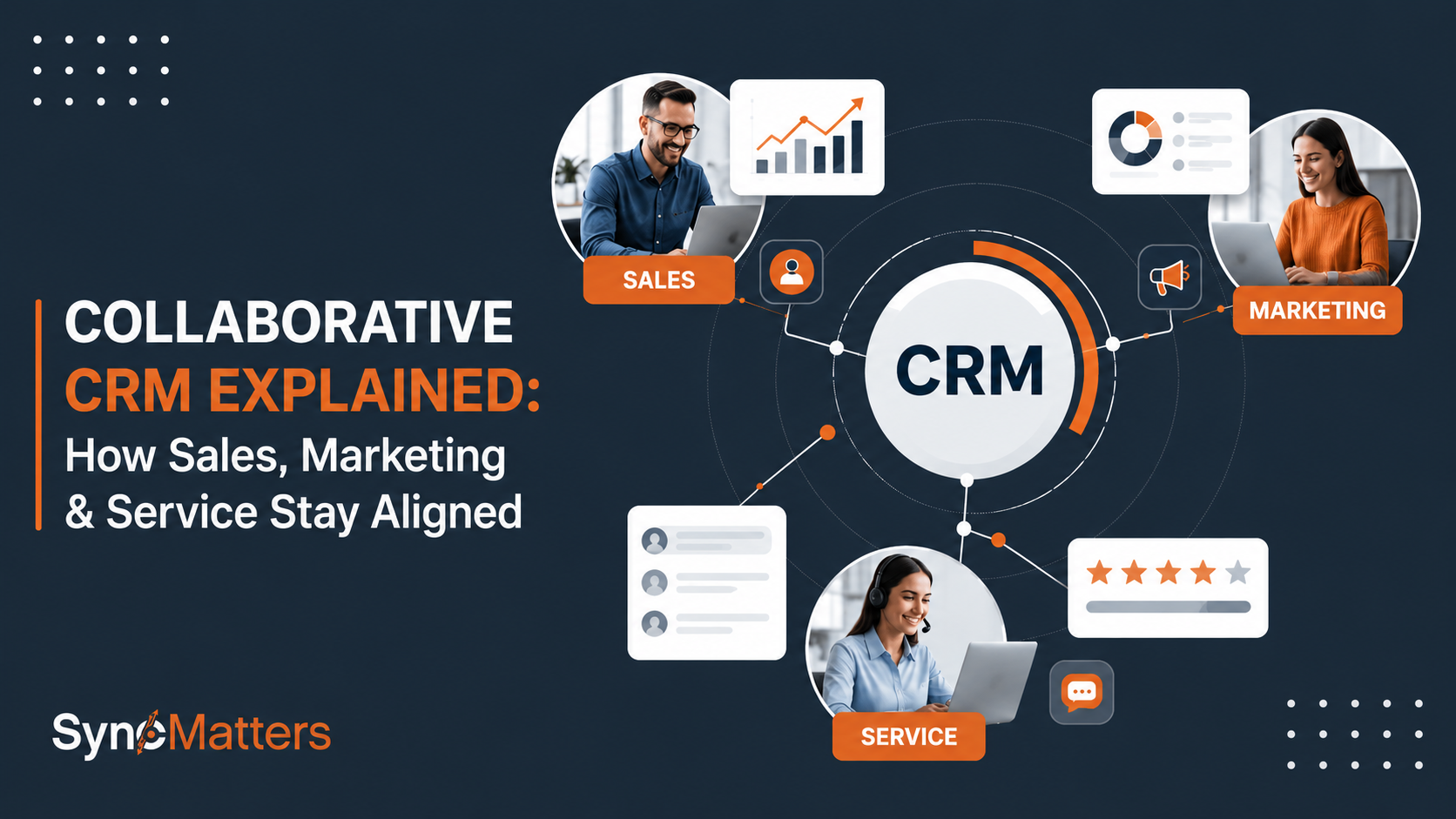
Collaborative CRM is a customer relationship management approach focused on enabling seamless information sharing and coordination across all customer-facing departments. Unlike operational CRM systems that automate individual processes or analytical CRM platforms that generate insights from data, collaborative CRM creates a shared customer record accessible to every team member who interacts with that account.
The fundamental principle underlying collaborative CRM is simple yet powerful: everyone who touches a customer relationship should have complete visibility into that relationship's history, current status, and planned next steps. When a service representative answers a customer call, they immediately see recent marketing campaigns the customer received, conversations with sales representatives, open support tickets, and purchasing history. This comprehensive context enables personalized, informed interactions regardless of which department handles the engagement.
Collaborative CRM systems centralize communication history including emails, calls, meetings, and chat conversations. They track deal progression and customer journey stages with clear handoff protocols between teams. Activity logs maintain transparent records of who did what and when. Shared task management ensures follow-ups never fall through organizational cracks. Document repositories provide consistent access to proposals, contracts, and reference materials.
The business case for collaborative CRM extends beyond operational efficiency. Organizations increasingly recognize that customer experience depends on coordination across touchpoints. Customers expect consistency whether they interact with marketing, sales, or service. They grow frustrated when forced to repeat information or encounter contradictory messages from different departments. Collaborative CRM eliminates these friction points by ensuring everyone operates from the same information foundation.
The Three Types of CRM: Understanding the Differences
Modern CRM systems generally fall into three categories, each serving distinct organizational needs. Understanding these differences clarifies collaborative CRM's unique value proposition.

Operational CRM
Operational CRM focuses on automating and streamlining customer-facing processes. Sales automation features manage pipeline stages, track opportunities, and facilitate deal progression. Marketing automation capabilities execute campaigns, nurture leads, and score prospect engagement. Service automation tools handle ticket management, case routing, and support workflows. The primary goal is efficiency through process optimization and task automation.
Analytical CRM
Analytical CRM emphasizes data analysis and business intelligence. These systems aggregate information from multiple sources, apply statistical models, and generate actionable insights. Predictive analytics forecast customer behavior and sales outcomes. Segmentation tools identify distinct customer groups. Performance dashboards visualize key metrics. The analytical approach answers strategic questions about customer patterns, campaign effectiveness, and revenue trends.
Collaborative CRM
Collaborative CRM prioritizes information sharing and cross-functional coordination. Rather than optimizing individual department processes or generating analytical insights, collaborative systems ensure everyone accesses the same customer information in real time. The focus shifts from automation or analysis to communication and alignment. Collaborative CRM asks "how do we ensure sales, marketing, and service work together effectively" rather than "how do we automate this process" or "what does this data tell us."
These three approaches are complementary rather than mutually exclusive. Organizations achieve optimal results when collaboration capabilities support operational efficiency and inform analytical insights. Leading CRM platforms increasingly incorporate all three dimensions, though individual systems often emphasize one approach over others.
| CRM Type | Primary Focus | Key Features | Best For |
|---|---|---|---|
| Operational CRM | Process automation | Sales automation, marketing campaigns, service ticketing | Streamlining daily workflows |
| Analytical CRM | Data insights | Predictive analytics, customer segmentation, and reporting | Strategic decision-making |
| Collaborative CRM | Information sharing | Unified records, shared communication, cross-team coordination | Breaking down silos |
Key Components of Collaborative CRM Software
Effective collaborative CRM software includes several essential components that enable seamless coordination:
- Unified customer records accessible across departments
- Shared communication history from all channels
- Cross-functional task management with clear handoffs
- Integrated communication tools (email, calls, messaging)
- Document sharing with version control
- Workflow automation for department transitions
- Real-time activity feeds showing recent updates
- Collaborative dashboards with shared metrics
Unified Customer Records
The foundation of collaborative CRM is a single, comprehensive customer record accessible across departments. This centralized profile consolidates contact information, company details, interaction history, purchase records, service tickets, marketing engagement, and custom fields relevant to your business. When any team member updates information, changes immediately appear for everyone. This real-time synchronization eliminates conflicting data versions and ensures consistent customer understanding.
Shared Communication History
Collaborative CRM platforms capture and store all customer communications in one accessible location. Email threads, phone call recordings and notes, meeting summaries, chat transcripts, and social media interactions create a complete engagement timeline. Representatives quickly understand context without interviewing colleagues or searching multiple systems. This historical visibility prevents redundant conversations and enables personalized follow-ups.
Cross-Functional Task Management
Effective collaboration requires clear accountability for follow-up actions. Collaborative CRM systems assign tasks to specific team members, set due dates and priorities, track completion status, and send automated reminders. When opportunities transition between departments, such as marketing-qualified leads moving to sales or closed deals transferring to implementation teams, task workflows ensure seamless handoffs with documented responsibilities.
Integrated Communication Tools
Modern collaborative CRM platforms incorporate communication channels directly into the system interface. Built-in email clients send and receive messages while automatically logging correspondence. Click-to-call phone integration enables calling from contact records with automatic activity tracking. Team messaging features facilitate internal discussions about specific accounts. Video meeting integration schedules and joins calls without leaving the CRM environment.
Document Sharing and Version Control
Customer relationships generate numerous documents including proposals, contracts, presentations, case studies, and implementation plans. Collaborative CRM provides centralized document libraries where teams upload, access, and collaborate on files. Version control prevents confusion about which proposal iteration was sent or which contract terms were agreed upon. Permission settings ensure sensitive information reaches only appropriate team members.
Workflow Automation for Handoffs
Critical collaboration points occur when customer relationships transition between departments. Lead handoffs from marketing to sales, deal transitions from sales to implementation, and escalations from support to account management all require clear protocols. Collaborative CRM automates these workflows by triggering notifications, creating tasks, updating record ownership, and documenting transition details. Automation reduces manual coordination burden while ensuring consistent processes.
Real-Time Activity Feeds
Activity streams provide at-a-glance visibility into recent account developments. Team members see the latest emails, calls, meetings, notes, and status changes without digging through records. Filters customize views to show relevant activities for specific roles or time periods. This transparency keeps everyone informed about customer relationship dynamics.
Collaborative Dashboards and Reporting
While primarily an analytical CRM feature, collaborative systems incorporate shared dashboards showing pipeline health, forecast accuracy, campaign performance, and service metrics. Unlike siloed reporting, where each department tracks different KPIs, collaborative dashboards emphasize metrics that span functions such as lead conversion rates, customer acquisition costs, and satisfaction scores. Shared visibility into performance metrics aligns teams around common goals.
Benefits of Collaborative CRM for Cross-Functional Teams
| Benefit | Impact | Key Metric |
|---|---|---|
| Enhanced Customer Experience | Seamless interactions across departments | Higher satisfaction scores |
| Accelerated Sales Cycles | Reduced coordination delays | 8-14 days shorter cycles |
| Improved Lead Conversion | Better qualification and follow-up | 41% conversion improvement |
| Increased Customer Retention | Coordinated engagement strategies | 36% higher retention |
| Higher Revenue Growth | Aligned teams drive results | 20-30% revenue increase |
| Better Resource Allocation | Data-driven investment decisions | Optimized marketing spend |
Enhanced Customer Experience
When sales, marketing, and service teams coordinate effectively, customers experience seamless interactions regardless of which department they engage. Representatives access complete relationship histories, enabling personalized conversations that acknowledge previous interactions. Customers avoid repeating information or receiving contradictory messages from different departments. This consistency builds trust and strengthens relationships.
Accelerated Sales Cycles
Collaborative CRM shortens the path from prospect to customer by eliminating coordination delays. Marketing teams pass qualified leads to sales with complete context about content consumed, pages visited, and questions asked. Sales representatives access this intelligence immediately, enabling relevant opening conversations. When prospects request information, any team member can respond using shared document libraries. Organizations implementing collaborative CRM report deal cycles shortened by eight to fourteen days on average.
Improved Lead Quality and Conversion
Marketing and sales alignment dramatically impacts lead quality and conversion rates. When both teams collaboratively define lead qualification criteria, marketing delivers prospects sales actually wants to pursue. Collaborative lead scoring incorporates insights from both teams about which characteristics predict successful conversions. Organizations using aligned lead scoring report conversion rate improvements of 41 percent.
Reduced Internal Friction
Departmental silos breed finger-pointing when revenue targets are missed. Marketing blames sales for inadequate follow-up while sales criticizes marketing for poor lead quality. Collaborative CRM eliminates this unproductive dynamic by creating shared accountability for outcomes. Transparent activity tracking shows exactly what happened at each customer journey stage. Teams focus on solving problems rather than assigning blame.
Better Resource Allocation
Visibility into the entire customer lifecycle enables smarter resource decisions. Marketing teams see which campaigns generate opportunities that actually close, allowing budget reallocation toward high-performing channels. Sales managers identify where deals stall and provide targeted coaching. Service leaders detect recurring issues indicating product improvements or additional training needs. This coordinated intelligence optimizes investments across functions.
Increased Revenue and Profitability
The cumulative effect of improved customer experience, faster sales cycles, higher conversion rates, and better resource allocation is measurable revenue growth. Organizations achieving sales and marketing alignment report revenue increases averaging 20 to 30 percent. Aligned companies also see 36 percent higher customer retention rates, reducing expensive acquisition costs by preserving existing relationships.
Scalable Growth
As organizations expand, maintaining coordination across growing teams becomes exponentially harder without systematic support. Collaborative CRM provides the infrastructure to scale communication and coordination. New employees access comprehensive customer histories rather than relying on tribal knowledge. Documented processes ensure consistency as teams add members. Organizations scale operations without sacrificing the collaborative advantages that drove initial success.
Real-World Examples and Case Studies

Grammarly: Aligning Sales and Marketing Through Salesforce
Grammarly, the AI-powered writing assistant, faced significant challenges as they expanded into the B2B market. Marketing generated substantial lead volumes, but sales teams struggled with lead quality and slow conversion cycles. The disconnect between marketing and sales created tension and missed opportunities.
Grammarly implemented Salesforce with Einstein AI capabilities to bridge this gap. The solution included several collaborative components:
- Einstein lead scoring - Analyzed multiple factors to identify high-quality prospects, creating shared definitions of qualified leads
- Automated lead routing - Assigned prospects to appropriate sales representatives based on territory, expertise, and capacity
- Slack integration - Enabled seamless communication between sales and marketing teams within their existing workflows
- Shared dashboards in Tableau - Provided both teams with visibility into pipeline health and conversion metrics
The collaborative approach transformed Grammarly's results. Senior Marketing Operations Manager Kelli Meador noted that improved alignment increased conversion rates between marketing and sales leads while building genuine trust between the teams. Grammarly achieved an 80 percent increase in plan upgrades, demonstrating the revenue impact of breaking down departmental silos.
Coca-Cola Germany: Enhancing Service Through Salesforce
Coca-Cola Germany, managing significant European market operations, needed to improve customer service speed and internal collaboration. As the business expanded, customer inquiries increased while response times suffered. The company lacked integrated systems for tracking customer issues across departments.
Coca-Cola Germany implemented Salesforce CRM with a focus on collaborative service capabilities:
- Instant access to customer histories - Service representatives could personalize interactions and resolve issues efficiently
- Issue logging and tracking tools - Problems received appropriate attention through resolution
- Mobile accessibility - Distributed service team stayed connected and productive regardless of location
- Enhanced collaboration features - Improved coordination between service, sales, and marketing teams
The results significantly enhanced customer satisfaction through faster, more informed responses. Streamlined processes reduced issue resolution time while collaboration capabilities prevented customers from experiencing disconnected service across touchpoints. The implementation demonstrated how collaborative CRM transforms service operations from isolated problem-solving to coordinated customer experience management.
Chargebee: Scaling Through Cross-Functional Collaboration
Chargebee, a subscription management platform, struggled with disconnected sales, marketing, and customer success operations as they scaled. Teams operated in separate systems, creating data silos that prevented effective coordination. Leadership lacked visibility into how different departments' activities contributed to revenue outcomes.
Chargebee implemented Freshsales CRM to create a collaborative foundation for growth. The platform's lead scoring capabilities aligned marketing and sales around shared definitions of qualified prospects. In-platform communication features allowed teams to share notes, updates, and insights about specific leads and deals without leaving the system. Comprehensive reporting dashboards gave both teams visibility into conversion rates, deal progression, and pipeline health.
The collaborative approach enabled Chargebee to scale their sales team tenfold over two years while maintaining efficiency. Teams prioritized leads more effectively through shared scoring criteria. Response times improved as coordination increased. Most significantly, the ability to collaborate through the CRM itself reduced the friction that typically accompanies rapid growth. Chargebee's success illustrates how collaborative CRM provides the operational infrastructure for scalable expansion.
HR Covered: Improving Collaboration Through Simplified Systems
HR Covered, a Canadian HR consulting firm, spent years struggling with complex CRM implementations that hindered rather than helped collaboration. Their eight-person sales team needed unified communication and straightforward collaboration tools without expensive integrations or consultant dependencies.
The company implemented Close CRM, prioritizing collaborative features that actually worked for their team size and complexity. Centralized communication brought calls, texts, and emails into one accessible location. Integration with Zoom and Slack enabled seamless collaboration without switching between multiple platforms. Smart Views allowed team members to see relevant pipeline information while call coaching features facilitated knowledge sharing.
CEO Randy Nordgren credits Close as their primary growth tool, enabling faster scaling, more effective coaching, and significant cost savings. The implementation reinforced a critical lesson about collaborative CRM: simplicity often beats sophistication. Teams need systems they will actually use consistently rather than feature-rich platforms that prove too complex for daily workflows.
How SyncMatters Enables Collaborative CRM Success
Collaborative CRM effectiveness depends entirely on clean, integrated data flowing between all systems customer-facing teams use. This foundational requirement is precisely where SyncMatters delivers exceptional value. As a specialized CRM integration and migration partner, SyncMatters addresses the technical and operational challenges that often undermine collaborative initiatives.
Comprehensive Integration Across Platforms
SyncMatters connects over 55 CRM systems with marketing automation platforms, sales enablement tools, customer service applications, financial systems, and specialized business software. This extensive integration capability ensures collaborative CRM platforms receive complete information from every customer touchpoint.
Key integration capabilities:
- Marketing automation platforms (HubSpot, Marketo, Pardot)
- Sales enablement tools and CRM systems (Salesforce, Microsoft Dynamics)
- Customer service applications (Zendesk, Freshdesk)
- Financial systems (NetSuite, QuickBooks)
- E-commerce platforms and specialized business software
- Real-time data synchronization across all connected systems
When data flows automatically between systems, teams avoid the manual updates that introduce errors and delays while undermining collaboration.
The company's custom integration services adapt to unique business requirements rather than forcing organizations into rigid templates. Whether connecting HubSpot with customer service platforms, synchronizing Salesforce with marketing automation systems, or integrating specialized industry tools, SyncMatters creates tailored solutions that preserve collaborative workflows. As a certified Elite HubSpot partner with extensive multi-platform experience, the team brings deep expertise to integration projects of any complexity.
Seamless Data Migration
Organizations hesitating to upgrade collaborative capabilities often cite migration complexity as a primary concern. SyncMatters specializes in data migrations that maintain the historical information essential for collaborative effectiveness. Complete communication histories, relationship timelines, and interaction records transfer accurately to new systems, ensuring teams retain the context necessary for coordinated customer engagement.
Customer testimonials consistently highlight migration accuracy and efficiency. One client noted that while they initially considered handling migration internally, calculating opportunity costs made partnering with specialists the clear choice. The resulting migration's accuracy enabled immediate collaborative value from the new system without data quality issues undermining adoption.
Unified Data for Better Collaboration
Collaborative CRM requires more than technical connections between systems. Data quality, consistency, and completeness determine whether teams can actually coordinate effectively. SyncMatters ensures collaborative foundations through careful data mapping, transformation, and validation. The platform addresses duplicate records, inconsistent formatting, and incomplete information that compromise team coordination.
Real-time data synchronization keeps information current across all connected systems. When sales representatives update opportunity stages, marketing sees pipeline changes immediately. When service teams log customer issues, account managers receive instant visibility. This synchronized accuracy eliminates the "whose data is right" debates that plague collaborative efforts.
Minimal Operational Disruption
Business operations cannot pause for technology implementations. SyncMatters designs integration and migration solutions that deliver substantial collaborative benefits without disrupting daily work. Most integration projects complete within two to three months while teams maintain full productivity. This approach ensures organizations begin realizing collaborative advantages quickly rather than enduring extended implementation periods that test stakeholder patience.
Client testimonials emphasize smooth implementation experiences. One noted that milestones were reached on schedule with clear communication throughout. Another highlighted that a previous provider's failed implementation cost over one hundred thousand dollars, while SyncMatters delivered working integrations in six weeks. These experiences underscore the importance of partnering with specialists who understand both technical requirements and change management realities.
Ongoing Support and Optimization
SyncMatters relationships extend beyond initial implementation. The company provides ongoing support ensuring integrations continue performing optimally as business needs evolve. Technology stacks change, CRM platforms release updates, and organizational processes mature. Sustained partnership helps organizations maximize collaborative CRM investments over time rather than treating implementations as one-time projects.
White-Label Services for Agencies
For agencies managing multiple clients' CRM implementations, SyncMatters offers white-label integration services. This collaborative approach enables agencies to expand capabilities without building internal integration expertise. Agencies deliver sophisticated solutions while SyncMatters handles technical implementation behind the scenes. This partnership model exemplifies the collaborative principles at the heart of effective CRM strategies.
Implementing Collaborative CRM: Best Practices
Successfully implementing collaborative CRM requires careful planning and execution. Follow these eight best practices to ensure your implementation drives genuine collaboration:
- Start with alignment on goals - Define shared objectives across departments
- Define clear processes and responsibilities - Document workflows that span teams
- Choose technology that fits your team - Select platforms appropriate for your size and complexity
- Integrate across your entire tech stack - Connect all customer-facing systems
- Invest in change management and training - Ensure adoption through comprehensive support
- Establish shared metrics and incentives - Align rewards with collaborative behaviors
- Start small and expand gradually - Begin with focused use cases that deliver quick wins
- Measure and iterate continuously - Monitor performance and refine approaches
Start with Alignment on Goals
Before selecting technology, bring sales, marketing, and service leaders together to define shared objectives. What customer experience challenges require better coordination? Where do handoffs break down? Which information gaps create friction? Collaborative CRM implementations succeed when driven by genuine business needs rather than technology enthusiasm.
Define Clear Processes and Responsibilities
Technology alone does not create collaboration. Document workflows that span departments including lead handoff criteria, opportunity transition protocols, service escalation procedures, and account expansion processes. Specify which team owns each customer journey stage and what information must transfer during handoffs. Clear process definitions enable consistent collaboration rather than ad hoc coordination.
Choose Technology That Fits Your Team
Select collaborative CRM platforms appropriate for organizational size, complexity, and technical sophistication. Small teams benefit from user-friendly systems with intuitive interfaces. Larger organizations may require sophisticated platforms supporting complex workflows. Prioritize adoption likelihood over feature lists. Teams collaborate effectively through systems they actually use consistently.
Integrate Across Your Entire Tech Stack
Collaborative CRM effectiveness depends on comprehensive data integration. Partner with specialists like SyncMatters to connect CRM platforms with marketing automation, customer service, e-commerce, financial systems, and specialized tools. Avoid creating new data silos through partial integration. The collaborative vision requires complete information flow across all customer-facing systems.
Invest in Change Management and Training
Technology implementations succeed or fail based on user adoption. Provide comprehensive training ensuring every team member understands how collaborative features improve their daily work. Address concerns about transparency and accountability proactively. Celebrate early wins demonstrating collaborative benefits. Allocate sufficient change management resources rather than assuming people will naturally embrace new systems.
Establish Shared Metrics and Incentives
Align individual and team incentives with collaborative objectives. When sales compensation depends entirely on closed deals while marketing rewards lead volume, collaboration suffers regardless of technology. Create shared accountability for metrics like qualified lead conversion, customer acquisition costs, and revenue attainment. Design incentive structures that reward collaborative behaviors.
Start Small and Expand Gradually
Organizations new to collaborative CRM should begin with focused use cases delivering quick wins. Improving lead handoffs between marketing and sales provides tangible benefits while demonstrating collaborative advantages. Success with initial implementations builds momentum and secures support for broader initiatives. Gradually expand collaborative capabilities as teams develop coordination competencies.
Measure and Iterate Continuously
Monitor collaborative CRM performance against defined objectives. Which coordination improvements delivered the most value? Where do teams still experience friction? What additional integration or training needs emerged? Use these learnings to refine approaches and prioritize enhancements. Collaborative effectiveness improves through continuous iteration rather than one-time implementation.
Common Challenges and Solutions
Organizations implementing collaborative CRM frequently encounter several challenges. Here's how to address them:
| Challenge | Root Cause | Solution |
|---|---|---|
| Resistance to Transparency | Fear of accountability | Frame transparency as mutual support, not surveillance |
| Information Overload | Too much detail in customer records | Implement smart filtering and activity summaries |
| Inconsistent Data Entry | Manual documentation burden | Automate capture, provide templates, use mobile apps |
| System Complexity | Feature-rich platforms overwhelm users | Prioritize simplicity, role-specific training |
| Integration Gaps | Specialized tools remain isolated | Work with integration specialists like SyncMatters |
| Process Misalignment | Departments have conflicting workflows | Address process alignment before technology |
Challenge: Resistance to Transparency
Some team members resist collaborative CRM because increased visibility creates accountability. Sales representatives accustomed to managing relationships privately may hesitate to share detailed notes. Service teams might worry that documented resolution times invite unfair criticism.
Solution: Frame transparency as mutual support rather than surveillance. Demonstrate how shared information helps colleagues serve customers better. Address performance concerns through coaching rather than using activity data punitively. Build trust gradually by showing that collaboration benefits everyone.
Challenge: Information Overload
Comprehensive customer records can overwhelm users with excessive detail. When every email, call, and note appears in chronological feeds, identifying relevant information becomes difficult.
Solution: Implement smart filtering allowing users to customize views based on roles and priorities. Use activity summaries highlighting key developments rather than forcing review of every detail. Design interfaces that surface actionable information prominently while making historical details accessible when needed.
Challenge: Inconsistent Data Entry
Collaborative CRM effectiveness depends on complete, accurate data. However, busy teams often skip documentation or enter minimal information. Incomplete records undermine the collaborative vision.
Solution: Make data entry as frictionless as possible through mobile apps, email integration, and workflow automation. Capture information automatically whenever feasible rather than relying on manual entry. Provide templates and quick-entry options reducing documentation time. Share examples showing how good data helped colleagues succeed.
Challenge: System Complexity
Feature-rich CRM platforms can overwhelm users, particularly in small teams without dedicated administrators. Complex systems see lower adoption as frustrated users revert to familiar spreadsheets and email.
Solution: Prioritize simplicity over comprehensiveness. Implement only features teams will actually use rather than activating every capability. Provide role-specific training focused on daily workflows instead of comprehensive platform tours. Consider starting with simpler systems and upgrading as collaborative maturity increases.
Challenge: Integration Gaps
Collaborative CRM requires comprehensive integration across marketing automation, customer service, e-commerce, and financial systems. However, many implementations connect only core platforms while leaving specialized tools isolated.
Solution: Work with integration specialists like SyncMatters who handle complex, multi-system integrations. Audit your complete tech stack identifying all customer-facing tools requiring connectivity. Prioritize integrations based on data volume and collaborative impact. Address integration gaps systematically rather than accepting isolated systems.
Challenge: Process Misalignment
Technology cannot fix fundamentally misaligned processes. When sales and marketing disagree about lead qualification criteria or service and sales lack escalation protocols, collaborative CRM simply makes dysfunction more visible.
Solution: Address process alignment before technology implementation. Facilitate cross-functional workshops defining shared standards, handoff criteria, and coordination protocols. Document agreed processes clearly. Use technology to enforce and optimize aligned processes rather than expecting technology to create alignment.
The Future of Collaborative CRM
AI-Powered Collaboration Intelligence
Artificial intelligence is transforming collaborative CRM from passive information sharing to active coordination assistance. AI systems analyze communication patterns, identify collaboration breakdowns, and suggest improvements. Smart routing algorithms assign leads and cases to team members best positioned to succeed based on expertise, workload, and past performance. Automated summaries extract key points from lengthy email threads or call recordings, making information sharing more efficient. Predictive insights alert teams about accounts requiring coordinated attention before problems escalate.
Unified Communication Platforms
The boundary between CRM systems and communication platforms continues blurring. Salesforce's acquisition of Slack exemplifies this convergence trend. Future collaborative CRM will embed comprehensive communication capabilities including messaging, video meetings, and social collaboration directly into customer records. Teams will conduct all customer-related conversations within CRM environments rather than switching between multiple platforms.
Voice-First Interfaces
Voice-activated CRM updates reduce manual data entry friction that undermines collaboration. Representatives speak meeting notes, update opportunity stages, or log calls through voice commands rather than typing detailed records. Voice interfaces make documentation so effortless that information capture becomes automatic, dramatically improving collaborative data quality.
Augmented Reality Collaboration
Emerging AR technologies enable new collaborative possibilities. Service technicians wearing AR glasses access customer histories and expert assistance in real time while remaining hands-free for repairs. Sales presentations incorporate AR demonstrations allowing prospects to visualize solutions while representatives simultaneously access customer data and collateral. These immersive experiences require deeply integrated collaborative CRM foundations.
Ecosystem Collaboration
Traditional collaborative CRM focuses on internal coordination between sales, marketing, and service. Future systems will extend collaboration beyond organizational boundaries to partners, distributors, suppliers, and even customers themselves. Secure, permission-based information sharing enables coordinated experiences across entire value chains rather than just within individual companies.
Automated Workflow Orchestration
Advanced collaborative CRM platforms will automatically orchestrate complex, multi-party workflows based on customer signals and business rules. When specific trigger events occur, such as contract renewals approaching or usage patterns changing, systems will automatically coordinate appropriate team responses, including marketing campaigns, sales outreach, and proactive service contacts. This orchestrated collaboration reduces manual coordination burden while ensuring consistent customer engagement.
FAQ
What is collaborative CRM, and how does it differ from regular CRM?
Collaborative CRM emphasizes information sharing and coordination across departments, particularly sales, marketing, and customer service. Regular CRM typically refers to operational systems focused on automating individual department processes. The key difference lies in purpose: collaborative CRM prioritizes cross-functional teamwork and unified customer views, while operational CRM optimizes specific workflows within departments. Collaborative systems ensure everyone accesses the same customer information in real time, enabling coordinated engagement regardless of which department handles interactions.
Why is collaborative CRM important for businesses?
Collaborative CRM addresses the fundamental challenge of departmental silos that fragment customer experiences and reduce efficiency. Organizations with aligned teams achieve 36 percent higher customer retention and 20 percent higher customer lifetime value. Customers increasingly expect consistent experiences across all touchpoints. They grow frustrated when forced to repeat information or receive contradictory messages from different departments. Collaborative CRM eliminates these friction points while enabling teams to work together effectively rather than competing for resources or blaming each other when targets are missed.
What features should I look for in collaborative CRM software?
Essential collaborative CRM features include unified customer records accessible across departments, shared communication history showing all emails, calls, and meetings, cross-functional task management with clear handoff workflows, integrated communication tools including email and calling, centralized document libraries with version control, real-time activity feeds showing recent developments, and collaborative dashboards tracking shared metrics. Prioritize platforms that make information sharing effortless rather than systems requiring manual coordination. Integration capabilities connecting your entire tech stack are critical for comprehensive collaboration.
How does collaborative CRM improve sales and marketing alignment?
Collaborative CRM aligns sales and marketing by creating shared visibility into lead quality, campaign performance, and conversion metrics. Marketing teams see which campaigns generate opportunities that actually close, enabling budget optimization. Sales representatives access complete context about prospect engagement including content consumed, emails opened, and pages visited. Collaborative lead scoring incorporates insights from both teams, ensuring marketing delivers prospects sales wants to pursue. Organizations implementing aligned lead scoring report 41 percent improvement in conversion rates. Transparent activity tracking eliminates finger-pointing by showing exactly what happened at each journey stage.
Can small businesses benefit from collaborative CRM?
Small businesses often gain proportionally greater benefits from collaborative CRM than larger organizations. Smaller teams require more coordination as each person typically handles multiple roles. When everyone understands what colleagues are doing with specific customers, efficiency increases dramatically. Collaborative CRM prevents the common small business problem of multiple team members contacting the same prospect without realizing others already engaged. Modern cloud-based platforms make sophisticated collaborative capabilities accessible and affordable for organizations of any size. The key is selecting systems appropriate for team size rather than enterprise-scale complexity.
How long does it take to implement collaborative CRM?
Implementation timelines vary based on system complexity, integration requirements, and organizational readiness. Basic collaborative CRM deployments for small teams may complete within weeks. Mid-market implementations with moderate integration needs typically require two to three months. Enterprise deployments involving complex data migrations and extensive integrations may extend six months or longer. However, collaborative benefits often emerge progressively rather than waiting for complete implementation. Teams begin coordinating more effectively as soon as shared customer records and communication histories become available, even before all features activate or integrations complete.
What are common mistakes when implementing collaborative CRM?
Organizations frequently make several implementation mistakes. Selecting overly complex platforms that overwhelm users rather than facilitating collaboration is common. Inadequate change management and training lead to poor adoption regardless of technology quality. Partial integration leaves some systems connected while others remain isolated, creating new data silos. Failing to address process misalignment before technology implementation means collaborative CRM simply makes dysfunction more visible. Neglecting data quality allows incomplete, inconsistent information to undermine coordination. Focusing on technology features rather than business outcomes causes implementations to drift from original objectives. Working with experienced partners like SyncMatters helps avoid these pitfalls through proven implementation methodologies.
How much does collaborative CRM cost?
Collaborative CRM costs vary dramatically based on platform selection, user count, and integration complexity. Small business solutions start around fifteen to twenty-five dollars per user monthly for basic collaborative features. Mid-market platforms typically range from fifty to one hundred fifty dollars per user monthly. Enterprise solutions with advanced capabilities may cost several hundred dollars per user. Integration services add one-time costs based on complexity. However, ROI calculations consistently show investments pay for themselves through improved efficiency, higher conversion rates, and increased retention. Organizations report CRM ROI exceeding eight dollars for every dollar invested.
How do you measure collaborative CRM success?
Measure collaborative CRM success through metrics that span departments rather than isolated KPIs. Lead conversion rates from marketing-qualified to sales-accepted to closed deals indicate alignment quality. Sales cycle length shows whether coordination accelerates progression. Customer satisfaction scores reflect whether coordinated engagement improves experiences. Employee adoption rates reveal whether teams find collaborative features valuable. Pipeline visibility and forecast accuracy demonstrate whether shared information improves planning. Revenue growth and customer lifetime value provide ultimate success indicators. Establish baseline measurements before implementation and track improvements over defined periods to quantify collaborative impact.
What role does data integration play in collaborative CRM?
Data integration is absolutely fundamental to collaborative CRM effectiveness. Collaboration requires complete, accurate information flowing automatically between all customer-facing systems. Without comprehensive integration, teams must manually transfer data between platforms, introducing errors and delays that undermine coordination. Marketing automation systems, customer service platforms, e-commerce tools, financial software, and specialized applications all generate customer information necessary for effective collaboration. Organizations attempting collaborative CRM without proper integration inevitably create new data silos despite good intentions. Partnering with integration specialists like SyncMatters ensures the data foundation necessary for genuine collaboration.
Can collaborative CRM work with remote and distributed teams?
Collaborative CRM is particularly valuable for remote and distributed teams who cannot coordinate through casual office conversations. Cloud-based systems provide universal access from any location and device. Mobile apps enable field teams to access customer information and update records in real time. Integrated communication tools facilitate coordination without requiring everyone in the same physical space. Activity feeds and notifications keep distributed teams informed about developments without constant meetings. Remote work actually increases collaborative CRM's importance by providing structured coordination mechanisms that replace informal office interactions. Organizations with distributed teams should prioritize collaborative CRM as essential infrastructure rather than optional enhancement.
How does collaborative CRM support customer service teams?
Collaborative CRM transforms customer service from isolated problem-solving to coordinated experience management. Service representatives access complete relationship histories including sales conversations, marketing engagement, and previous support interactions. This context enables personalized assistance without forcing customers to repeat information. When service teams identify recurring issues, they share insights with product and sales teams through collaborative platforms. Cross-functional visibility allows proactive outreach when customer behaviors signal potential problems. Service-to-sales handoffs for upselling opportunities become seamless when both teams work from shared records. Organizations implementing collaborative service approaches report significant improvements in customer satisfaction and retention.



.svg)